
What Are Tents Made Of? Materials, Standards & Choices
This post contains affiliate links. As an Amazon Associate, we earn from qualifying purchases.
Modern tents are primarily made from synthetic fabrics like nylon or polyester, coated with polyurethane (PU) or silicone for waterproofing, and supported by poles of aluminum alloy or fiberglass. The specific combination, such as a 20D silnylon fly with 7001-T6 poles, determines its weight, durability, and performance against wind, rain, and UV exposure.
You learn a lot about a tent by pinching the fabric. That first hand-feel tells me more about its denier and coating than any marketing spiel. A cheap polyester feels plasticky and stiff, while a premium silicone-coated nylon has a distinct, silky toughness. It’s this tactile reality, not the advertised “season,” that predicts how a shelter will perform when the weather turns.
I’ve spent too many nights listening to fabric flap and poles groan, learning the hard way that specs matter. This guide breaks down the real-world implications of tent materials, the international standard that grades them, and why your repair kit might be useless on a $700 shelter.
Key Takeaways
- The ISO 5912:2020 standard assigns tents a Performance Level (1-3) based on lab-tested tear strength and waterproof pressure, giving you an objective benchmark beyond vague “4-season” claims.
- Silicone-coated nylon is supremely waterproof and UV-resistant, but its slick surface rejects adhesive tapes, making permanent field repairs nearly impossible.
- Polyurethane (PU) coatings are heavier and degrade faster in sunlight, but they accept seam tape and patch glue, making them the pragmatic choice for most family and budget tents.
- Aluminum alloy poles are not all equal; 7001-T6 alloy is more ductile and bends under stress, while stiffer 7075-T9 is stronger but can fracture under sudden shock loads.
- Your perfect tent material is a trade-off between durability, weight, and repairability. There’s no single “best” option, only the right one for your specific trip.
ISO 5912:2020 Table 2 specifies that a Level 3, Category B expedition tent’s outer coated fabric must resist a tear force of at least 20 Newtons and water penetration up to 30,000 Pascals. The groundsheet for the same tent requires 50,000 Pa resistance.
What Does the ISO 5912 Standard Actually Tell You?
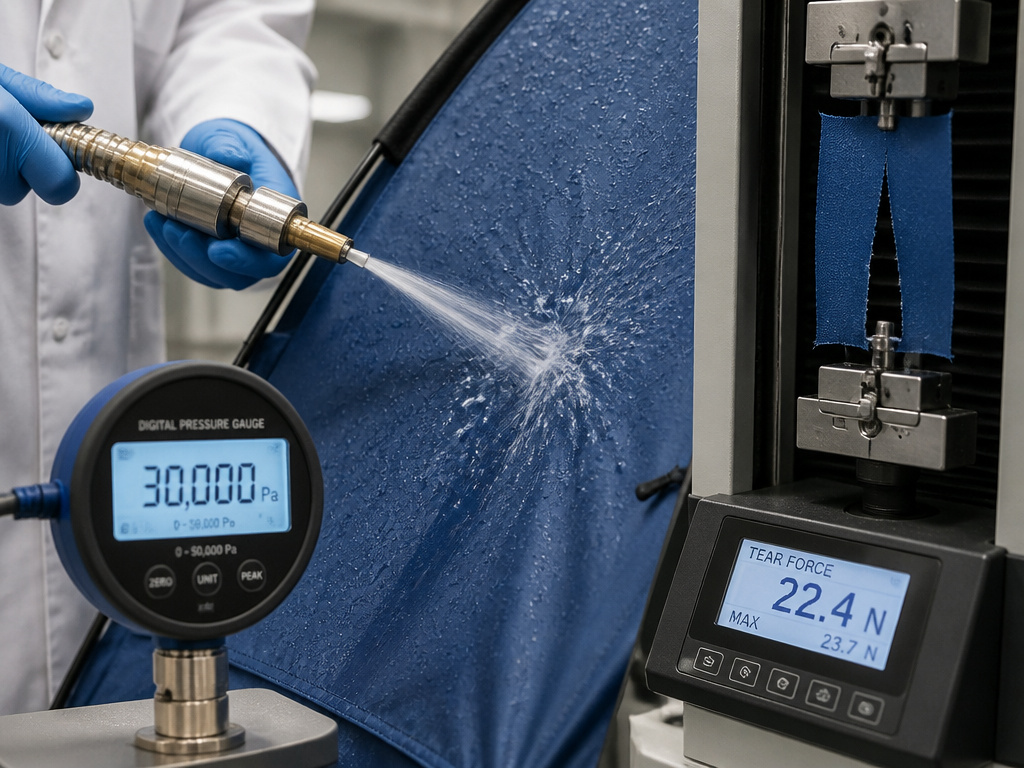
Marketing terms like “expedition-ready” are meaningless without a standard. ISO 5912:2020 is that standard. It classifies tents into two categories: Category A (lightweight, ≤2.5kg per sleeping berth) and Category B (heavier). More importantly, it defines three Performance Levels based on measurable lab tests.
A Level 1 tent is for fair-weather, occasional use. Its fabric might only need to resist 10N of tear force. A Level 3 tent, built for mountaineering, must withstand 20N and have a rainfly that holds back 30,000 Pa of water pressure. That 50,000 Pa groundsheet rating? That’s what lets you pitch on a soggy field without a separate footprint. Most brands don’t advertise these numbers because they reveal a lot. Finding “Meets ISO 5912:2020” in the specs is a green flag; seeing the actual Performance Level is even better.
TL;DR: Ignore vague labels. An ISO 5912 Performance Level is the only objective measure of a tent’s waterproof and tear strength.
How Do You Choose Between Nylon, Polyester, and Canvas?
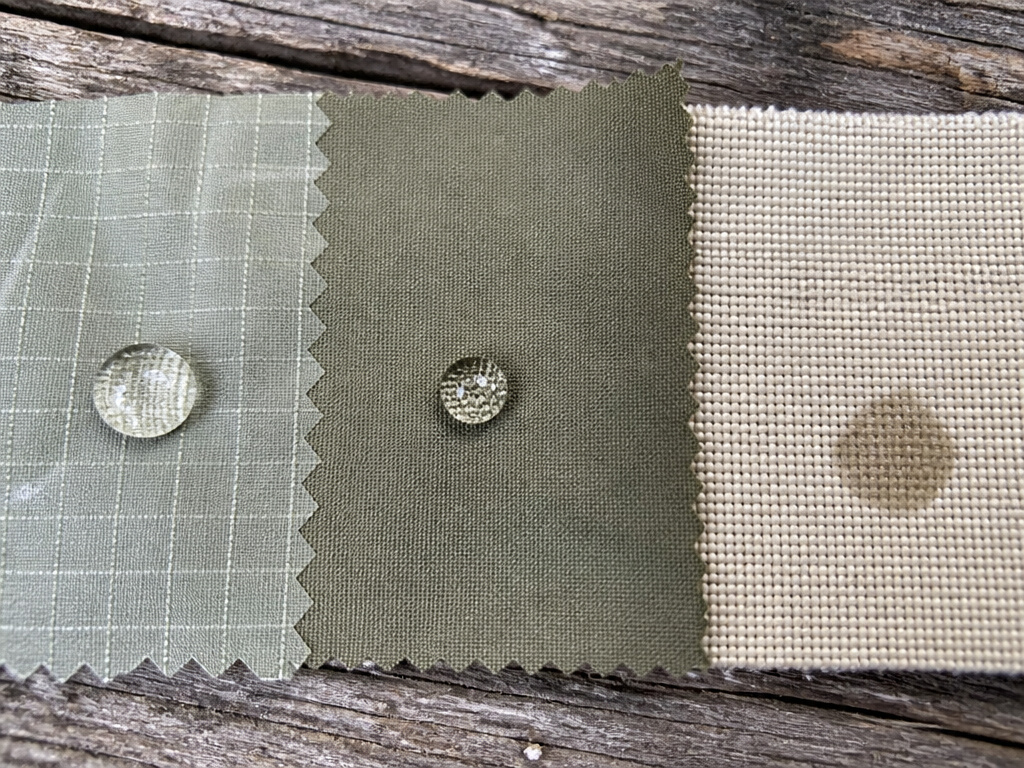
Forget color, the fiber type defines the experience. My personal litmus test is a Scottish drizzle: will the fabric sag by morning?
Nylon is stronger and lighter than polyester, but it absorbs about 4% of its weight in water. That’s why you’re outside in your pajamas at dawn, re-tensioning guylines while your coffee gets cold. Silnylon (silicone-impregnated nylon) reduces this stretch and boosts water resistance, making it a favorite for ultralight tent fabrics. Ripstop nylon weaves thicker threads in a grid to stop tears, but the base fabric can still puncture easily.
Polyester doesn’t absorb water, so it stays taut in the rain. It also resists UV degradation far better than nylon. This stability and lower cost make it the default for most mid-range family tents and affordable models like the Naturehike Cloud-Up 2. The trade-off is a slightly heavier weight for the same strength.
Canvas (traditionally cotton) is in a league of its own. It’s incredibly heavy but breathes beautifully, reducing condensation. Modern cotton canvas tents are often treated for water resistance. Their real magic is handling heat, which is why they’re the go-to for canvas tents with stove jacks. A spark that would melt a synthetic fly just chars cotton.
| Fabric Type | Best For | Key Limitation |
|---|---|---|
| Silnylon | Ultralight backpacking, tarp shelters where weight is critical | Stretches when wet; silicone coating rejects repair tapes |
| PU-Coated Polyester | Budget-friendly tent brands, family camping, frequent sun exposure | Coating degrades with UV exposure over 3-5 seasons |
| Canvas | Basecamp, heavy-duty canvas tents, winter camping with stoves | Extreme weight; will mildew if packed away damp |
| Dyneema Composite Fabric (DCF) | Extreme ultralight pursuits, minimalist shelter materials | Prohibitively expensive; can develop pinholes over time |
Common mistake: Choosing a tent based on denier (D) alone. A 30D silicone-coated nylon is far more tear-resistant and waterproof than a flimsy 70D uncoated polyester, despite the lower number.
Why Can’t You Fix a Silicone-Coated Tent with a Patch Kit?
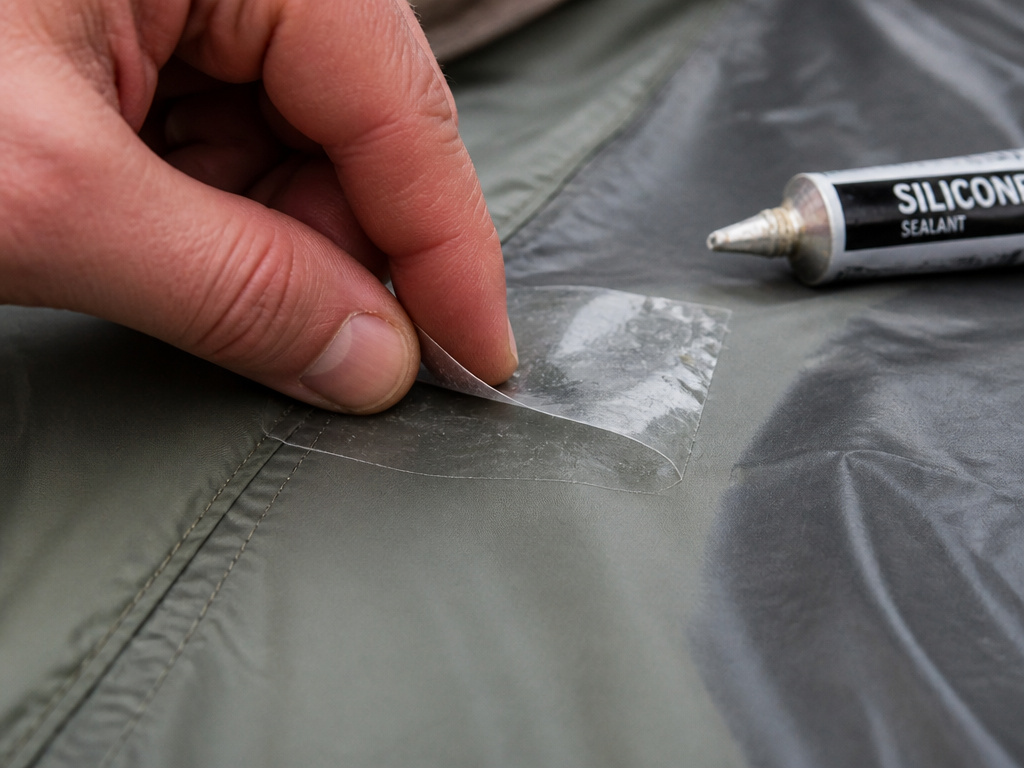
The coating is what makes fabric waterproof, and it also dictates your repair options. This is a choice between long-term durability and field-fixable failure.
Polyurethane (PU) coating is a liquid layer applied to the fabric’s interior. It’s affordable and bonds perfectly with adhesive tapes and sealants. A hole gets a piece of Tenacious Tape, and you’re done. The downside is that PU breaks down under UV light. After a few seasons of festival sun, a fly can feel tacky and start to peel. This is the standard for most polyester tent construction.
Silicone elastomer coating is often applied to both sides of a nylon fabric. It creates a supremely waterproof, UV-resistant, and lightweight sheet. The problem is right in the research: this double-sided coating “make[s] accidental damage difficult to repair with adhesive tapes.” The surface is too slick. Your only field fix is a messy dab of silicone sealant, which never fully cures on the trail. You trade easy repairs for ultimate weather resistance.
- Assess your typical use. For car camping where a repair kit is always handy, PU’s repairability wins.
- Consider the climate. For high-UV environments or expedition use where failure isn’t an option, silicone’s durability is worth the repair headache.
- Check the specs. Look for “silicone-coated” or “PU-coated” explicitly. Vague terms like “waterproof” are meaningless.
What’s the Real Difference Between Aluminum Pole Alloys?
Poles don’t just hold things up, they dictate how your tent fails. I’ve bent them back over a rock and I’ve watched one snap clean. The alloy grade tells you which scenario you’ll face.
7001-T6 aluminum is the workhorse of performance tents. It’s ductile, meaning it bends under extreme stress, like a deep snow load or a sudden gust. You can often straighten a bent section. 7075-T9 is stronger and stiffer, but more brittle. It resists bending better, but when it goes, it can fracture. High-end models like the Marmot Tungsten use 7001-T6 for its predictable flex, while some mountaineering shelters opt for 7075-T9 for maximum strength where weight is critical.
Fiberglass poles are cheaper and heavier. They flex well but fatigue over time, eventually splintering. You’ll find them on entry-level tents. Steel is for stand-up tent frames and commercial shelters where weight doesn’t matter.
| Pole Material | Typical Use | Failure Mode | Weight |
|---|---|---|---|
| 7001-T6 Aluminum | Most 3-season & 4-season backpacking tents | Bends under extreme load; often field-repairable | Light |
| 7075-T9 Aluminum | High-end mountaineering & four-season tent fabrics | Can fracture under sudden shock; difficult to field-repair | Very Light |
| Fiberglass | Entry-level family & large tent structural materials | Splinters and cracks after repeated flexing | Heavy |
| Steel | Cabin tents, hot tent construction, event shelters | Rarely fails in camping applications | Very Heavy |
I watched a 7075-T9 pole on a friend’s tent fracture at a ferrule during a violent wind shift in the Rockies. The 7001-T6 poles on my own shelter bent that same night. We jury-rigged his with a splint; mine I straightened over a rock the next morning.
How Do You Decode a Tent’s Technical Spec Sheet?
The product page is a minefield. Here’s what to actually look for before you buy.
First, find the Fabric Specs. It should list denier and coating for each part: fly, canopy, floor. “75D 185T polyester taffeta” is specific. “20D silnylon” tells you it’s thin and silicone-coated. If it just says “polyester,” they’re hiding a low-grade fabric.
Second, scrutinize the Pole Description. “7001-T6 aluminum” is precise and good. “Aircraft-grade aluminum” is meaningless marketing. Note the diameter: 9.5mm is stronger than 8.5mm and signals a tent built for storm-resistant tent construction.
Third, look for Standards Compliance. “Meets ISO 5912:2020” is excellent. Mentions of “CPAI-84” or “NFPA 701” refer to fire-retardant standards for commercial events, not relevant for most camping.
Finally, understand the Weight. “Trail weight” is the tent, poles, and stuff sack. “Packaged weight” includes every stake and guyline. For lightweight nylon tents, the trail weight is the number that matters on your back.
Common mistake: Assuming a “3000mm hydrostatic head” rating applies to the entire tent. That rating is typically for the floor. The rainfly often has a lower rating (e.g., 1500mm), which is fine for rain but can wet through under prolonged pressure or if touched from inside.
Frequently Asked Questions
What is the most durable tent material for long-term use?
For long-term durability against abrasion and UV, a heavyweight canvas tent material like 10.10 oz cotton duck is unmatched. For synthetic fabrics, a high-denier (70D or higher) polyester tent construction with a PU coating will generally outlast thinner nylons under continuous sun exposure, though it is significantly heavier.
Should I choose a nylon or polyester tent?
Nylon is stronger for its weight and more packable, but it stretches when wet, requiring re-tensioning. Polyester is more dimensionally stable, cheaper, and better at resisting sun damage. For a car-camping tent or a budget-friendly tent brand, polyester is often the more practical choice. For ultralight backpacking, silicone-coated nylon (silnylon) is the standard.
What does “ripstop” actually do?
Ripstop is a weaving technique where thicker reinforcement threads are woven into the fabric in a crosshatch grid. If a tear starts, it hits one of these thicker threads and stops propagating. It doesn’t make the fabric puncture-proof, but it prevents a small tear from becoming a large one. Most ripstop nylon materials use this technique.
Can you permanently repair a tear in a silicone-coated tent?
Not easily. Standard adhesive tapes won’t bond to the slick silicone surface. The only semi-reliable field fix is to apply a liquid silicone sealant (like SilNet) to both sides of the tear and press a patch of nylon fabric into it. It’s messy, takes hours to cure, and is never as strong as the original. This is the trade-off for the fabric’s superior weatherproofing.
What makes a 4-season tent fabric different from a 3-season one?
4-season tent uses heavier durable tent frame materials and stronger wind-resistant tent poles. The fabrics are also more robust: higher denier, stronger coatings, and often a higher ISO 5912 Performance Level (Level 3). A 3-season tent uses lighter materials to save weight, sacrificing ultimate strength for storms or snow loads.
Before You Go
After testing dozens of shelters, my personal go-to for UK mountain trips is a silnylon tent, not because it’s the lightest, but because the silicone coating shrugs off our constant drizzle and the 7001-T6 poles have bent back into shape for me multiple times after Cairngorm gusts. I’ll trade finicky repairs for that storm-proof reliability any day.
Your perfect tent material is a match for your specific trips. For car camping where a patch kit is always handy, a PU-coated polyester tent offers the best balance. For a thru-hike where every gram counts, silicone-coated nylon is worth its weight. And for a basecamp where you’ll sleep for weeks, the breathability of a treated canvas shelter is unbeatable.
Your tent is your shelter. Knowing what it’s made of, down to the alloy grade and coating type, lets you buy with confidence, use it appropriately, and understand its limits. Always check for the ISO standard, the denier, and the pole alloy. Your future dry, storm-proof self will thank you. For more on specific applications, explore our guides on the best tents for heavy rain or the best ultralight tents for 2-person teams.
