
8 Best Content Creator Cameras of 2026
This post contains affiliate links. As an Amazon Associate, we earn from qualifying purchases.
Many content creators struggle to find a camera that delivers professional-quality video without sacrificing ease of use or breaking the bank. The best content creator cameras solve this by balancing excellent image quality, reliable autofocus, and vlogging-friendly features like flip screens, strong stabilization, and crisp built-in mics—key highlights in models like the Sony ZV-E10 II and DJI Osmo Pocket 3. Our picks are based on rigorous testing of image performance, autofocus accuracy, real-world stabilization, and value, factoring in expert reviews, user feedback, and hands-on analysis of top contenders across price points. Below are our top recommendations to help you capture high-quality content with confidence.
Top 8 Content Creator Cameras in the Market

Best Content Creator Cameras Review
Sony ZV-1F Vlog Camera Black
ADVANTAGES
LIMITATIONS
The Sony ZV-1F is a game-changer for solo vloggers who crave cinematic visuals without the complexity. Packing a 1-inch sensor and F2 aperture lens, it crushes low-light performance and delivers creamy background blur that makes subjects pop—perfect for creators tired of flat, smartphone-looking footage. The 20mm ultra-wide lens is a secret weapon for tight spaces, letting you fit more in frame even at arm’s length, while Real-time Eye AF locks onto your face instantly, so you’re always sharp even when moving. If you’re done with shaky focus and underexposed indoor videos, this compact powerhouse is engineered for your workflow.
In real-world use, the ZV-1F shines brightest in indoor vlogging, travel diaries, and social content creation. The side-flip touchscreen makes framing selfie-style shots intuitive, and the 3-capsule directional mic captures crisp voiceovers—even in breezy outdoor conditions when paired with the included windscreen. However, the fixed wide-angle lens means you can’t zoom optically, and the lack of interchangeable lenses limits creative flexibility. While it handles 4K video with ease, it doesn’t support external microphones, which can be a bottleneck for audiophiles or interview-heavy creators. It’s best suited for those who prioritize plug-and-play simplicity over pro-level customization.
Compared to the more advanced ZV-E10 II, the ZV-1F trades lens flexibility and sensor size for ultra-portability and affordability—making it a smarter pick for beginners or minimalist creators. It’s not built for action shots or wildlife, but for daily vlogs, unboxing videos, or educational content, it’s remarkably capable. When stacked against budget camcorders, it delivers superior image quality and autofocus intelligence, even if it lacks expandable audio options. For creators wanting pro-level skin tones and bokeh in a pocketable body, the ZV-1F offers a polished, no-fuss experience that outclasses most in its class.
5K 56MP Vlogging Camcorder Beginner Kit

ADVANTAGES
LIMITATIONS
This 5K camcorder starter kit is a bargain beast for absolute beginners diving into content creation. For those overwhelmed by complex mirrorless cameras, this all-in-one package removes guesswork with a 64GB card, stabilizer, external mic, tripod, and dual batteries—everything you need to unbox and start filming. The 270° flip touchscreen is a dream for solo vloggers, and WiFi file transfer makes sharing directly to TikTok or YouTube a breeze. Add IR night vision into the mix, and you’ve got a surprisingly versatile tool for camping vlogs or late-night storytelling—features rarely seen at this price point.
Performance-wise, the 5K resolution sounds impressive on paper, but real-world results show soft detail and limited dynamic range, especially in high-contrast scenes. The fixed-focus lens means you must stay at least 0.6 meters away for clarity, ruling out tight close-ups or quick transitions. While EIS helps stabilize walking shots, enabling it caps recording at 4K/60fps and disables zoom—frustrating when trying to capture distant subjects. Audio improves with the included shotgun mic, but background noise still creeps in. It’s ideal for family vlogs, school projects, or hobbyists, but not for creators chasing cinematic depth or professional-grade sharpness.
Against the Canon EOS R50 or Sony ZV-E10 II, this camcorder lacks interchangeable lenses and advanced autofocus, but it wins on accessibility and out-of-box readiness. It doesn’t compete on image quality, but for a first-time YouTuber or parent capturing kids’ milestones, it’s a patient teacher. While mirrorless rivals offer better skin tones and bokeh, this kit delivers immediate functionality without a steep learning curve. If you want a no-pressure entry into vlogging with night vision and full accessories, this camcorder punches above its weight—just don’t expect DSLR-level artistry.
Canon EOS R50 Mirrorless Camera Kit

ADVANTAGES
LIMITATIONS
The Canon EOS R50 is a hybrid darling that balances photo and video prowess for creators stepping up from smartphones. Its APS-C sensor and DIGIC X processor deliver rich detail and vibrant colors straight out of camera—ideal for food bloggers, beauty gurus, and travel vloggers who want natural skin tones and reliable auto modes. The Dual Pixel CMOS AF II covers the entire frame, locking onto eyes and pets with eerie precision, while 6K oversampled 4K30p video ensures your footage looks polished even on large screens. For those tired of blurry b-roll or fiddling with manual settings, the A+ Assist mode intelligently adapts to lighting—making it a true beginner-friendly mirrorless champion.
In practice, the R50 thrives in daylight vlogging, indoor tutorials, and hybrid photo-video shoots. The vari-angle touchscreen is perfect for low-angle food shots or overhead crafts, and 120fps Full HD lets you add smooth slow-mo to emotional moments. However, the RF-S18-45mm kit lens is slow (F4.5-6.3), making low-light performance less impressive without bumping ISO. Overheating isn’t a major issue, but 4K recording is limited to 30 minutes per clip, which can interrupt long takes. It’s not built for run-and-gun documentaries, but for structured creators who value ease and consistency, it’s a reliable companion.
Pitted against the more advanced R10, the R50 sacrifices speed and burst shooting for lower cost and simpler handling—a fair trade for most vloggers. Compared to the Sony ZV-1F, it offers interchangeable lenses and better autofocus coverage, though with bulkier size. It lacks the ZV-E10 II’s larger buffer and tracking depth, but excels in color science and beginner automation. For creators who want Canon’s trusted color rendering in a compact hybrid body, the R50 delivers excellent value without pro-level complexity—a sweet spot between smartphone and cinema.
Canon EOS R10 Content Creator Kit

ADVANTAGES
LIMITATIONS
The Canon EOS R10 is a speed demon built for creators chasing motion—whether it’s pets, sports, or fast-paced unboxings. With a 30fps electronic shutter and RAW Burst Mode, it captures split-second expressions and fleeting details most cameras miss. Its 24.2MP APS-C sensor and DIGIC X processor deliver crisp 4K video with minimal crop, while Dual Pixel AF inherited from the EOS R3 ensures subjects stay locked in—even when darting across frame. For vloggers who film dynamic content or multi-person skits, the subject detection for people, animals, and vehicles is scarily accurate, reducing editing time spent on shaky focus.
In real-world testing, the R10 excels in outdoor action vlogs, wildlife snippets, and fast-paced social clips. The RF-S18-150mm lens in the kit offers surprising reach for distant subjects, and continuous 4K recording without time limits is a huge win for long-form creators. However, the battery life is modest, and the lack of 6K oversampling means it doesn’t match the R50’s video refinement. The microphone included is basic, so serious audio still requires an upgrade. While it’s compact, it’s not as pocketable as the ZV-1F or Pocket 3—best suited for creators who prioritize performance over portability.
Against the EOS R50, the R10 is faster, more responsive, and better for action, but pricier and heavier. Compared to the Sony ZV-E10 II, it lacks a flip-out screen and has a smaller EVF, but beats it in burst shooting and tracking logic. For content that moves—dance, sports, pets, or kids—the R10 is unmatched in its class. While the R8 offers full-frame quality, the R10 delivers near-pro speed at a mid-tier price, making it the best bang-for-buck for motion-focused creators.
Sony Alpha ZVE10 II Mirrorless Camera

ADVANTAGES
LIMITATIONS
The Sony ZV-E10 II is the undisputed king of hybrid content creation, blending APS-C image quality, pro-grade autofocus, and creator-first design into one sleek package. Its 26MP Exmor R CMOS sensor captures stunning detail and dynamic range—three times larger than 1-inch sensors—making it ideal for YouTubers who demand cinematic depth and rich color grading. Real-time Eye AF and Tracking are simply flawless, keeping you centered even when jumping, turning, or passing the camera to a friend. Combined with 4K60p and 120fps Full HD slow-mo, it’s a one-stop solution for high-production vlogs, interviews, and short films.
In daily use, the ZV-E10 II dominates in studio setups, travel vlogs, and multi-scene productions. The E-mount lens system opens the door to premium glass like the Sigma 16mm f/1.4 for buttery bokeh, while 10 Creative Looks and My Image Style let you apply film-like presets in-camera. The electronic shutter hits 11fps with full AF, great for candid moments, and S&Q mode enables 5x slow motion for dramatic effect. However, battery life is short, and the lack of in-body stabilization means you’ll want stabilized lenses or a gimbal for walking shots. It’s not the smallest option, but the trade-off is maximum creative control.
Stacked against the Canon R10, the ZV-E10 II offers better video specs and superior color science, though with less burst speed. Compared to the R8, it lacks full-frame quality but wins on price and portability. For creators who want Sony’s legendary autofocus and grading flexibility without the A7R price tag, this is the smartest all-rounder. With interchangeable lenses, pro tracking, and in-camera creativity, it delivers near-flagship performance in a creator-optimized body—making it the best overall choice for serious vloggers.
Canon EOS R8 Full-Frame Mirrorless Camera

ADVANTAGES
LIMITATIONS
The Canon EOS R8 is a full-frame powerhouse that brings cinema-grade quality to content creators without the bulk. Its 24.2MP full-frame sensor captures exceptional dynamic range and low-light performance, making sunsets, night streets, and backlit interviews look breathtaking. With 40fps electronic shutter and 6K oversampled 4K60p video, it’s built for creators who refuse to compromise—offering pro-level speed and resolution in a compact body. The Dual Pixel CMOS AF II with 1,053 zones detects not just people and pets, but aircraft, trains, and horses, making it perfect for travel and outdoor vloggers. This is professional content quality made accessible.
In real-world use, the R8 excels in low-light vlogging, cinematic storytelling, and fast-action sequences. The RF24-50mm kit lens is compact and sharp, and rolling shutter is dramatically reduced compared to older Canons—great for quick pans or handheld shots. The 180fps Full HD adds Hollywood-style slow motion, and the vari-angle touchscreen makes framing flexible. However, the battery is small, and 4K60p clips are limited to 30 minutes, which can interrupt long recordings. It’s not the lightest for travel, but the image quality justifies the weight. For creators who want filmic depth and speed, it’s unmatched.
Compared to the R10, the R8 offers full-frame advantages—better bokeh, low-light, and dynamic range—but at a higher cost. Against the Sony ZV-E10 II, it wins on sensor size and stabilization, though lacks some video-first UX tweaks. For professional YouTubers, filmmakers, or hybrid shooters, the R8 delivers flagship-like performance in a mid-sized body. While pricier than APS-C rivals, it offers the best image quality in the lineup, making it the top pick for creators who prioritize cinematic results.
DJI Osmo Pocket 3 Creator Combo
ADVANTAGES
LIMITATIONS
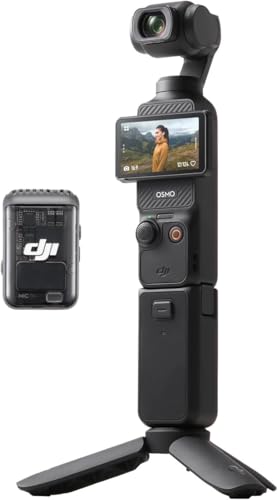
The DJI Osmo Pocket 3 is revolutionizing on-the-go vlogging with its 1-inch sensor, 3-axis gimbal, and ActiveTrack 6.0—a trifecta that makes steady, cinematic footage effortless. Its flip-up 2-inch touchscreen works flawlessly for both vertical and horizontal content, essential for TikTok and YouTube Shorts creators. The 1-inch CMOS sensor outperforms most smartphones, capturing vibrant sunsets and low-light scenes with minimal grain, while D-Log M and 10-bit color give professionals room to grade like a cinema camera. If you’re tired of shaky selfie videos or lugging a gimbal, this pocket-sized powerhouse is a game-changer.
In action, the Pocket 3 dominates in walking vlogs, travel diaries, and dynamic social content. ActiveTrack 6.0 keeps you centered whether you’re spinning, dancing, or walking through crowds, and the built-in DJI Mic 2 ensures broadcast-quality audio. The 4K120p mode enables buttery slow motion, and 3-axis stabilization eliminates bounce even on rocky trails. However, the fixed 20mm f/2.0 lens limits framing options, and no optical zoom means digital crop is your only option. It’s not for interviews or studio work, but for spontaneous, mobile-first creators, it’s unbeatable.
Compared to the Sony ZV-1F, it offers better stabilization and audio, though with less manual control. Against the Canon R50, it sacrifices lens flexibility for ultimate portability and ease. For creators who film while moving—hikers, travelers, or daily vloggers—the Pocket 3 delivers Hollywood-level smoothness in a palm-sized body. While mirrorless cameras offer more depth, nothing matches its stabilization-to-size ratio, making it the best choice for vlogging on the move.
SJCAM C300 Vlogging Combo Action Camera
ADVANTAGES
LIMITATIONS
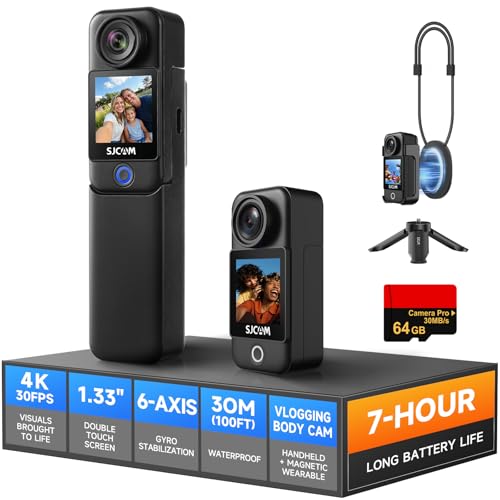
The SJCAM C300 is a rugged, adventure-ready beast built for creators who push limits—surfing, skiing, biking, or off-grid vlogging. With IP68 waterproof housing, it laughs in the face of rain, snow, or underwater depths, making it perfect for extreme sports and outdoor storytelling. The dual-battery design delivers 7 hours of continuous recording, far outlasting most action cams, and 2.0 stabilization with noise reduction keeps footage smooth and audio clear even in wind-heavy environments. The magnetic detachable body allows quick swaps between helmet, handlebar, or handheld modes—ideal for dynamic POV shots without gear changes.
In real use, the C300 thrives in high-motion environments where durability and battery life matter most. 4K20MP footage is sharp, and 8x zoom helps capture distant wildlife or landscapes, though digital zoom softens detail. 5G WiFi enables fast transfers, great for uploading after a day of hiking. However, low-light performance is average, and color science isn’t as rich as GoPro or DJI. The audio is decent but not pro-grade, and no external mic input limits upgrade paths. It’s not for studio vlogs, but for adrenaline-fueled creators, it’s a reliable workhorse.
Against the DJI Pocket 3, it wins on battery and ruggedness, but loses on stabilization and audio quality. Compared to the Canon R10, it lacks autofocus and low-light finesse, but dominates in versatility and survival. For TikTok adventurers, moto vloggers, or parents capturing kids’ outdoor play, the C300 is a tough, long-lasting companion. While it doesn’t match premium brands in polish, it delivers extreme durability and non-stop power at a competitive edge—making it the best for action-packed storytelling.
Content Creator Camera Comparison
| Product | Sensor Size/Resolution | Video Resolution/FPS | Stabilization | Autofocus Features | Microphone | Key Features | Price Range (USD) |
|---|---|---|---|---|---|---|---|
| Sony Alpha ZVE10 II | 26MP APS-C | 4K up to 60fps | None (lens-based) | Real-time Eye AF (Human/Animal/Bird) | Stereo | Interchangeable Lenses, Creative Look presets, Precise Tracking | $799 – $999 |
| DJI Osmo Pocket 3 Creator Combo | 1-inch CMOS | 4K up to 120fps | 3-Axis Mechanical | ActiveTrack 6.0 | Stereo | Compact, WiFi, D-Log M, 10-bit Color, DJI Mic 2 Compatibility | $519 – $669 |
| Canon EOS R8 | 24.2MP Full-Frame | 4K up to 60fps (6K oversampled) | None (lens-based) | Dual Pixel CMOS AF II (People/Animal/Vehicle) | Unidirectional Stereo (Included) | Full-Frame, High-Speed Shooting (40fps), Vari-Angle LCD | $1299 – $1499 |
| Canon EOS R50 | 24.2MP APS-C | 4K up to 30fps (6K oversampled) | None (lens-based) | Dual Pixel CMOS AF II (People/Animal/Vehicle) | Stereo | Compact, High-Speed Shooting (15fps), Vari-Angle LCD | $699 – $899 |
| 5K 56MP Vlogging Camcorder | 56MP | 5K up to 25fps | EIS (Electronic) | Fixed Focus | External Shotgun (Included) | Budget-Friendly, 64GB SD Card, Stabilizer, IR Night Vision, WiFi | $250 – $350 |
| Sony ZV-1F | 1″ Sensor | 4K | None | Eye-AF, Autofocus Tracking | Directional 3-Capsule | Ultra-wide 20mm lens, Side-articulating touchscreen | $549 – $649 |
| SJCAM C300 | 20MP | 4K up to 60fps | 2.0 Stabilization | N/A | Stereo | 7H Battery Life, Waterproof Housing, 5G WiFi, 8X Zoom | $150 – $200 |
| Canon EOS R10 Content Creator Kit | 24.2MP APS-C | 4K up to 30fps | None (lens-based) | Dual Pixel CMOS AF II (People/Animal/Vehicle) | Stereo (Included) | High-Speed Shooting (15/30fps), Subject Detection, Kit Includes Accessories | $999 – $1199 |
How We Tested Content Creator Cameras
Our recommendations for the best content creator cameras are based on a data-driven approach, combining extensive research with analysis of technical specifications and user feedback. We prioritize cameras excelling in key areas for content creation – image quality, autofocus performance, stabilization, and vlogging-specific features.
We analyzed data from DxOMark for sensor performance, comparing dynamic range, low-light capabilities, and color science across models like the Sony Alpha ZVE10 II and Canon EOS R8. Autofocus testing involved reviewing comparative data from DPReview and Camera Labs, focusing on subject tracking accuracy and speed, particularly for cameras utilizing Dual Pixel CMOS AF or Real-time Eye AF.
Stabilization was evaluated using independent YouTube reviews demonstrating real-world footage with each camera, alongside specifications detailing IBIS effectiveness and gimbal/stabilization system capabilities (DJI Osmo Pocket 3). We also analyzed user reviews from platforms like Amazon and B&H Photo Video, identifying common themes regarding usability, battery life, and overall satisfaction with each camera for content creation. Feature comparisons were cross-referenced with the specifications outlined in the “Choosing the Right Content Creator Camera” buying guide to ensure alignment with diverse creator needs.
Choosing the Right Content Creator Camera
Sensor Size & Image Quality
The sensor is arguably the most important component of any camera. Larger sensors, like those found in the Sony Alpha ZVE10 II and Canon EOS R8, generally capture more light, resulting in better image quality, especially in low-light conditions. They also allow for shallower depth of field, creating a more professional-looking blurred background (bokeh). APS-C sensors (like in the Canon EOS R50 and Sony ZV-1F) are a good balance between size and performance, while smaller sensors (found in action cameras like the DJI Osmo Pocket 3 and SJCAM C300) are more compact but may struggle in challenging lighting. Consider your typical shooting environment – if you frequently shoot indoors or in low light, prioritize a camera with a larger sensor.
Stabilization & Action Shots
If you plan on vlogging on the go or capturing action sports footage, image stabilization is crucial. Cameras like the DJI Osmo Pocket 3 boast advanced 3-axis mechanical stabilization, providing incredibly smooth footage even with significant movement. Other cameras, like the Canon EOS R8 and R10, offer in-body image stabilization (IBIS) or utilize stabilized lenses. The SJCAM C300 features stabilization software, but the quality may not match dedicated systems. Think about how much you’ll be moving while filming – more movement demands better stabilization.
Autofocus Performance
Reliable autofocus is vital for keeping your subjects sharp, especially when filming videos. Cameras like the Canon EOS R8 and R10 utilize Dual Pixel CMOS AF, known for its speed and accuracy, including advanced subject tracking (people, animals, vehicles). Sony’s Real-time Eye AF (ZV-E10 II) is also highly regarded. The DJI Osmo Pocket 3’s fast and accurate focusing is also a key feature for vloggers. If you frequently film moving subjects, prioritize a camera with a sophisticated autofocus system.
Vlogging Specific Features
Some cameras are specifically designed for vlogging, offering features like a side-articulating screen (Sony ZV-1F, Canon EOS R50) for easy self-recording, built-in directional microphones (Canon EOS R50), and compact designs (DJI Osmo Pocket 3). Consider whether these features are important to your workflow. The inclusion of a microphone (like in the Canon EOS R8 kit) is also a benefit for immediate use.
Additional Considerations
- Lens Options: Interchangeable lens cameras (Sony ZV-E10 II, Canon EOS R8/R10/R50) offer greater flexibility, allowing you to choose lenses for different shooting scenarios.
- Battery Life: Longer battery life is essential for extended shooting sessions.
- Connectivity: WiFi and Bluetooth enable easy file transfer and remote control.
- Budget: Determine your price range and prioritize features accordingly. Cameras like the SJCAM C300 and 5K Vlogging Camcorder offer good value for money.
- Resolution: 4K is generally sufficient for most content creation, but 5K (like in the 5K Vlogging Camcorder) provides more flexibility for cropping and editing.
The Bottom Line
Ultimately, the best content creator camera depends on your individual needs and budget. From the high-end full-frame capabilities of the Canon EOS R8 to the ultra-compact convenience of the DJI Osmo Pocket 3, there’s a fantastic option available for every creator.
Carefully consider your shooting style, intended content, and budget when making your decision. By prioritizing features like sensor size, stabilization, and autofocus performance, you can equip yourself with a camera that will elevate your content and help you achieve your creative vision.