
How to Fold a Pop Up Beach Tent Without the Fight
This post contains affiliate links. As an Amazon Associate, we earn from qualifying purchases.
To fold a pop-up beach tent, you must collapse its spring-loaded frame in the correct sequence: push the top arch down and inward, gather the resulting four fabric loops in one hand, then fold each loop into the next to form a flat disc. Success depends on technique, not force, and prevents damaging the irreparable poles.
I’ll be honest, my first pop-up beach tent didn’t survive its third outing. In a hurry to beat the rain on a Brighton beach, I ignored the gathering step and tried to muscle my IAN 445808_2307 model flat from the sides. A sharp crack from the central hub was my reward. The tent never popped up symmetrically again, and I spent the rest of a soggy weekend explaining the lopsided shelter to my @dacia_uk adventure crew. It was a £90 lesson in patience I’m here to help you avoid.
These shelters are brilliantly convenient, but they operate on different physics than your standard camping tent. This guide translates those confusing manual diagrams into a reliable, real-world method that works, whether you’re dealing with an IAN, LIVARNO home, or Komodo model.
Key Takeaways
- Dry it First, Every Time. Sand and moisture left inside guarantee mildew stains, a direct warning from the IAN 96793 manual. Shake it out, then air it out at home.
- Never Fight the Wind. The IAN 445808_2307 manual explicitly warns against assembly or takedown in strong wind. The canopy can act like a sail, whipping the frame out of control.
- Gather, Don’t Twist. The correct motion is to gather the four collapsed loops and fold them into each other. Twisting the frame stresses the pole hubs and leads to failure.
- Storage is Non-Negotiable. Store your folded tent in a cool, dry place. Damp storage destroys the fabric and coating, and as the manual states, the poles cannot be repaired.
- Your Model Matters. While the core technique is universal, your specific model might have a slight variation. Find your manual online using the model number from the tag.
Before You Start: The Two Unbreakable Rules
Before you start: A pop-up tent’s frame is under high tension. A sudden, uncontrolled release can cause poles to snap back with enough force to cause injury. Always ensure the area is clear, especially of children and pets. Furthermore, never attempt to fold the tent in a strong wind, the OEM manual for the IAN 445808_2307 states this clearly, as the wind can catch the canopy and turn the frame into an unpredictable projectile.
Your success hinges on preparation. First, the tent must be clean and dry. Shake out every grain of sand and wipe away any condensation or salt spray with a dry cloth. The IAN 96793 manual is unequivocal: “To prevent the formation of mould or mildew stains, always dismantle the beach tent in a clean and dry condition.” A damp tent sealed in its bag is a mold colony waiting to happen.
Second, find a flat, soft spot. Grass or sand is ideal; concrete or asphalt can grind debris into the fabric during the folding process. This isn’t just about cleanliness, a stable base gives you the control you need for the next step.
What’s the Universal 5-Second Folding Method?
This core technique works for about 95% of pop-up beach shelters on the market. It’s the sequence depicted in most manuals, from the IAN 96793 to the Komodo KDPOPBHTNTA.
The pop-up beach tent folding process relies on overcoming the spring tension of its continuous hoop frame in a controlled sequence, guiding the energy into a stable, folded disc shape rather than fighting it with lateral force.
- Collapse the Top Arch. Stand facing the side of the tent. Place one hand firmly on the highest point of the arched roof. Push straight down, then guide that arch directly toward the tent’s center. You’ll feel the flexible poles buckle and the structure begin to fold in on itself. Control this descent.
- Identify and Secure the Four Loops. As the frame collapses, it will form four distinct fabric loops, one at each corner. This is the critical transition. Immediately reach down and gather all four loops tightly in one hand. Your other hand is now free to work.
- Fold Loops Sequentially. With your free hand, take the topmost loop, press it down toward the ground, and tuck it into the center. Continue with the next loop, folding it into the newly formed bundle. The IAN 470682_2407 manual describes it: “Keep pressing downwards the new loops with one hand while the other hand keeps holding the other four loops together.”
- Form the Disc and Bag It. Once all loops are nested, you’ll have a flat disc roughly 60cm in diameter. Slide it into the carry bag, don’t cram it. If it doesn’t fit, the loops aren’t fully folded.
TL;DR: Push down and in, gather the four loops tightly, fold each loop into the center to form a disc, then slide it into the bag.
Where Can I Find Instructions for My Specific Model?
While the physics are universal, manufacturers sometimes tweak the wording or starting position. Your model number, usually on a tag inside the canopy or on the bag, is your key. If you’ve lost the paper manual, search for this number followed by “manual PDF” online.
| Model / Brand | Key Manual Instruction | Notable Difference |
|---|---|---|
| IAN 96793 | “Push the upper arch (C) downwards… fold it in towards the centre (B).” | Emphasizes the initial arch push with less detail on the final loop fold. |
| IAN 445808_2307 (LIVARNO home) | Detailed sequence with Figs. A–E for gathering loops and folding. | Specifies starting at the rear to let air escape completely through the front entrance. |
| IAN 470682_2407 (Model HG12625B) | Nearly identical to 445808, with model-specific diagrams. | Also includes the note on allowing air to escape for a cleaner fold. |
| Generic / Komodo Models | Often provides generic “folding” instructions without detailed diagrams. | Requires you to infer the universal method, which is where most user error occurs. |
Common mistake: Trying to fold the tent side-to-side like an accordion. This torques the central hub and can permanently deform or crack the frame. The tent will never pop up symmetrically again, a flaw you’ll notice immediately on your next beach day.
If you’re in the market for a new one and want to avoid confusion, checking detailed pop-up tent reviews can highlight models with clearer instructions or more intuitive designs.
Why Won’t My Tent Stay Folded?
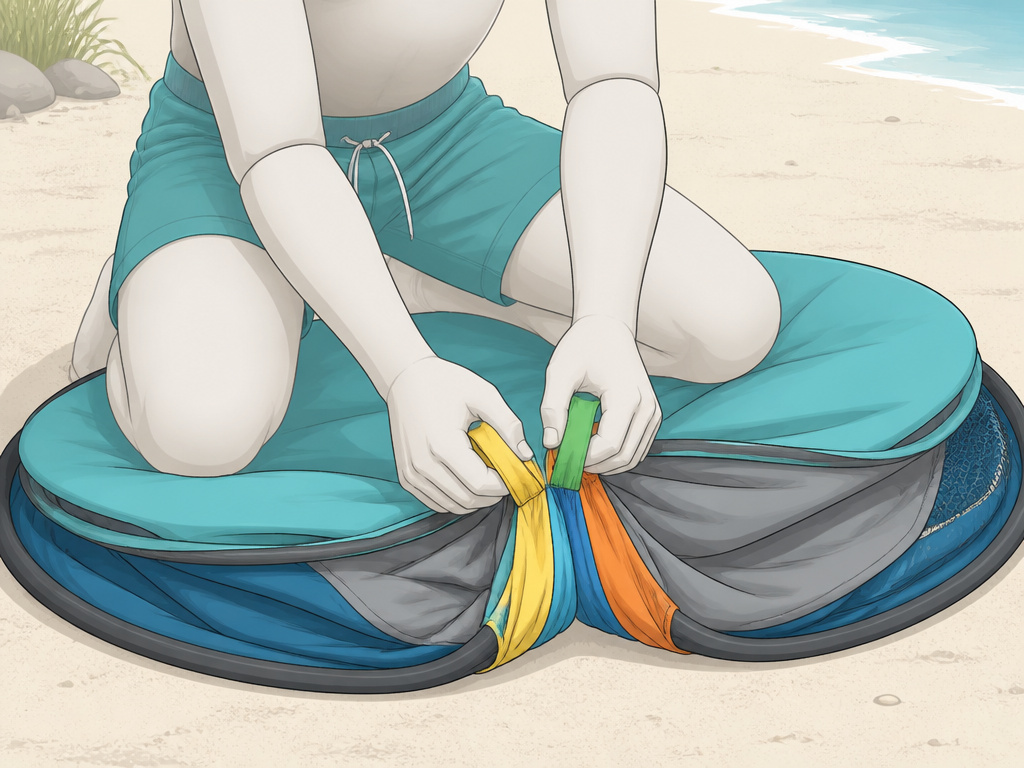
Let’s talk about the spring-back problem. We’ve all been there, one knee on a wobbly disc, feeling like you’re wrestling an octopus. I learned that the fix isn’t more muscle. What you need is to pin the center with your body weight to free both hands for a proper gather. It looks silly, but it turns a fight into a five-second win.
Use this table to diagnose the most common folding failures:
| Problem | Likely Cause | Immediate Fix |
|---|---|---|
| Frame springs open as you let go. | You haven’t fully overcome the spring tension or aren’t holding the gathered loops tightly. | Re-collapse, then kneel or sit on the center of the tent to pin it. This frees both hands to get a death-grip on all four loops before standing. |
| Folds into a messy bundle, not a neat disc. | Folding loops randomly instead of sequentially into the center. | Lay the bundle flat, re-identify the four loops, and start over, folding one at a time, each under the last. |
| Disc is too big for the carry bag. | Loops aren’t fully nested, or excess fabric is bunched. | Don’t force it. Unfold the last loop, smooth out all canopy fabric completely, and refold. A single twisted corner is often the culprit. |
If you’re consistently struggling, your tent’s bag might be overly tight. For a replacement, a 24-inch Trekker Ultralight Stuff Sack is a perfect, more durable fit for most models. If the frame itself is damaged, all is not necessarily lost. For IAN and LIVARNO home models, the distributor Outsunny sometimes stocks spare pole sets, search your model number. However, for a major hub break, the OEMs are right; it’s often more cost-effective to replace the whole shelter, which is why I’m so militant about the fold. When that time comes, our guide to the best pop-up beach tents is a great place to start your search.
How Should I Clean and Store My Beach Tent?
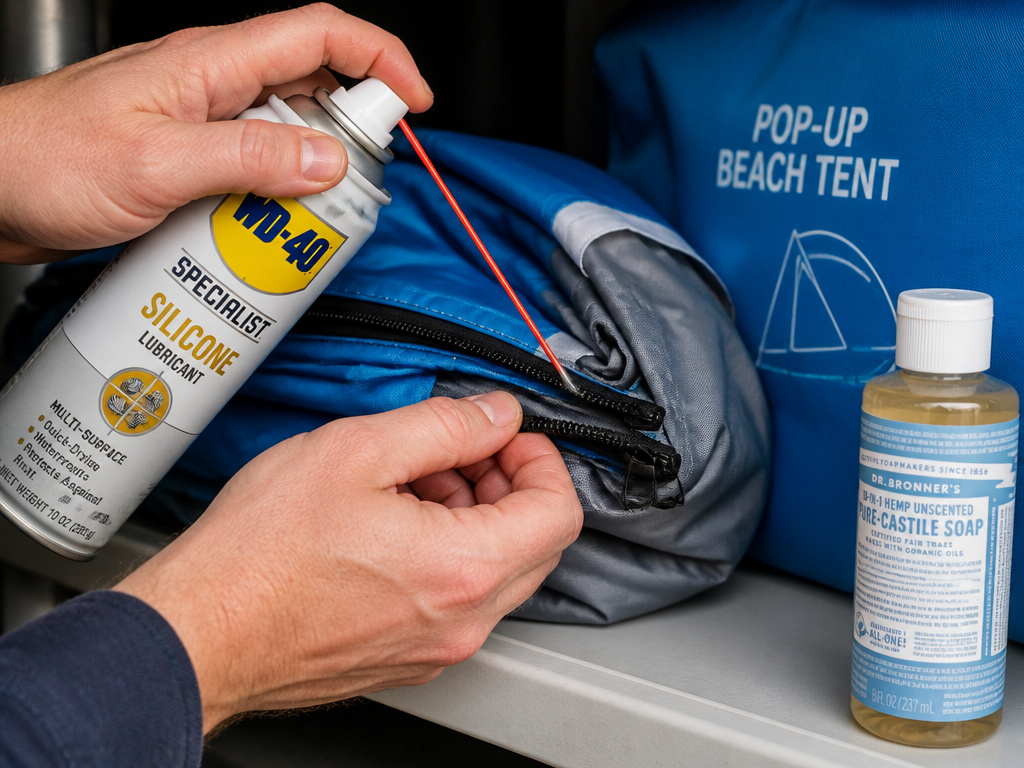
Folding it correctly is only half the battle. Long-term care is what separates a tent that lasts one season from one that lasts for years.
Dry it Completely, Every Single Time. Even on a sunny day, humidity and dew linger. When you get home, take the tent out of the bag and let it air out in a shaded, ventilated space for an hour. This follows OEM advice to counteract condensation, which “can form in all synthetic products.”
Clean It the Right Way. For general cleaning, I keep a small bottle of Dr. Bronner’s unscented castile soap in my kit, it’s biodegradable, leaves no residue to attract sand, and won’t degrade the PU coating. For a stubborn zipper, a tiny shot of WD-40 Specialist Silicone Lubricant (the white can) on the teeth works wonders because it’s a dry lubricant that won’t gum up with sand. This aligns with the IAN 470682_2407 manual’s advice to use silicone spray and its stern warning: “Never wash the product in a washing machine. Never use petrol, solvent or other cleaning agents.”
Store It Like Fine Gear. The manual for the IAN 96793 couldn’t be clearer: “Keep the article in a cool, dry and well-ventilated place away from frost. Avoid packaging and storage in a damp condition.” A closet shelf is perfect; a damp basement or hot attic will ruin it. This rule is as critical for synthetic pop-ups as it is for durable canvas tents.
Frequently Asked Questions
Can I fold a pop-up tent by myself?
Yes, the manuals are written for a single person. The key is using your knees and body weight to stabilize the tent during the initial collapse, freeing both hands for the crucial gathering step. If it’s windy, a helper to steady the canopy is a smart safety move.
Is it okay to leave my pop-up tent assembled for a few days?
For a multi-day beach trip, it’s generally fine. However, be mindful of the elements. Constant UV exposure will degrade the fabric’s coating (the IAN 470682_2407, for example, has a UV STANDARD 801-UPF 30 rating). If left out overnight, dew will soak it, you must dry it thoroughly before final storage.
What does it mean if I hear a cracking sound when folding?
Stop immediately. A crack typically signals a fractured fiberglass pole rib. Continuing can push the sharp end through the fabric sleeve. Per the manufacturer’s warnings, the tent is likely now unsafe. The IAN 96793 manual explicitly states, “The poles of this product cannot be repaired.”
My carry bag ripped. What can I use instead?
generic stuff sack of similar diameter (around 24 inches/60cm) works well. Ensure it’s made of a breathable material to prevent moisture buildup. This is a common piece of essential camping gear that often needs replacing before the tent itself.
Before You Go
Folding a pop-up beach tent isn’t a test of strength, it’s a lesson in geometry and patience. Master the simple sequence of collapse, gather, and fold, and you’ll transform the most dreaded part of the beach day into a five-second task. Remember, a dry tent avoids mold, a calm environment prevents accidents, and a perfect fold guarantees your shelter is ready for next time, whether it’s one of the budget tents under $100 or a premium model. Now go enjoy that sunset. Packing up will be easy.