
What Is a Tism Tent? A Sensory Shelter & Calm Space Guide
This post contains affiliate links. As an Amazon Associate, we earn from qualifying purchases.
A “Tism Tent” is community shorthand for a sensory play tent, a purpose-built, enclosed shelter designed to provide a calming, controlled environment. It’s not a medical device or a specific brand, but a category of product defined by features like blackout canopies, tactile panels, and secure closures that help individuals, often autistic children, manage sensory overload and anxiety.
You won’t find “Tism Tent” in any tent manual or the ISO 5912:2020 camping standard. The term grew from online communities as a contraction of “autism tent.” This guide cuts through the confusion. I’ve pitched everything from ultralight backpacking shelters to giant family camping tents, and I apply that same critical eye to these specialized indoor shelters. We’ll look at what truly defines them, how to decode the specs, and why a good one has more in common with a professional sensory pod than a cheap pop-up playhouse.
Key Takeaways
- A Tism Tent is defined by its function, sensory regulation, and its specific design features, not by a brand name.
- Core features are non-negotiable: true blackout fabric, a stable and quiet frame, interactive interior panels, and a secure closure.
- Durability specs borrowed from camping standards, like tear strength (measured in Newtons), are your best benchmark for quality.
- Placement and pairing are crucial; a tent in a noisy spot or filled with chaotic toys can do more harm than good.
- They are tools for co-regulation and retreat, not for imaginative play or punishment.
What Exactly Is a Tism Tent?
Forget the jargon for a moment. Imagine a space where the world’s volume gets dialed from an 11 down to a 3. The blaring lights soften, the chaotic sounds mute, and the only inputs are the ones you choose, a soft texture under your fingers, a gentle glow, the deep pressure of a weighted blanket. That’s the intent behind a sensory tent.
It works by hacking the environment. It’s a portable retreat engineered to reduce unpredictable sensory input, which can overwhelm a nervous system. This isn’t about creating a dark cave for sleep; it’s about offering a predictable, safe harbor during waking moments of distress or dysregulation.
A sensory play tent creates a bounded micro-environment that reduces ambient sensory load. This allows for the deliberate introduction of specific, regulating stimuli, which can help modulate the autonomic nervous system’s response to sensory overwhelm.
You can’t just grab any kids’ tent and call it a Tism Tent. The community-driven definition hinges on three concrete features. If a tent misses one, it’s just a play tent.
True Blackout Canopy: The fabric must kill external light. Many mass-market play tents use thin, colored nylon that glows like a lantern when backlit. A proper sensory tent uses a heavier, often layered fabric with a blackout liner. This eliminates the strobe-effect of passing shadows or headlights, which can be deeply distressing.
Interactive Interior Panels: The walls are active, not passive. They’re lined with tactile surfaces, crinkly fabric for auditory feedback, soft bristle boards for tactile resistance, satin ribbons for smooth repetitive motion. These provide a contained, predictable focal point for fidgeting and exploration.
Secure, Full Closure: A simple overlapping flap is useless. Effective designs use zippers, magnetic seals, or heavy-duty Velcro to create a visual and auditory barrier. This isn’t about locking someone in; it’s about creating a seal that feels safe and doesn’t flap or rustle with every air current, breaking the calm.
TL;DR: A real sensory tent blocks light, offers contained tactile stimulation, and closes securely. If it’s made of glowing polyester with a flapping door, it’s a play tent.
Sensory Tent vs. Standard Play Tent: A Side-by-Side Look
Their design priorities are fundamentally different. A standard play tent, like the Pig Pic Pin three-piece set with a tunnel and ball pit praised in one YouTube review for being “simple and easy to put together,” is built for fun and durability during roughhousing. A sensory tent is built for psychological safety and sensory modulation.
| Design Priority | Standard Play Tent | Sensory “Tism” Tent |
|---|---|---|
| Primary Goal | Imaginative play, entertainment. | Co-regulation, anxiety reduction, safe retreat. |
| Canopy Material | Thin, brightly colored nylon/polyester (often translucent). | Heavy, opaque fabric, often with a dedicated blackout liner. |
| Door/Closure | Simple overlap flap, tie-backs, or roll-up. | Zipper, magnetic seal, or heavy-duty Velcro for a full seal. |
| Interior Features | Thematic prints, maybe a pocket for toys. | Integrated tactile panels (crinkle, bristle, satin), ports for soft LED lights. |
| Structural Focus | Quick setup, easy collapse, portability. | Stability when occupied, minimal sway, and silent operation (no pole creak). |
| Best For | Neurotypical children during active playtime. | Neurodivergent individuals (often children) for sensory regulation. |
The Builder Sensory Play Tent from another YouTube review is marketed directly at this need, called a “calm Oasis” that “helps reduce anxiety and Chaos.” One is not better than the other; they are different tools for different jobs. Using a standard play tent for sensory retreat is like using a picnic tarp as a rainfly in a storm, it covers the space but won’t handle the pressure.
How to Choose the Right Sensory Tent: A Buyer’s Framework
You’re not just buying a product; you’re building a therapeutic environment. Start by profiling the primary user’s sensory needs. Are they a seeker or an avoider? My experience with my sensory-seeking nephew taught me this the hard way.
For Seekers: They need more input, firmer textures, more resistance. Prioritize tents with extremely sturdy frames (think fiberglass over thin wire) and robust, textured panels they can push against without fear of collapse. The interior should be a playground for their hands.
For Avoiders: They need less, softer textures, minimal seams, maximum buffering from external chaos. Prioritize the highest level of opacity and sound dampening. Look for tents with seamless interiors and avoid anything with rough stitching or hard plastic components inside.
I bought the “CalmKids Sensory Dome” from a popular online retailer. Its single layer of 70-denier polyester looked fine until my nephew, a proprioceptive seeker, leaned into the wall. The plastic pole connector (part #PC-3A) snapped with a loud crack, the fabric tore, and the sudden collapse triggered a meltdown. I replaced it with the “OT-Pro Fortress Tent” from a specialist retailer, which uses 190D Oxford nylon and steel-reinforced pin-and-ring connectors. It’s lasted three years of daily use because that reinforced design distributes force across the entire pole.
Your sourcing options break into clear tiers with trade-offs.
- Mass-Market “Sensory” Tents: Brands like the “Builder Sensory Play Tent” (often listed as BLD-120) or generic Amazon listings. Pros: Affordable, fast shipping. Cons: Quality lottery; “blackout” often means “dark grey.” You must scrutinize return policies.
- Specialist Retailer Tents: Sold through occupational therapy (OT) supply companies (e.g., Fun & Function, Southpaw Enterprises). Pros: Professionally vetted, higher-quality materials like 300-denier fabric, better support. Cons: Significantly more expensive.
- DIY / Custom Tents: Modifying a sturdy play tent frame. Pros: Total control over every material. Cons: Requires sewing skill and time; the final product may lack structural polish.
Skip the “quiet corner” if it’s under an air vent. I learned this when the sudden whoosh of our HVAC triggered my daughter’s startle reflex, negating the tent’s calm. We moved it three feet to a dead-wall spot, muffling the sound. The real test? Lay on the floor first. Listen for the fridge hum, the pipe clank. Place the tent where the floorboard creaks least.
TL;DR: Profile the user first, then match the tent’s physical properties. Source from a specialist if possible, and always pair it with external tools like a weighted blanket and dimmable light.
Decoding Safety and Durability: What the Labels Hide
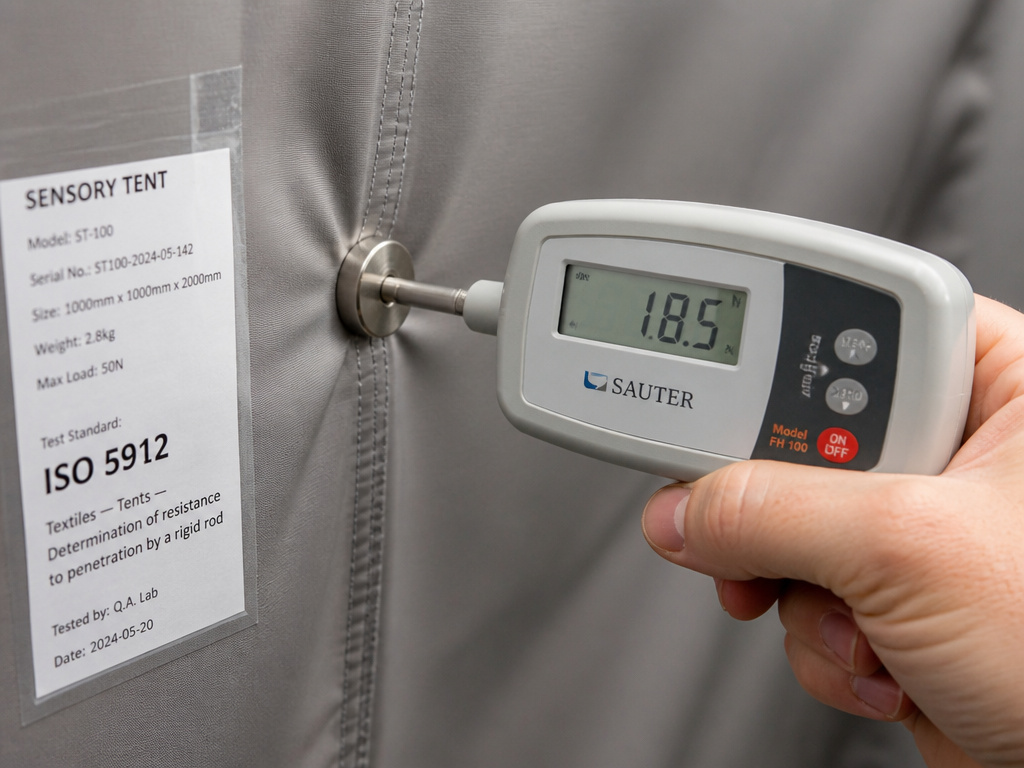
No official standard exists for “sensory tents.” They live in a gray area between toy, textile, and therapeutic device. Your best tool for vetting quality is to borrow benchmarks from ISO 5912:2020, the international standard for camping tents. Its fabric tests are revealing.
- Tear Resistance (in Newtons, N): Measures how much force the fabric can take before ripping. ISO 5912 requires a minimum of 10N for a lightweight tent. For a sensory tent facing pushes and leans, aim for over 15N.
- Hydrostatic Head (HH in mm): Indicates water pressure resistance. For our use, it’s a proxy for fabric density and quality. A higher rating (e.g., 3000mm) suggests a tighter weave that better blocks light and muffles sound.
- Breaking Strength (in Newtons, N): Tests the force needed to break a seam or fabric. This matters when a child leans against the wall.
| ISO 5912:2020 Fabric Benchmark (Category B, Level 2) | Minimum Requirement | Why It Matters for a Sensory Tent |
|---|---|---|
| Tear Resistance (ISO 13937-2) | 15 N | Fabric must withstand pulling and pressure from inside. Lower strength means failure when a user pushes against it. |
| Breaking Strength (ISO 13934-2) | 400 N | Seams and attachment points must hold under the weight of a child leaning or lying against the structure. |
| Resistance to Water Penetration | 20,000 Pa (~2000mm HH) | A higher rating indicates a denser, more opaque fabric weave, which directly improves light and sound buffering. |
Ventilation is a critical, overlooked safety spec. A fully enclosed space can become stuffy. Look for mesh panels near the top, often with a fabric cover. The ISO 5912 standard warns about “sealed tents” where blocked vents can lead to a “build-up of harmful gases.” While not directly analogous, the principle holds: a sealed environment needs managed air exchange.
Before you start: Never use a sensory tent as a locked or unsupervised space. Keep it away from direct heat sources like radiators or space heaters, as many synthetic fabrics can melt. Always ensure an adult is within earshot.
Fire retardancy is another murky area. If you have concerns about proximity to heat, look for a CPAI-84 or NFPA 701 certification on the fabric. The tent is a tool for regulation, not a container for time-out.
Setting Up for Success: Placement, Curation, and Use
Getting this right is as important as buying the right tent. A poorly placed or stocked tent can become a source of new stress.
Placement is Everything: Choose a low-traffic area, a bedroom corner, a quiet part of the living room. Avoid high-traffic zones or under flickering ceiling lights. The goal is to reduce auditory and visual surprises. I learned to avoid spots near humming appliances or creaky floorboards after a few failed attempts.
Assembly Matters: Ensure all frame connectors are fully seated and the fabric is taut. A sagging canopy feels unstable and cave-like, which can be unnerving. A drum-tight fabric feels secure and transmits less vibration. Most use simple pop-up or pole-and-sleeve designs.
Introduce It Slowly: Don’t usher a child in during a meltdown. Let them explore it empty during a calm moment. Place a familiar, comforting item inside and let them control the entrance. Forcing the association turns a safe space into a trigger.
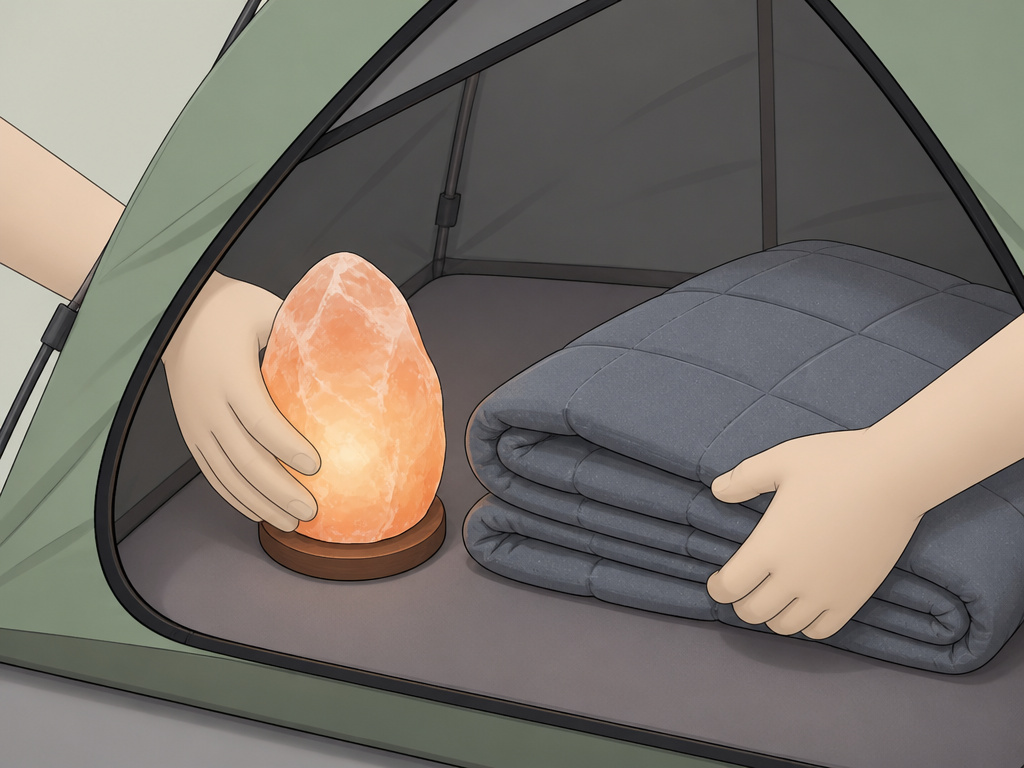
Curate the interior environment with a minimalist approach. Start with just two things:
1. A weighted blanket or lap pad for deep pressure.
2. A soft, diffuse light source like dimmable LED string lights or a salt lamp.
Then, based on observation, you might add:
* One or two fidget toys matching the user’s preference (chewelry, twist toys, stress balls).
* A noise-cancelling headset or a white noise machine outside the tent.
* A familiar-smelling item, like a loved one’s worn t-shirt.
Common mistake: Filling the tent with every sensory toy you own, this creates visual clutter and overstimulation, defeating the tent’s purpose. Start sparse and add slowly.
Finally, model its use. Sit in it yourself to read. Show it as a place for quiet recharge, not punishment. Its power comes from being a chosen haven.
Frequently Asked Questions
Are Tism Tents only for autistic children?
No. While the term originated in autism communities, the design benefits anyone who needs a sensory-buffered space. This includes people with ADHD, anxiety disorders, sensory processing disorder, or even neurotypical individuals seeking a quiet retreat. The principles of reducing sensory load apply broadly.
Can I use a regular play tent instead?
You can, but it likely won’t be effective. The difference is in material opacity, structural stability, and closure security. A regular tent is designed for visibility and airflow during play. A sensory tent is designed for opacity and enclosed calm. Using a regular tent is like using a sunshade for rain protection, it’s the wrong tool.
How do I clean a sensory tent?
Most fabric covers are removable and machine washable on a gentle, cold cycle. Always air dry completely, heat from a dryer can degrade elastics and shrink fabrics. Wipe down the frame with a damp cloth. For tents with built-in, non-removable tactile panels, spot clean with a mild detergent and a soft brush.
What age are these tents appropriate for?
There’s no upper age limit, the need for sensory regulation doesn’t end in childhood. The constraint is physical size. Most “kid-sized” tents fit users up to about 4’6″ tall. For older children, teens, or adults, look for larger “reading nook” tents, consider repurposing a small spacious camping tent indoors, or build a DIY version using a canopy frame and blackout curtains.
Do they help with sleep?
They can, as part of a bedtime routine, by creating a dark, calm pre-sleep environment. However, they are not a substitute for a bed or good sleep hygiene. Their primary role is for wakeful regulation, not overnight sleep. The tent should not be used for sleeping in an otherwise stimulating room.
Before You Go
A Tism Tent isn’t a product you find on a shelf; it’s a purpose-built environment. Its value lies not in the poles and fabric, but in the controlled, safe space it creates. The best ones borrow their durability from serious outdoor gear, like the robust materials used in storm-resistant shelters, and combine it with an understanding of sensory needs.
Ignore marketing that slaps “sensory” on every pop-up playhouse. Look for the tangible specs: fabric that blocks light, a frame that doesn’t creak, and a closure that seals. Then, place it thoughtfully, stock it minimally, and let it become a tool for peace. The right tent, in the right spot, can turn an overwhelming moment into a manageable one. That’s the only metric that truly matters.
