
How to Heat a Party Tent: The Real Math and Safety Rules
This post contains affiliate links. As an Amazon Associate, we earn from qualifying purchases.
Heat a party tent by calculating its cubic volume, multiplying by your desired temperature rise and an insulation factor of 0.25, then matching that BTU/hour to a forced-air propane heater placed outside with ducted warm air. The most common failure is underestimating propane needs, which leaves you with a frozen tank and a cold tent by 9 PM.
I’ve learned this through expensive mistakes. At a friend’s autumn wedding, we placed a 150,000 BTU heater just eight feet from the tent. A gust of wind pressed the sidewall against the exhaust guard. In under a minute, the “flame-retardant” polyester was smoldering with an acrid, plastic stench. We had to cut out a two-foot section mid-reception, a $500 repair and a near-disaster. Now my rule is 15 feet of clearance, no exceptions.
This guide is that hard-won lesson turned into a plan. We’ll use the manufacturer’s formula, tackle the vapor pressure math everyone ignores, and walk through the setup that actually works.
Key Takeaways
- Use the exact formula: Tent Length (ft) × Width (ft) × Height (ft) × Desired Temp Rise (°F) × 0.25 = Required BTU/hour. Guessing leads to failure.
- A half-full 100lb propane tank at 40°F delivers only 125,000 BTU/hour, not the 214,000 BTU/hour of a full tank. You’ll need multiple tanks manifolded together.
- Never place a fuel-burning heater inside the tent. The only safe method is a forced-air unit outside, ducting warm air in through a sidewall.
- “Flame retardant” fabric is not fireproof. It will burn if exposed to direct flame or sustained high heat from a heater placed too close.
- Electric options like the Eurom Partytentheater 1500 Ind. are for tiny spaces only, requiring a specific 230V, 50Hz outlet with a 30 mA residual current device.
How many BTUs do I actually need for my party tent?
Forget the vague charts from rental sites. The real number comes from a formula used by tent manufacturers who guarantee their work for commercial clients. You need three measurements: length, width, and peak height. Multiply them for cubic feet. Then decide how many degrees you need to raise the inside temperature, a 30°F rise is a common comfort target. The final multiplier, 0.25, is the insulation factor for a single-layer tent fabric. It’s how fast heat escapes.
Cubic Volume of Tent × Temperature Rise Required × 0.25 = BTU/hour needed. For a 40’x80’x15’ tent needing a 30°F rise: 48,000 × 30 × 0.25 = 360,000 BTU/hour.
That 360,000 BTU/hour is your target. If your heater outputs 150,000 BTU, you need three of them. This math is non-negotiable. I once trusted a rental company’s “this should do it” for a 20’x30’ tent in 35°F weather. Their 80,000 BTU heater ran non-stop, never got the space above 50°, and drained two tanks in four hours. We were calculating BTU per shiver by midnight.
TL;DR: Plug your tent’s dimensions and desired warmth into the formula (L×W×H×Temp Rise×0.25). That’s your heater’s minimum BTU rating.
Why does my propane heater keep shutting off on a cold night?
You did the math. You rented a perfect 400,000 BTU heater. You connect a single 100-pound propane tank, confident for the night. Two hours later, the flame sputters and dies. The tank feels icy, and it’s still half full. This is vaporization pressure, and it’s the detail that breaks most setups.
Liquid propane must turn to vapor to burn. The rate it can vaporize depends on the outside temperature and how much liquid is left. According to the Rainier Tent TechTips guide, a full 100lb tank at 40°F can produce about 214,000 BTU/hour. Take that same tank down to half full at 40°F, and it can only muster about 125,000 BTU/hour. Your 400,000 BTU heater suddenly needs vapor from nearly four half-full tanks.
| Tank Status | Outside Temperature | Approx. BTU/hr Output | Tanks Needed for a 360,000 BTU/hr Heater |
|---|---|---|---|
| Full | 40°F | 214,000 | 2 |
| Half Full | 40°F | 125,000 | 3 |
| Quarter Full | 20°F | < 80,000 | 5+ |
The fix is a manifold kit connecting multiple tanks. This pools the vapor, letting the heater draw from all sources at once. Always plan your tank count using the half-full, cold-weather output.
Common mistake: Connecting one 100lb tank to a high-BTU heater. The tank freezes, vapor pressure crashes, and the heater shuts off as the dance floor fills, forcing a dangerous, gloveless tank swap in the dark.
What’s the safest way to set up a propane heater?
This isn’t just about placement; it’s a safety drill. The heater must be outside on stable, level ground. My rule is 15 feet from any tent wall, with the exhaust pointed away from people and flammable materials. You’ll need specific gear, not just generic tools.
- A forced-air propane heater with your calculated BTU output. Brands like L.B. White are industry standards. An undersized unit runs constantly, wasting fuel without warming the space.
- Flexible aluminum ducting, 10-inch minimum. Cheap vinyl ducts sag from the heat, restrict airflow, and can melt. Aluminum handles the high temps.
- A propane regulator and manifold kit, like the Marshall Excelsior MEGR-249. Without it, you’ll be swapping a single frozen tank at 10 PM. I’ve done this dance, fumbling with a wrench while the tent temperature plummeted 15 degrees in minutes.
- A GFCI-protected extension cord rated for your heater’s amperage. For electric models, a standard cord will overheat and fail.
Run the duct through a dedicated port or a securely fastened sidewall flap, never under a loose wall where it can disconnect. Use hose clamps to secure it to the heater’s collar. A disconnected duct blows 500°F air onto grass or a tarp.
Before you start: Propane is heavier than air and pools in low spots. A leaking connection upwind can flow into the tent. Check every fitting with leak detection fluid (I use Gasoila, not dish soap). Also, some cities require a permit for propane use at events, failing to get one can shut you down.
Can I use an electric heater for my party tent?
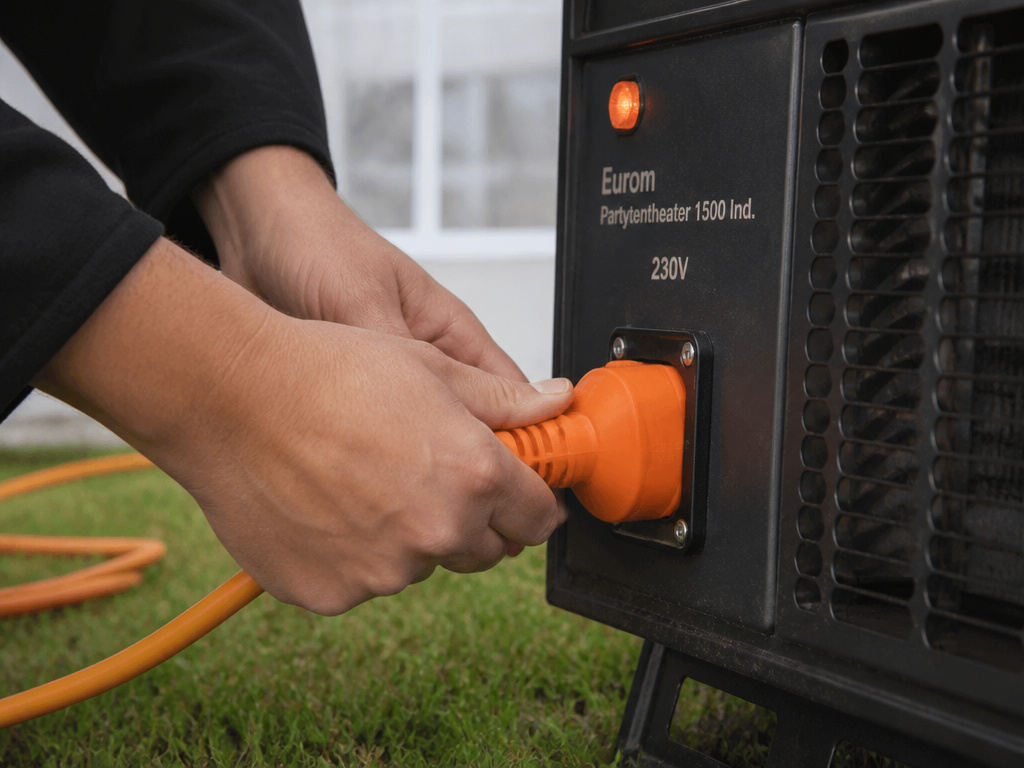
Electric sounds clean and easy. Then I tried to run a 1500-watt Eurom heater off a 200-foot extension cord at a fall festival. The voltage drop was so severe the element glowed orange and dimmed like a dying ember before tripping the breaker. Electric is a niche player with very specific demands.
Models like the Eurom Partytentheater 1500 Ind. need a 230V, 50Hz, single-phase earthed socket and a 30 mA residual current device (RCD), per its official manual. Its maximum 1500-watt output translates to a paltry 5,118 BTU/hour. It won’t heat a large tent.
They make sense for:
* Supplemental heat in a specific zone, like a caterer’s prep area within a larger, propane-heated tent.
* Very small, fully enclosed spaces under 1,500 cubic feet.
* Venues where propane is strictly prohibited and you have certified 230V power access.
For most events, propane forced-air is the only practical choice. However, for managing comfort in a complex setup, pairing a main propane system with targeted portable climate control for specific areas can be part of a broader strategy.
How do I stop the heat from escaping immediately?
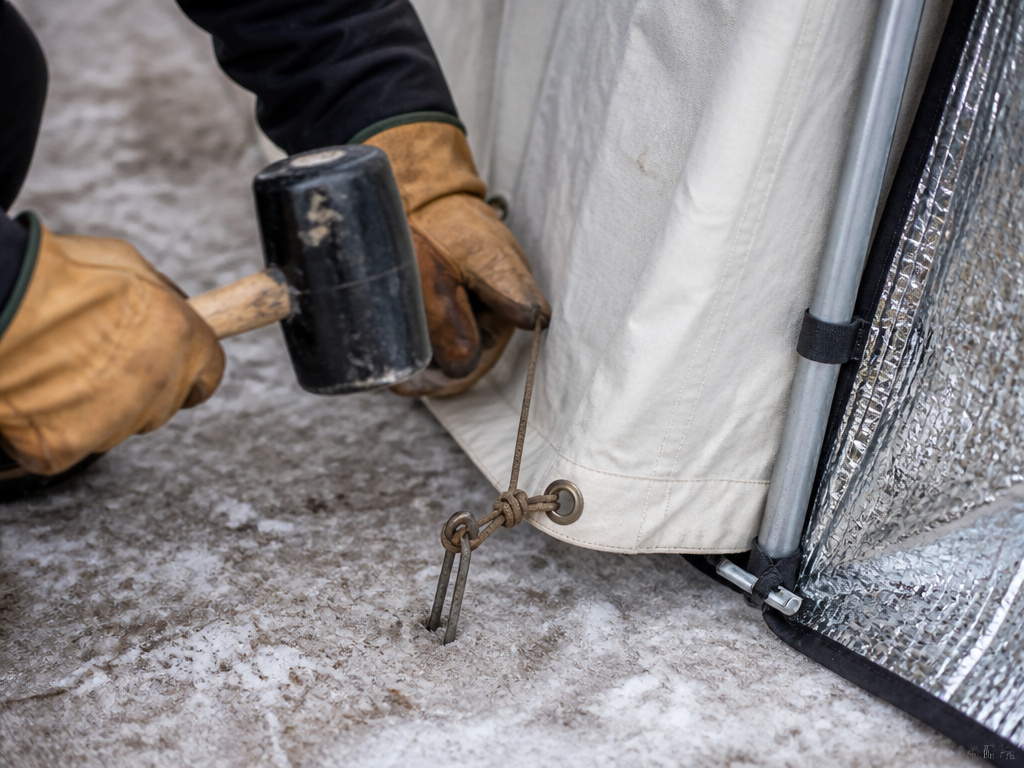
A tent is a sieve for warmth. Your heater fights a constant battle against conduction and wind. Beyond the heater itself, your tent camping accessories and setup choices are your first line of defense.
First, use solid sidewalls, not mesh. Stake down the bottom of the walls tightly with stakes or sandbags to seal out wind that sneaks underneath. A flapping wall isn’t just noisy, it exchanges the entire air volume in minutes.
Second, consider a liner. An insulating tent liner, like an ArcticShield Reflective model, creates a dead air space that acts as a thermal barrier. In my experience, a good liner can make the interior feel 10°F warmer for the same heater output. It’s a game-changer for all-night winter events.
Finally, tent material matters. Thicker, durable canvas tents inherently retain heat better than thin polyester. For the ultimate in heat retention and safety with high-temperature sources, look into canvas tents with stove jacks designed for wood stoves, though that’s a different heating system altogether.
What does “flame retardant” really mean for my tent?
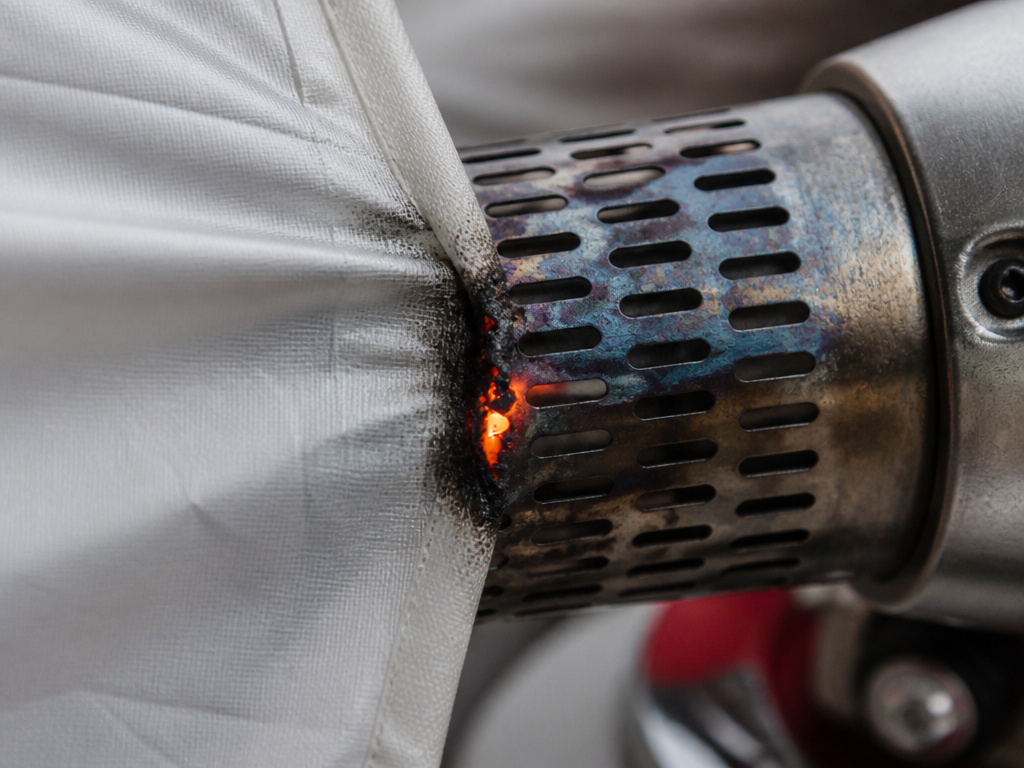
Almost every party tent has a “flame certificate.” This means the fabric is treated with chemicals to slow ignition, it is not fireproof. That treatment buys you maybe 30 seconds to react if a direct flame touches it. Sustained high heat will make it smolder and burn.
A flame certificate means the tent fabric is flame-retardant, not fireproof. It will still burn if exposed to high heat or direct flames for prolonged periods.
This is why that 15-foot clearance rule exists. Even ducted, the heater’s body and exhaust are extremely hot. A gust of wind pressing a loose wall against a hot surface is a real risk. Proper staking and a disciplined heater placement are your true safety features, not the fabric’s rating.
Frequently Asked Questions
How much does it cost to heat a party tent for one night?
Cost hinges on propane consumption. A 400,000 BTU heater burns about 4.4 gallons per hour. For an 8-hour event on a cold night, that’s roughly 35 gallons. With propane at $3-$4 per gallon, fuel costs $105-$140. Heater and tank rentals add another $150-$300.
Can I use a small portable propane heater inside the tent?
Absolutely not. Any heater that burns fuel inside an enclosed space produces deadly carbon monoxide. This includes the popular “buddy” heaters marketed for ice shanties. Use only externally placed forced-air heaters with ducting or certified electric units.
Is it safe to use a wood-burning stove in a party tent?
Only in tents specifically designed for it, like hot tents or canvas tents with stove jacks. These have proper heat shields, spark arrestors, and certified stove jack installations. Never retrofit a standard party tent with a stove.
What’s the single biggest safety mistake?
Using a torpedo heater inside the tent. It’s an open-flame, fuel-burning device that exhausts directly into the space, creating an immediate fire and carbon monoxide hazard. The second is ignoring local permit requirements for propane use at public events.
The Bottom Line
Heating a party tent is engineering, not guesswork. The Rainier Tent formula gives you the real BTU number. The vapor pressure of cold, half-empty propane tanks is the variable that kills your plans. Solve both, and you have warmth.
Place your forced-air heater outside with a 15-foot clearance, duct the air in, and manifold your tanks. Check every connection for leaks. Understand that “flame retardant” is a rating, not a shield. Your success hinges on the brutal arithmetic of volume, output, and fuel. Get it right, and your guests remember the party, not the cold.
