
The Right Way To Fold a Babymoov Tent: Model-Specific Steps
This post contains affiliate links. As an Amazon Associate, we earn from qualifying purchases.
To fold a Babymoov tent, flip it upside down, fold the base in half towards you, then coil the right side under and the left side over to form three tight, overlapping loops. The exact folded diameter varies by model: the A038219_US tent folds to 18.5 inches, while its mosquito net folds to 26 inches.
Most people force the tent into its carry bag, fighting the spring steel frame until something bends or a seam pops. That initial resistance is the frame telling you the technique is wrong. The coil method feels counterintuitive until you see the loops snap into place.
This guide walks through the universal method shown in Babymoov’s official video, then details the specs and variations for your specific model. You will also learn how to handle the mosquito net separately.
Key Takeaways
- The core technique involves flipping the tent, folding the base, and coiling the frame into three loops. Practice on a soft surface.
- Model matters. The A038219_US tent folds to 18.5 inches; the A038215/A038216 models fold to about 23.6 inches.
- Never fold the mosquito net with the tent. The net has its own, larger folded diameter (26 inches for the A038219_US) and forcing it damages both.
- If the tent won’t coil, you are likely holding it too high off the ground. Get on your knees and use the floor for leverage.
- Store the folded tent in its bag without extra compression. Cranking down the straps warps the frame over a single season.
The Universal Folding Method (For Most Models)
This sequence comes straight from the Babymoov North America YouTube channel tutorial for the Marine tent. The presenter notes it works for “some of the other Babymoov Anti-UV pop-up tents.” If your tent looks like a dome with a fabric base, start here.
Flip the tent with the base facing up. Grasp the two farthest ends of the base fabric and bring them together towards your body, collapsing the dome. Keep the folded tent closed with one hand, then get on the floor. Push the right side of the frame in and under itself to form a coil, then bring the left side over to complete three overlapping loops.
The floor is not a suggestion. When you try this standing up, the frame has too much leverage against your wrists. Your first few attempts will feel clumsy. That’s normal.
The goal is three flat, concentric circles. If you end up with a figure-eight or a single large loop, you missed the “under and over” step. Unfold and restart from the folded-half position.
TL;DR: Flip, fold, floor, coil right-under-left-over. The result is three flat loops ready for the bag.
Step-by-Step Breakdown
Follow these steps exactly. Rushing step two is why most people fail.
- Flip it upside down. Place the tent on grass or a carpeted floor with the fabric base facing the sky. The dome frame should be against the ground. This orientation lets the frame collapse naturally when you fold it.
- Fold the base in half. Find the two points on the base fabric that are farthest apart. Pull them together towards your chest. The dome will collapse flat. Hold this fold firmly with one hand.
- Get low. This is the leverage step everyone skips. Kneel or sit on the floor with the folded tent in front of you. You are now working with the frame, not against it.
- Create the first coil. With your free hand, push the right side of the folded frame inward and downward. It will want to twist under itself. Guide it to form the first tight circle. You may need to press down on the coil to keep it flat.
- Lock it with the left side. Bring the remaining left side of the frame over the top of the right coil. Tuck it underneath to form the second and third loops. The three loops should now be stacked and concentric.
- Compress and store. Gently squeeze the three loops together. They should align neatly. Slide the bundle into the storage bag. Do not force it.
Common mistake: Folding the tent on a table or while standing — the frame springs back with enough force to strain your grip, and the coil never forms correctly. You’ll fight it for minutes and likely kink a wire.
Model-Specific Folding Details & Specs
Not all Babymoov tents fold identically. The official manuals list different folded diameters, and the YouTube tutorial only claims compatibility with “some” models. Your storage space and carry bag depend on knowing which one you have.
The most common point of confusion is the separate mosquito net. It folds differently and to a larger size than the tent. Treating them as one unit ruins the net’s mesh and stresses the tent’s seams.
| Model / Component | Folded Shape | Folded Diameter | Key Folding Note |
|---|---|---|---|
| A038219_US Tent | Round | 18.5 inches (47 cm) | Uses the universal coil method. |
| A038219_US Mosquito Net | Round | 26 inches (66 cm) | Fold separately; do not coil with tent. |
| A038215 / A038216 Tente Anti-UV | Round | Approx. 60 cm (23.6 inches) | Similar coil method, per manual. |
| A038205 Tente Anti-UV | Coiled Loops | Not specified | Manual describes forming a coil and compacting three loops. |
| Marine Tent (YouTube) | Three Loops | Not specified | Video demonstrates the universal method. |
Identifying Your Model and Its Rules
Check the label on the storage bag or the tent’s internal tag. The model number (like A038219_US) is printed there. If you only have a generic “Babymoov Anti-UV” label, the universal method is your safest bet.
For the A038219_US, the 18.5-inch tent diameter and 26-inch net diameter are hard numbers from the official manual. The net will not fit in the tent’s storage bag if folded with the tent. This is intentional. They are packed separately in the original box for a reason.
I packed the net inside my A038219_US tent for a full summer. By fall, the net had permanent creases that caught on every zipper, and the tent’s inner seams were stretched. Now I keep them in separate drawstring sacks inside the main carry bag.
The A038205 manual uses different language: “lift the two furthest ends… pull sides together to form a coil, and then compact three loops.” This matches the video’s outcome but confirms the steps can vary slightly. If your manual has diagrams, follow those first.
How to Fold the Mosquito Net
The net is the easier part, but it requires a gentle touch. Never twist or coil it.
Lay the net flat on the ground. Gather it loosely from one side, folding it over itself in wide, smooth arcs until you have a long bundle. Then, fold that bundle into thirds or roll it gently. The goal is to avoid sharp, permanent creases in the fine mesh. A 26-inch diameter is your target for the A038219_US net; other models will be similar.
This separate handling is a non-negotiable step for maintaining your pop-up beach tents and other shelters with integrated nets. Mesh is fragile.
What To Do If Your Tent Won’t Fold
Resistance means the technique is off. The frame is designed to coil. If it’s fighting you, stop and diagnose.
First, ensure you’re on a soft, flat surface. Concrete can snag the fabric and make the frame slide unpredictably. Grass or a carpet is ideal.
Second, re-check your step two. Are the two ends of the base truly folded together, or is one side of the dome still partially open? An incomplete fold makes the coil impossible.
Third, are you trying to fold the tent with the mosquito net still attached or inside? Remove the net completely. The extra bulk prevents the tight coil needed for the final loops.
If the frame feels like it’s locking in a weird position, you probably forced a twist the wrong way. Unfold it completely, let it pop back to its full shape, and start over from step one. The spring steel can handle dozens of resets.
Common mistake: Persisting with a half-formed coil — this is how you permanently deform a wire. If it hasn’t snapped into three neat loops after two attempts, stop. Full reset.
Storage Tips to Keep the Frame Springy
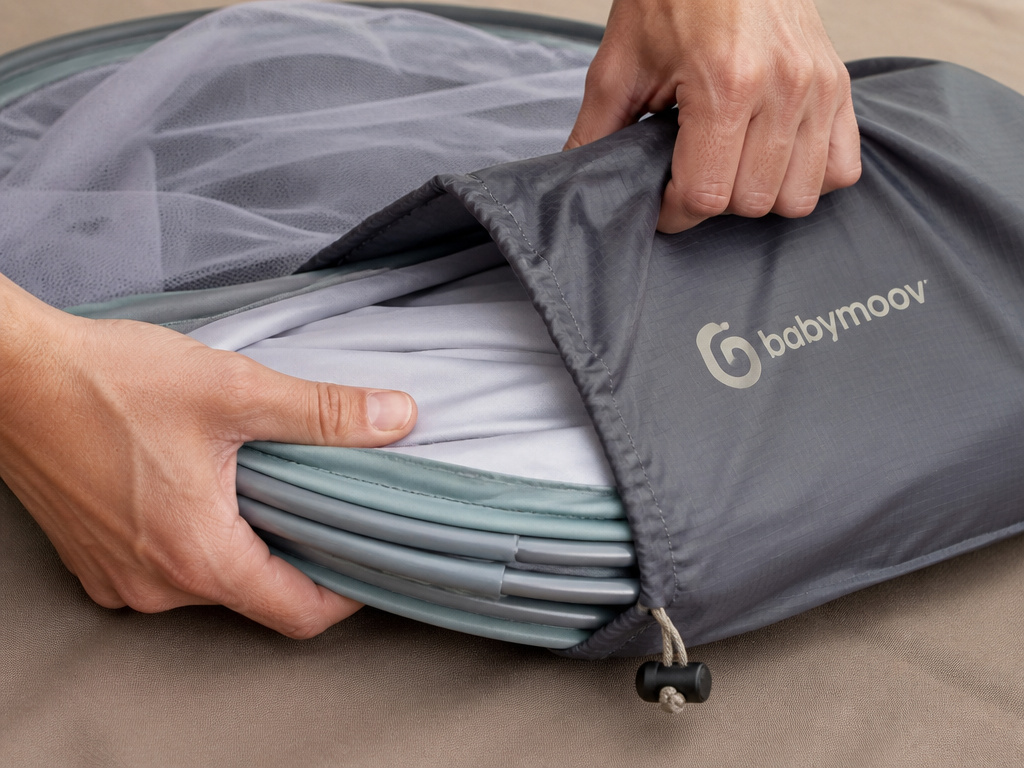
Once folded, the care isn’t over. How you store it determines how well it pops up next time.
Always use the provided carry bag. It’s sized for the folded dimensions. If you have the tent and net separate, the net can often be laid flat on top of the coiled tent inside the bag. Don’t crank the bag’s drawstring or compression straps tight. Snug is fine; tight creates pressure points that can warp the coiled frame over months.
Store the bag in a cool, dry place. Avoid damp basements or hot attics, as extreme moisture and heat can weaken the fabric coatings and the frame’s resilience. This is good practice for all your tent camping equipment, not just pop-ups.
For long-term winter storage, some owners prefer to hang the coiled tent in a closet rather than leave it compressed. This is optional but can extend the life of the spring steel.
Frequently Asked Questions
My Babymoov tent is stuck open. How do I collapse it?
Do not force it. Flip it upside down as if starting the fold. Look for any fabric caught on the frame or a wire that has jumped out of its sleeve. Gently work the material free. Then, push down on the center of the dome while guiding the edges inward. It should collapse.
Can I fold the tent differently to make it smaller?
No. The coil method is engineered for the frame’s memory. Alternative folds, like a simple tri-fold, stress the wires at unplanned points. They will fail sooner. The folded diameters in the manuals are the minimum possible size.
Is the folding method the same for all Babymoov pop-up products?
The official YouTube video states the Marine tent method applies to “some of the other Babymoov Anti-UV pop-up tents.” Always check your manual first. Products like the “3-in-1 shade” may use a similar but slightly different technique, as mentioned in other video transcripts.
How do I know if I’ve damaged the frame while folding?
The tent will not pop open fully or will have a saggy, uneven shape when deployed. You may see a visible kink or bend in one of the wire ribs. Once damaged, the frame cannot be reliably repaired and the tent’s wind resistance is compromised.
Can I wash my Babymoov tent before folding it for storage?
Spot clean only with mild soap and water. Do not machine wash or submerge the tent. The frame pockets and seams are not designed for heavy water exposure. Ensure it is completely, utterly dry before folding and storing. Dampness leads to mold and metal corrosion inside the sleeves.
Before You Go
Folding a Babymoov tent is a skill, not a struggle. The universal coil method works for most dome-style models, but always verify your specific manual for the correct folded diameter. Remember the mosquito net folds larger and separately. If the frame resists, get lower to the ground and reset rather than force it.
With practice, the whole process takes under a minute and keeps your tent reliable for seasons of use. This attention to detail is what separates a well-maintained shelter from a frustrating pile of fabric and wires, whether it’s a compact tent model or a spacious family tent. Now go put it away properly.
