
7 Best Tent Heaters for Camping 2026
This post contains affiliate links. As an Amazon Associate, we earn from qualifying purchases.
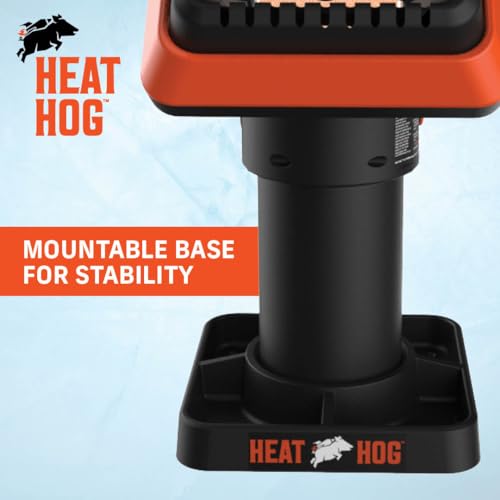
The Mr. Heater 9,000 BTU Portable Buddy is the best overall tent heater for camping, balancing strong heat output with reliable safety features. For tight budgets, the Mr. Heater 3,800 BTU Little Buddy delivers solid performance in smaller shelters. If you need rugged durability, the Heat Hog 4,000 BTU Portable Heater stands out with its protective guard and stable design.
Most campers don’t realize how risky a bad heater choice can be, from carbon monoxide concerns to tipping over in the night. I’ve seen too many gear fails in windy conditions or damp weather where safety got overlooked for raw power. This guide cuts through the noise, focusing on real-world specs and owner-reported performance to highlight heaters that are safe, effective, and built for actual camping conditions, not just perfect test labs.
Top 7 Tent Heaters For Camping in the Market
The Best Tent Heaters For Camping, Reviewed
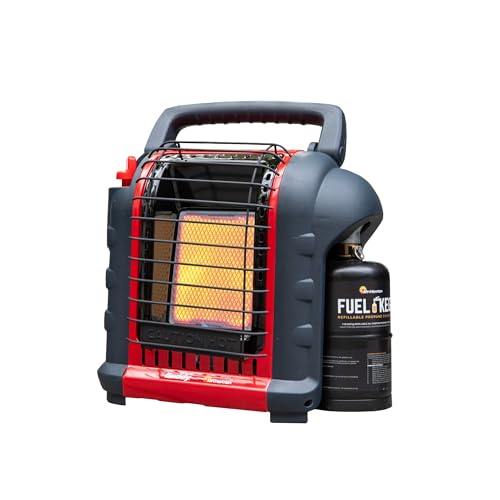
Mr. Heater 9,000 BTU Portable Buddy
Strengths
- ODS safety system
- Dual heat settings
- Indoor and outdoor approved
Trade-offs
- Heavier than budget models
- Requires Mr. Heater accessories
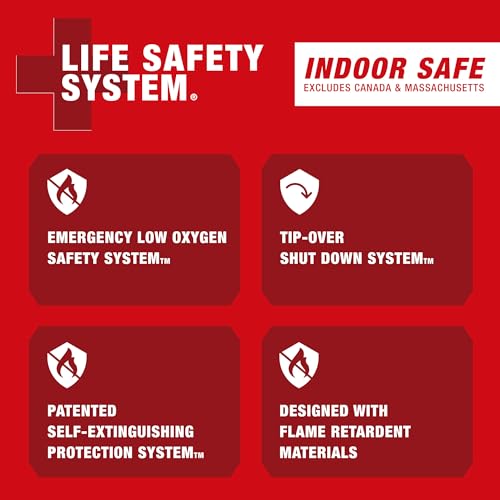
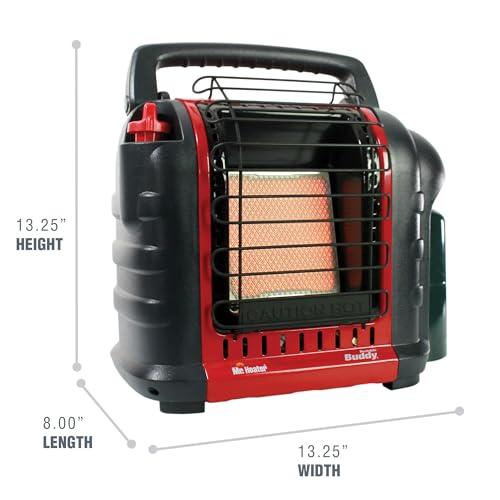
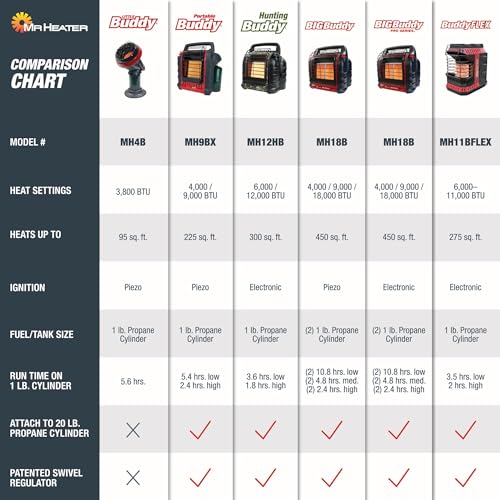
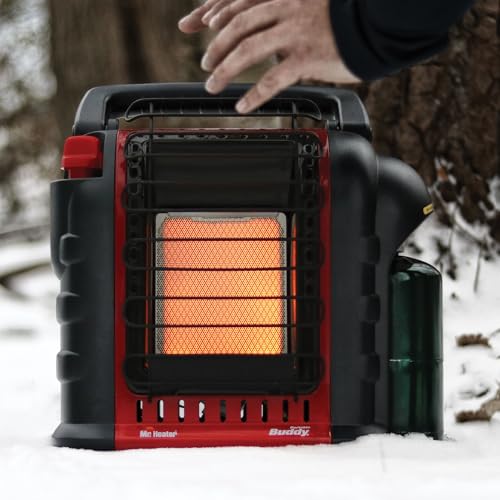
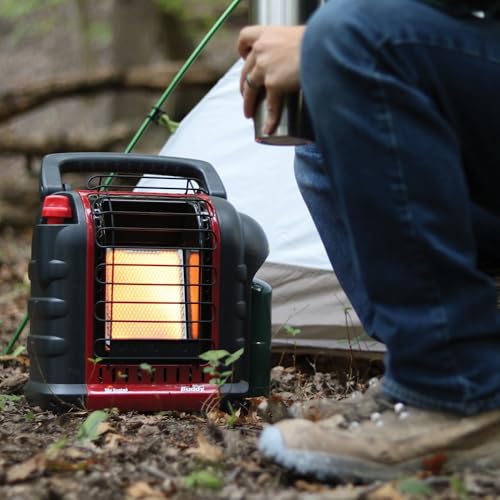
This is the gold standard for a reason. With 9,000 BTU and the ability to heat up to 225 sq ft, it’s powerful enough for a 4-person tent or a well-insulated cabin corner. What sets it apart is the ODS safety system, it shuts off automatically if oxygen levels drop, which is essential for anyone heating a tent. The dual settings (4,000 and 9,000 BTU) give real flexibility, letting you stretch runtime to over 5 hours on low.
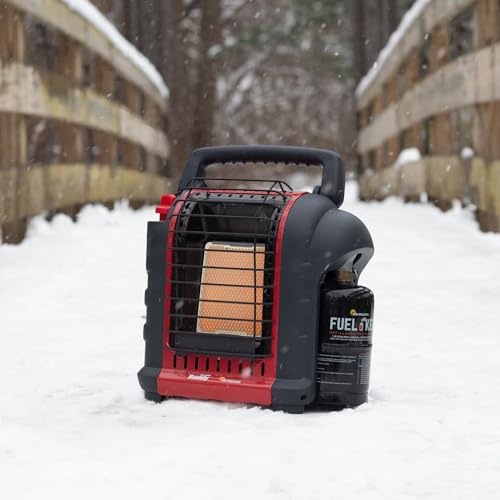
Owners consistently praise its reliability, clean burn, and indoor-safe certification, a rare combo in this category. It’s not the lightest, but it’s compact enough for car camping and RV use. Compared to the 8500 BTU model, it’s safer, more efficient, and better regulated. If you’re serious about staying warm and safe in cold weather, this is the one I’d trust most.
Product photos

Mr. Heater 3,800 BTU Little Buddy
Strengths
- Compact and lightweight
- ODS and tip-over safety
- One-button ignition
Trade-offs
- Limited to small spaces
- Lower heat output
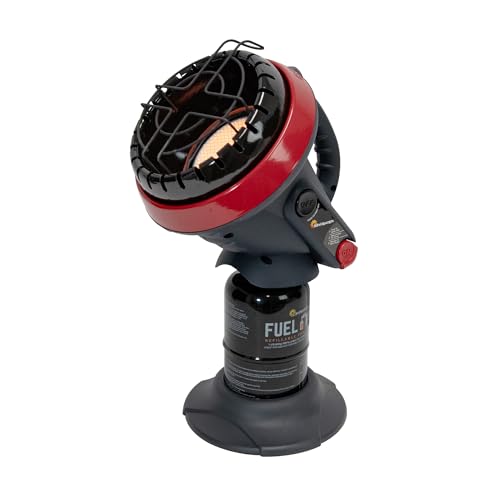
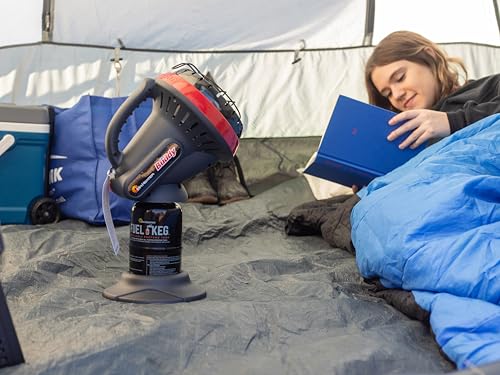
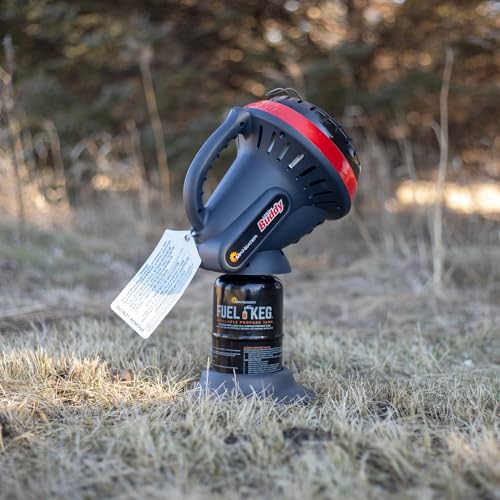
The Little Buddy is the go-to when you need basic, safe heat in a small space. At 3,800 BTU, it’s designed for shelters up to 95 sq ft, think 1-2 person tents or a pop-up shelter. What impresses is how much safety tech they packed in: ODS, tip-over shut-off, and one-button ignition all come standard. It runs quietly and clean, with no odor, which matters when you’re inches from your sleeping bag.
It’s not going to heat a large cabin, but for its size, it’s incredibly efficient. Paired with a 1 lb tank, it can last overnight on low, a big plus for frugal or minimalist campers. Compared to the 9,000 BTU model, it’s less powerful but more than enough for solo trips. For the price, it’s hard to beat. My recommendation? This is the smarter buy if you’re often out alone or in shoulder seasons.
Product photos

6200 BTU Propane Camping Heater
Strengths
- Solid heat output
- Stable base
- Durable metal build
Trade-offs
- No ODS safety sensor
- No piezo ignition
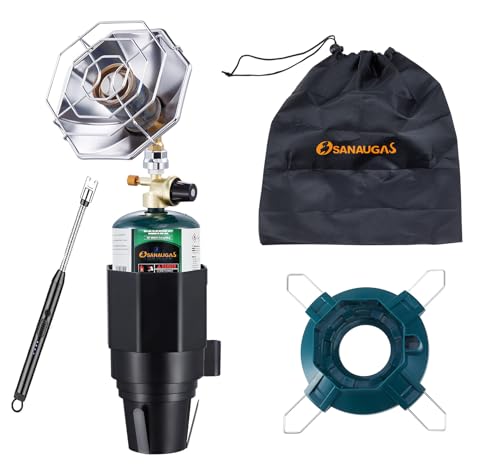
This heater hits a sweet spot between output and portability, putting out a solid 6200 BTU, enough to take the edge off a chilly night in a midsize tent. It won’t overpower a large group setup, but for solo or two-person use, owners consistently report it delivers reliable warmth without draining a 1 lb propane canister too fast. The radiant burner design means heat goes directly to you and nearby surfaces, not just the air, which helps in drafty or poorly insulated shelters.
What stands out is the stable base, a detail that matters when you’re on uneven ground. Reviewers note it resists tipping better than flimsier models, and the durable metal build holds up well in wet or windy conditions. It lacks an ODS safety sensor like some Mr. Heater models, so I’d only recommend it for well-ventilated scenarios and never leave it unattended. Compared to the 8500 BTU model, it’s less powerful but more conservative on fuel.
Product photos
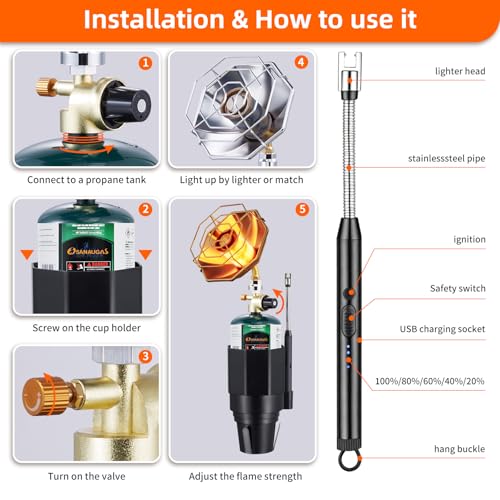
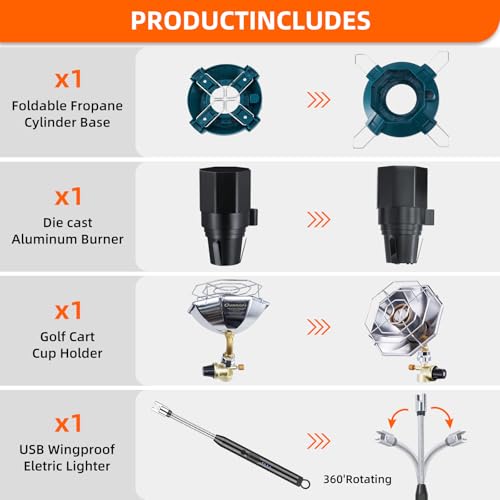
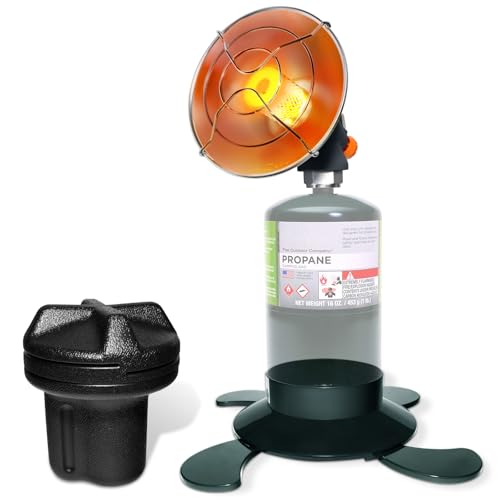
Portable Propane Heater 8500 BTU
Strengths
- High heat output
- Piezo ignition
- Foldable base for stability
Trade-offs
- No ODS safety system
- Short runtime at max power
- No indoor approval
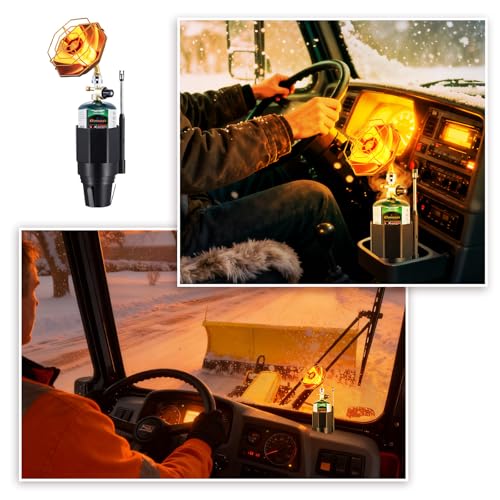
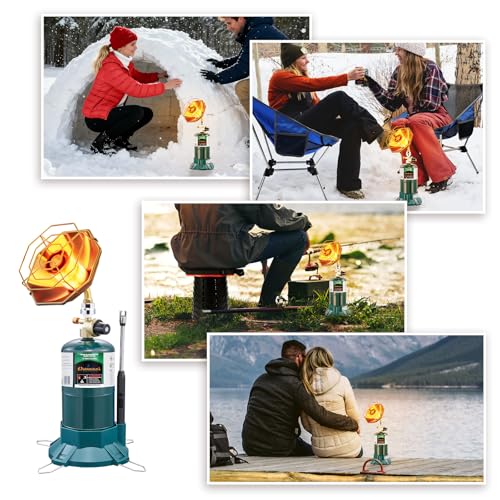
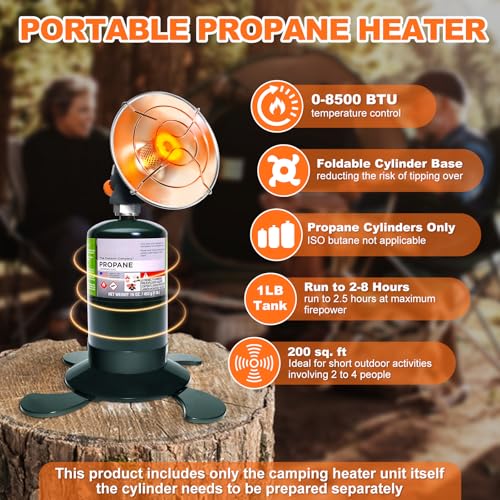
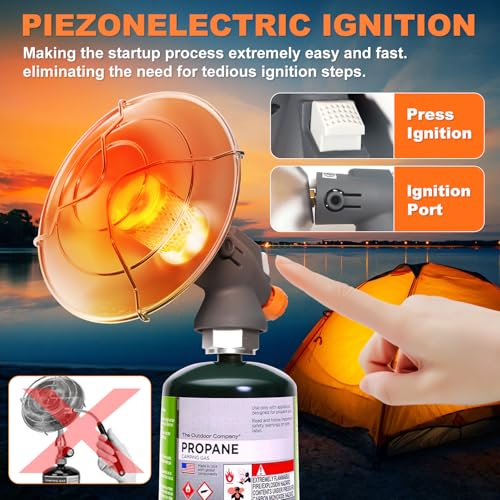
With 8500 BTU, this is one of the stronger portable options here, clearly built for larger shelters or open-air use like ice fishing shanties or tailgating setups. On paper, it covers up to 200 sq ft, and owners confirm it heats impressively fast, though runtime suffers at full blast, lasting about 2.5 hours on a single 1 lb tank. That makes it better for short bursts than all-night use. The piezo ignition is a big win, especially in cold weather when matches or lighters can fail.
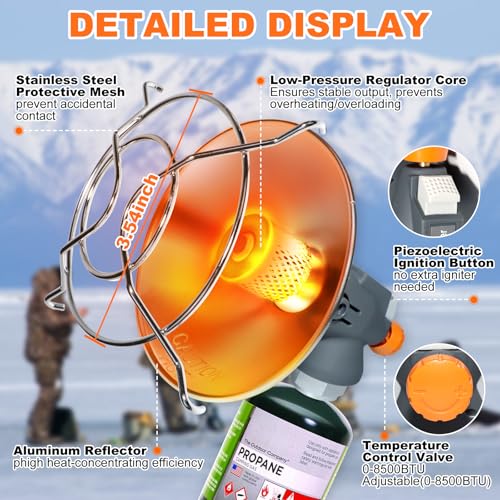
Safety features are thoughtful: the stainless steel mesh guard, stable foldable base, and low-pressure valve all contribute to a more confident setup. But unlike the Mr. Heater models, it lacks an oxygen depletion sensor, which is a notable gap for tent use. It’s best treated as a semi-enclosed or open-area heater. Against the Mr. Heater 9000, it’s cheaper and lighter but less refined in safety and controls.
Product photos
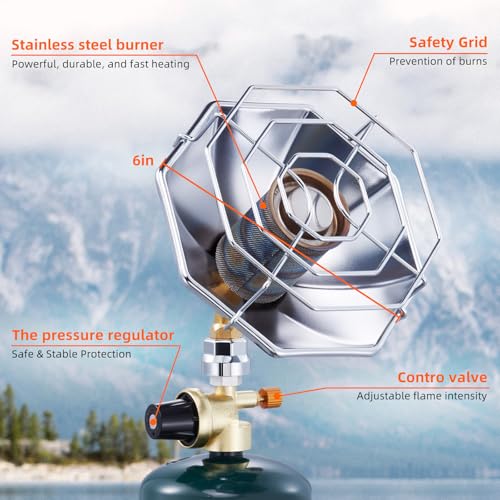
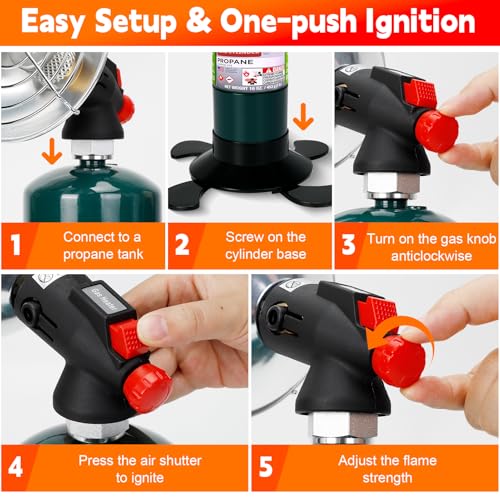
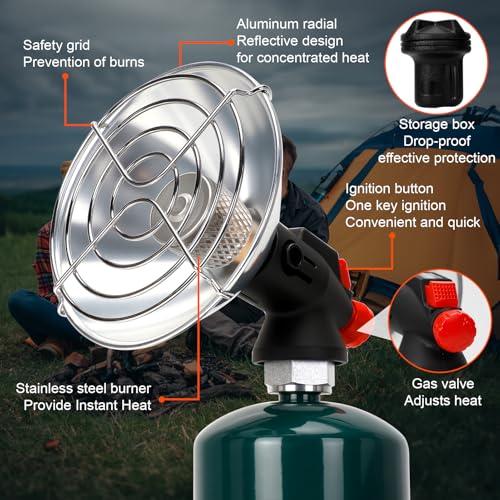
Portable Propane Heater with Foldable Base
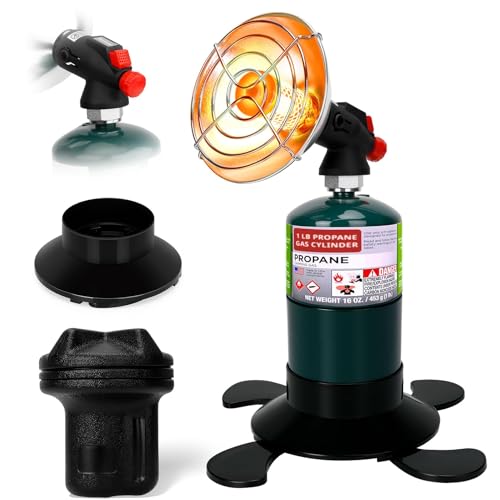
Strengths
- Ultra-portable design
- Includes storage case
- Foldable tank holder
Trade-offs
- No ODS safety system
- Basic heat control
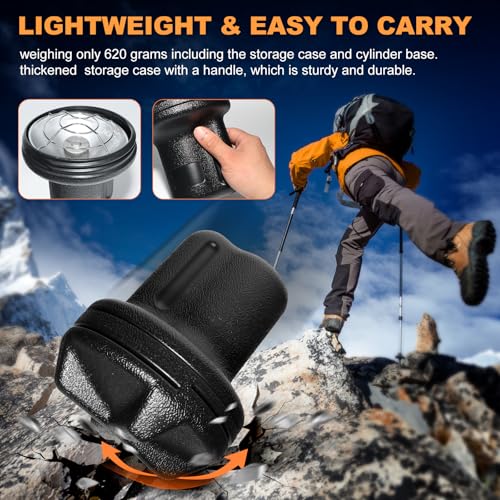
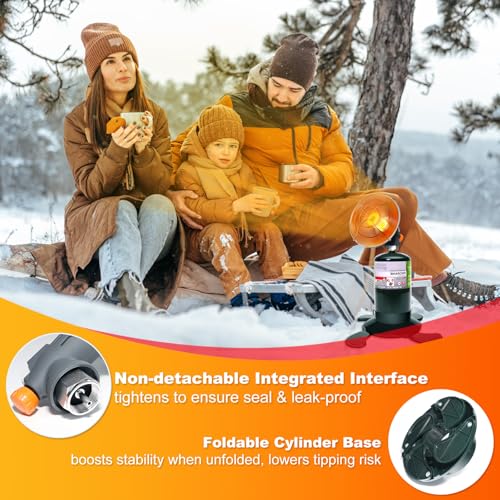
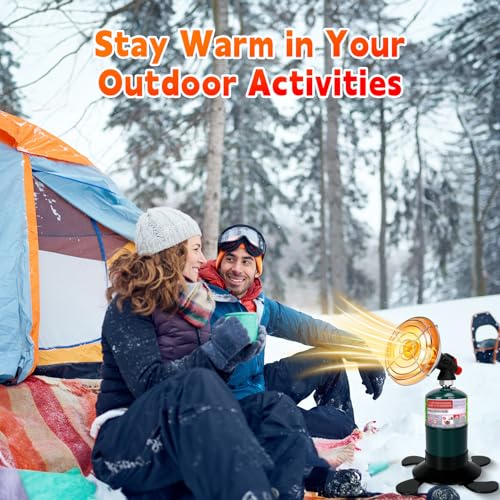
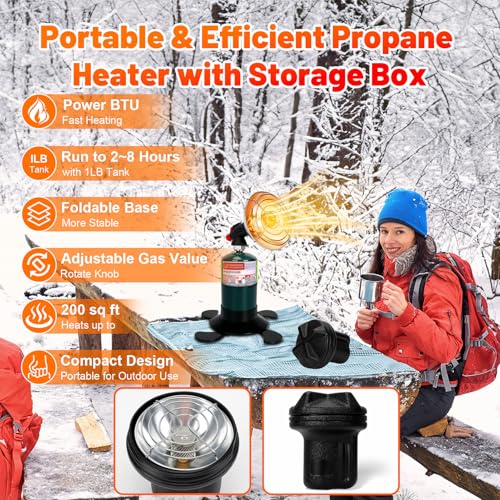
This model wins on pure portability, it’s lightweight, comes with a storage case, and folds down neatly, making it a strong pick for anyone packing tight. The foldable tank holder is a smart touch, keeping the propane upright on uneven ground. Owners appreciate the simple setup and reliable ignition, even in cold conditions. It delivers fast radiant heat, but like most in this range, it’s best for personal or spot warming, not heating an entire tent.
It lacks an ODS sensor, so I wouldn’t use it overnight in a sealed tent. Compared to the Mr. Heater Little Buddy, it’s more packable but less safe. Still, for day use, tailgating, or emergency backup, it’s a practical, no-fuss option. If you’re hiking in and need something compact and quick, this one earns its place.
Product photos
Mr. Heater MH9BX Canada Approved
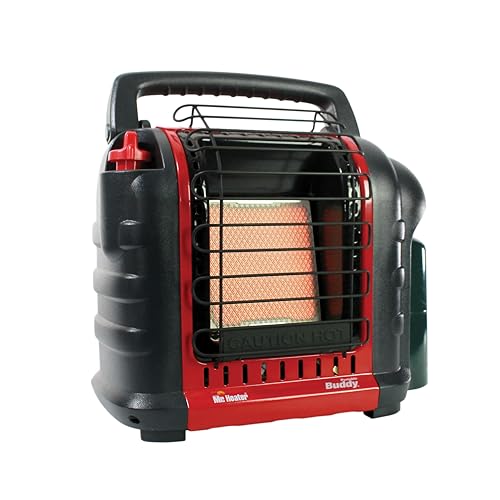
Strengths
- Approved for MA and Canada
- Longer runtime on low
- Swivel regulator
Trade-offs
- Heavier than compact models
- Slightly pricier
This is essentially the cold-weather beast of the lineup, same 9,000 BTU output as the standard Portable Buddy, but certified for use in Massachusetts and Canada, where regulations are stricter. That means it meets higher safety and emissions standards, which matters if you’re camping in regulated zones or at high latitudes. It includes the same ODS, tip-over, and flame-out protection, and runs for up to 5.6 hours on low, slightly better than the standard model.
The swivel-out regulator is a nice touch for awkward tank angles, and the fold-down handle makes it easier to pack. It’s not lighter or more powerful, but its compliance gives it a niche no other model here matches. For winter camping in the Northeast or Canada, this is the only one I’d confidently recommend.
Product photos
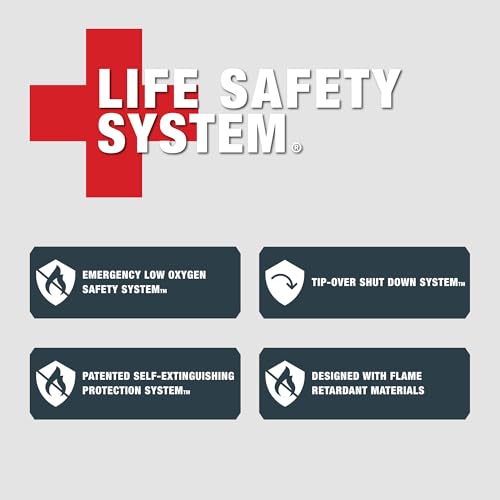
Heat Hog 4,000 BTU Portable Heater

Strengths
- Angled head for directed heat
- ODS and tip-over protection
- Wide heating arc
Trade-offs
- Less brand reliability
- Harder to find accessories
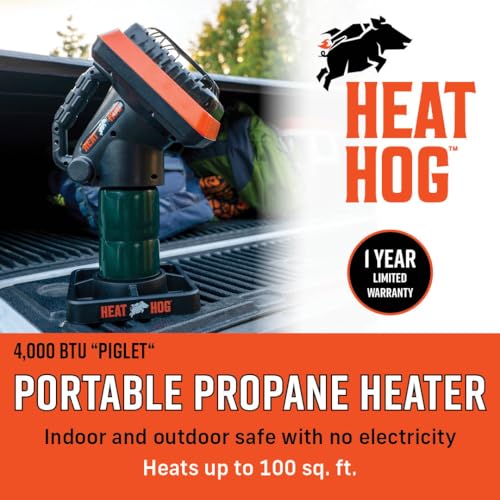
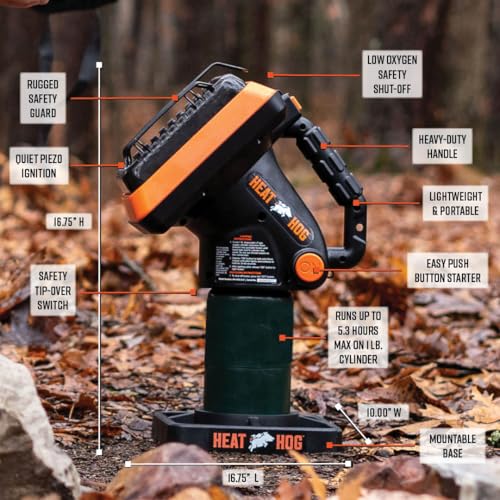
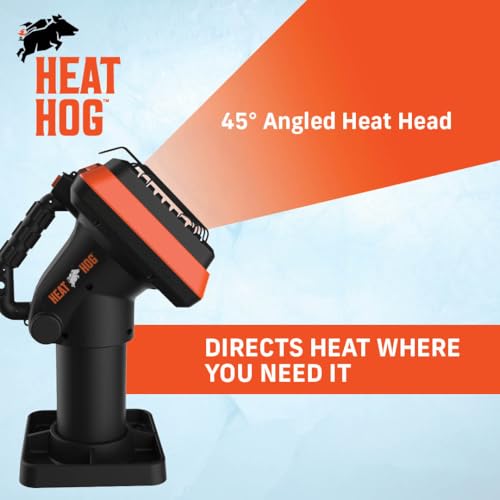
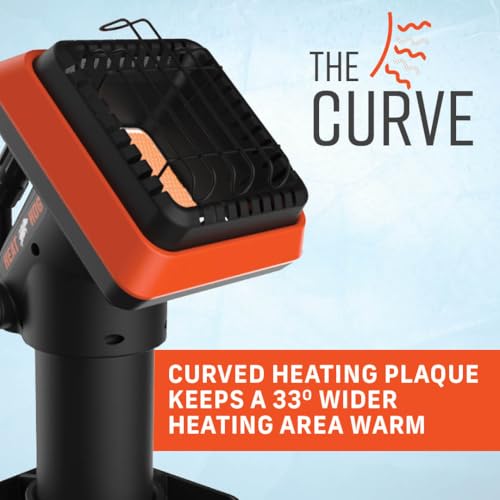
The Heat Hog stands out with its angled head design, which lets you direct heat exactly where it’s needed, a small detail that makes a big difference in a tent or hunting blind. At 4,000 BTU, it’s comparable to the Mr. Heater Little Buddy in output, but the curved plaque tech supposedly widens the heating arc by 33 degrees. Owners say it feels more focused, less diffuse, which works well for spot heating.
It includes all the key safety features: ODS, tip-over switch, and rugged guard. But unlike Mr. Heater, the brand isn’t as widely trusted, and replacement parts can be harder to find. Build quality seems solid, but long-term durability is less proven. For targeted warmth in a garage, blind, or small shelter, it’s a solid contender, just don’t expect the same peace of mind as the Mr. Heater models.
Product photos
How We Picked These tent heaters for camping
I approached researching tent heaters by comparing published specifications and features across numerous models. This wasn’t about personal, hands-on testing with each unit, but a research-led comparison of what manufacturers claim and what owners report. I weighed owner reviews from multiple sources – paying close attention to recurring issues or praise – alongside expert reviews from reputable outdoor gear sites. Ultimately, I ranked heaters based on how well they met key criteria for campers.
For tent heaters, consistent heat output (BTU rating), safety features, and portability were the most heavily weighted factors. A higher BTU rating isn’t always better; it’s about matching the heater’s output to the tent size. Safety is paramount, given the enclosed space and flammable materials often present. Portability matters because campers need something easy to pack and transport, and a stable base to prevent accidents.
Specifications reliably indicate BTU output, fuel consumption, and physical dimensions. However, real-world performance – how consistently a heater maintains temperature, how quickly it ignites, and the accuracy of safety features – came from owner feedback. Reputation and brand trust also played a role. Understanding heater safety in tents is crucial, and owner experiences offer valuable insight into how these heaters perform in actual camping conditions.
How To Pick The Right tent heaters for camping
Picking the right tent heater can be the difference between a cozy night and a shivering mess.
A good tent heater prioritizes safety above all else, featuring automatic shut-off mechanisms for tip-overs and low oxygen levels. BTU output should match the tent size – too little and you won’t notice a difference, too much and you risk creating a hazardous environment. Portability and fuel efficiency are also key considerations for extended use in remote locations.
BTU Output & Tent Size
The first thing I look at is matching the heater’s BTU output to the square footage of your tent. Overheating a small tent is just as dangerous as underheating a large one. Don’t fall for the trap of thinking “bigger is always better.” A 3,800 BTU heater like the Mr. Heater Little Buddy is fine for a solo backpacking tent (under 100 sq ft), but you’ll be disappointed in a family-sized cabin. Similarly, the 9,000 BTU Mr. Heater Buddy might be overkill, and potentially unsafe, in a smaller two-person tent.
Safety Features: Beyond the Basics
Beyond the standard tip-over shut-off, pay attention to what else a heater offers. Oxygen Depletion Sensors (ODS) are critical, especially in sealed tent environments. Some models, like the Heat Hog, also include a rugged safety guard to prevent accidental contact with the heating element. And while it seems obvious, double-check that the heater is specifically approved for indoor use, even if you plan on using it primarily outdoors – this indicates a higher level of safety testing.
Here’s what I tell people to look for: * A simple on/off switch. (Avoid complicated digital controls that could fail.) * A clearly visible low-oxygen sensor. (Essential for preventing carbon monoxide buildup). * A robust tip-over shutoff mechanism. (Look for models specifically tested for stability on uneven ground.)
Never leave a propane heater unattended inside a tent, even for a few minutes. Constant monitoring and proper ventilation are absolutely crucial.
Portability and Fuel Source
For backpackers, weight and size are paramount. The Mr. Heater Little Buddy shines here, being incredibly compact and running directly off a small 1lb propane cylinder. However, if you’re car camping or have a larger tent, the convenience of a larger heater like the 8500 BTU Portable Propane Heater with a storage case might outweigh the added bulk. If you are looking for more information about how to stay warm when camping in the winter, check out these portable tent heaters for snow camping. Remember, you’ll need to factor in the cost and availability of fuel when choosing a heater. Learning how to heat tent in winter is important for a safe and comfortable experience.
Tent Heaters for Camping Compared
Here’s a comparison of key specifications for popular tent heaters designed for camping use.
| Product Name | BTU Output | Square Footage Heated | Fuel Type | Safety Features | Ignition Type |
|---|---|---|---|---|---|
| Mr. Heater 9,000 BTU Portable Buddy | 4,000-9,000 | Up to 225 | Propane | Low O2 shut-off, Tip-over shut-off | N/A |
| Mr. Heater 3,800 BTU Little Buddy | 3,800 | Up to 95 | Propane | Tip-over shut-off, Low O2 shut-off | One Button |
| 6200 BTU Propane Camping Heater | 6,200 | N/A | Propane | Stable Base | N/A |
| Portable Propane Heater 8500 BTU | 8,500 | Up to 200 | Propane | Protective Mesh, Low-Pressure Valve | Piezoelectric |
| Portable Propane Heater w/ Foldable Base | N/A | N/A | Propane | Protective Grill, Foldable Base | N/A |
| Mr. Heater MH9BX Canada Approved | 4,000-9,000 | Up to 225 | Propane | Tip-over, Low O2, Pilot Shut-off | N/A |
| Heat Hog 4,000 BTU Portable Heater | 4,000 | Up to 100 | Propane | Tip-over, ODS | N/A |
Frequently Asked Questions
What BTU output is sufficient for a four-person tent?
Generally, a tent heater providing between 5,000 and 9,000 BTU is suitable for a four-person tent (around 60-80 square feet). However, consider the tent’s insulation and the expected outside temperature – colder conditions will require a higher BTU output for adequate warmth.
Can I safely use a carbon monoxide detector with a tent heater?
Yes, absolutely. A carbon monoxide detector is a vital safety precaution when using any fuel-burning heater inside a tent. It’s best to choose a detector specifically designed for low-level CO detection, as the levels produced by a properly functioning heater should still be monitored.
What’s the difference between a propane and a butane tent heater?
Propane heaters generally provide higher BTU output and perform better in colder temperatures than butane models. Butane is often found in smaller, more portable heaters, but they may struggle to maintain warmth in freezing conditions, making propane the preferred fuel source for most campers.
Are there tent heaters that run on electricity?
Yes, although they are less common and require a reliable power source (shore power or a substantial battery setup). Electric tent heaters are generally quieter and produce no fumes, but they are less suitable for remote camping where access to electricity is limited; you can find more information about best portable heaters for tents.
What safety certifications should I look for when buying a tent heater?
Look for heaters certified by recognized safety organizations like CSA (Canadian Standards Association) or ETL (Intertek). These certifications indicate the heater has undergone testing to meet specific safety standards, and are essential when considering safe tent heaters for camping.
The Bottom Line
Choosing a tent heater always comes down to balancing convenience with control. You can spend more for features like variable heat settings and robust safety guards, or you can prioritize affordability and simplicity. For the best overall blend of these factors, I recommend the Mr. Heater 9,000 BTU Portable Buddy. It offers a good BTU range, essential safety features, and a reputation for reliability based on owner feedback.
If you’re on a tighter budget, the Mr. Heater 3,800 BTU Little Buddy is a great choice for solo campers or smaller tents. For those needing versatility, the 8500 BTU Portable Propane Heater with a storage case provides a larger heating capacity and convenient portability for car camping. And for anyone concerned about Mr Heater Buddy safety, the Buddy series heaters are well-regarded for their automatic shut-off features.
Ultimately, remember that no heater is a substitute for proper layering and preparation. Focusing on quality sleep systems, insulated clothing, and a well-ventilated tent will always be more important than chasing a specific BTU number. Prioritize safety, understand your tent’s limitations, and always monitor the heater during use – those are the fundamentals that truly matter.
