
Are Tent Heaters Safe? The Real Data & Rules You Need
This post contains affiliate links. As an Amazon Associate, we earn from qualifying purchases.
A tent heater is only safe if it’s certified to ANSI Z21.63 or CSA 4.98 U.S., includes an Oxygen Depletion Sensor (ODS), and you maintain cross-ventilation. The CPSC documented 18 deaths from CO poisoning in five years from uncertified propane heaters used in tents and campers.
That headline risk isn’t fire. It’s an odorless, invisible gas that can overwhelm you while you sleep. You might wake up with a pounding headache, or you might not wake up at all.
I’ve chased winter trails from the Scottish Highlands to the Rockies, and the question of tent heat comes up every season. After digging into the actual government test reports and learning from close calls, I don’t rely on marketing promises. I rely on a certification label and a set of non-negotiable rules. Let’s cut through the noise and get to what actually keeps you safe.
Key Takeaways
- The Oxygen Depletion Sensor (ODS) is non-negotiable. In CPSC tests, heaters without one failed, with one model spewing over 2,100 ppm of carbon monoxide.
- Certification to ANSI Z21.63 or CSA 4.98 U.S. is your guarantee. Heaters sold as “for outdoor use only” lack the engineering for enclosed spaces and are deadly in a tent.
- Cross-ventilation is mandatory, even at -10°C. You need two open vents to replenish oxygen and flush out combustion gases. A single cracked door will not save you.
- Never run a combustion heater while sleeping. Use it to pre-warm your shelter, then turn it off before you zip up your bag. A carbon monoxide detector is your critical backup.
- Oxygen depletion happens before CO spikes. A heater can drop tent oxygen levels to a dangerous 19% in under an hour, causing drowsiness and confusion long before CO reaches lethal levels.
What Does the Government’s Test Data Actually Show?
Let’s talk facts, not fear. In 2001, the U.S. Consumer Product Safety Commission locked eight different portable propane heaters in a 100-cubic-foot chamber to see if they met the voluntary safety standard, ANSI Z21.63. This standard says a heater must keep carbon monoxide under 100 parts per million and oxygen above 16% in a small, ventilated space.
In a CPSC staff test, eight portable propane radiant heaters were evaluated against ANSI Z21.63 combustion requirements. Six heaters failed to comply, with carbon monoxide concentrations ranging from 260 ppm to 2,124 ppm. The two compliant heaters were equipped with Oxygen Depletion Sensors, which shut off the unit before oxygen fell below 19%.
The results were stark. Six of the eight heaters failed. One model, referred to as Heater E in the official portable radiant heater safety study, produced a staggering 2,124 ppm of CO. At that concentration, you could lose consciousness in under three minutes. Two other models (Heaters A and B) still produced over 350 ppm, enough to cause severe headache, nausea, and dizziness within an hour.
The two that passed? Heater G and Heater H. Their secret was a small, brilliant device: the Oxygen Depletion Sensor (ODS). This thermocouple sits in the pilot flame. If oxygen levels drop because the flame is consuming it, the flame lifts, the sensor cools, and a safety valve slams shut. In the test, these heaters shut off automatically when oxygen dipped to between 18.8% and 19.6%, and their CO output never exceeded 39 ppm.
TL;DR: The data is clear. A heater without an ODS and proper certification is a roll of the dice with your life. The ones that passed had the right engineering.
The One Label You Must Find Before Buying
Forget the box copy that says “Great for Camping!” Your only job is to find the certification sticker on the unit or in its manual. This isn’t a suggestion; it’s your first line of defense.
| Certification Standard | Core Safety Mandate | Why It Matters for Your Tent |
|---|---|---|
| ANSI Z21.63 | Limits CO to <100 ppm and O₂ to >16% in a 100 ft³ test chamber. | It’s the baseline U.S. standard proving the heater is engineered for low-ventilation scenarios similar to a tent. |
| CSA 4.98 U.S. | Requires an ODS that shuts off the heater before O₂ drops below 18%. CO must stay under 100 ppm in a sealed 500 ft³ room. | This is the stricter, gold-standard certification. The mandatory ODS and lower oxygen shutoff provide a critical safety buffer. |
If you’re considering a more permanent setup, like a canvas tent with a stove jack for a wood burner, the principles are different but the vigilance is the same. For propane, that CSA 4.98 U.S. label is what I look for. Heaters without it are for open-air patios or well-ventilated workshops, not your nylon shelter.
Common mistake: Assuming a “camping” heater is safe for tents. Most are not. You must see “Indoor-Safe” or “CSA 4.98 U.S.” on the label. My rule is simple: no label, no purchase.
Your Non-Negotiable Safety Protocol
Safety isn’t a vague concept. It’s a specific set of actions you practice every single time. These rules are distilled from the CPSC data and hard lessons learned on the trail.
- Engineer Cross-Ventilation. Open at least two vents on opposite sides or ends of your tent. This creates an airflow path that brings in fresh oxygen and pushes out combustion gases. In my REI Co-op Half Dome 2+, I open the top vent fully and crack the lower door zip about 6 inches. If I can’t feel a slight draft across my face when lying down, I open it more.
- Create a Stable, Fireproof Platform. Tent floors are rarely level. Place your heater on a solid piece of fire-rated cement board or a metal baking sheet. This prevents tipping and protects the tent floor from sparks or intense radiant heat. I learned this after a friend’s heater tipped in a Marmot Tungsten 3P and scorched a perfect circle into the footprint.
- Use a Digital CO Detector at Sleeping Height. A basic beeper isn’t enough. You need a detector with a digital PPM readout, like the Kidde KN-COPP-3. Mount it at head level where you’ll sleep. Check the battery before every trip, better yet, get one with a 10-year sealed lithium battery that won’t die in the cold.
- Pre-Warm, Then Power Off. Never sleep with a combustion heater running. Use it to take the deep chill off the tent and warm your sleeping bag for 15-20 minutes. Enjoy the coziness, then turn it off, disconnect the fuel, and sleep. The risk of a malfunction or oxygen drop is never zero.
Following this protocol makes using a heater as routine as any other piece of tent camping equipment. Ignoring a single step is how accidents happen.
Propane, Electric, or Battery: Choosing Your Heat Source
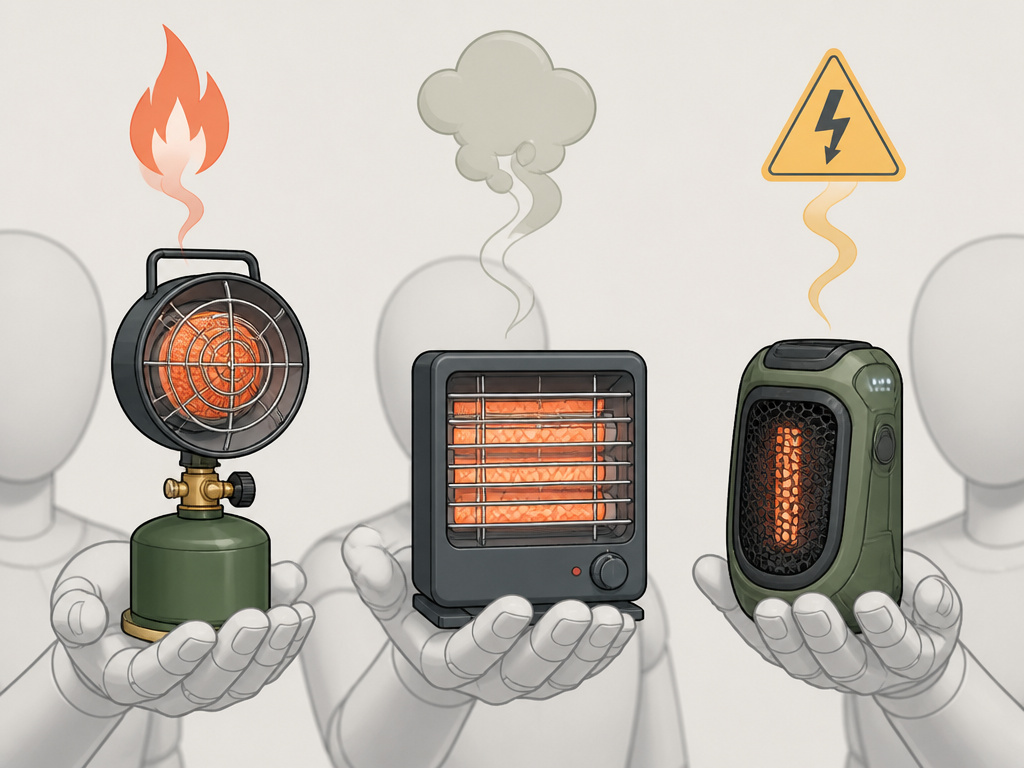
Your fuel choice dictates your risk profile and the precautions you must take. Here’s how they compare for tent use.
| Heater Type | Primary Hazard | Essential Safety Gear | Ideal Use Case |
|---|---|---|---|
| Propane (ODS-equipped) | Carbon monoxide poisoning, oxygen depletion. | Certified heater, digital CO detector, cement board, cross-ventilation. | Car camping or base camps in larger shelters like heavy-duty tents where you can maintain clearance. |
| Electric (Fan/Radiant) | Fire from overheated elements or faulty cords. | GFCI outlet, heavy-duty outdoor extension cord, direct plug-in (no daisy-chaining). | Campgrounds with reliable power hookups or van life with a robust inverter system. |
| Battery-Powered | Very limited run-time, potential lithium battery fire. | Manufacturer-specified battery packs, temperature monitoring, never cover vents. | Short-duration personal warmth in a small tent or pre-warming a sleeping bag. |
Propane heaters are the most common and carry the highest stakes. The CPSC’s 18 deaths were all from this category. A certified model like the Mr. Heater Little Buddy (MH4B) with an ODS is the maximum size I’d use in a standard 2-3 person tent. The larger Big Buddy (MH18B) is only suitable for a massive canvas shelter where its 18,000 BTU output won’t deplete oxygen in minutes.
Electric heaters eliminate CO risk, which is a huge win. The danger shifts to electrical safety. You must plug directly into a GFCI outlet. That glowing element can ignite a stray stuff sack in seconds, so maintain the same clear-radius rule.
Battery units are essentially powerful hand-warmers. They’re great for a quick warm-up but lack the output for all-night heat. The risk is the battery itself, never use a swollen pack, and don’t charge it unattended in your tent.
For true winter immersion, many seasoned campers prefer the dedicated safety of a wood-burning system in a hot tent, which uses a chimney to vent all gases outside. It requires specific gear like a hot tent stove but removes the internal combustion danger.
When You Should Absolutely Not Use a Tent Heater
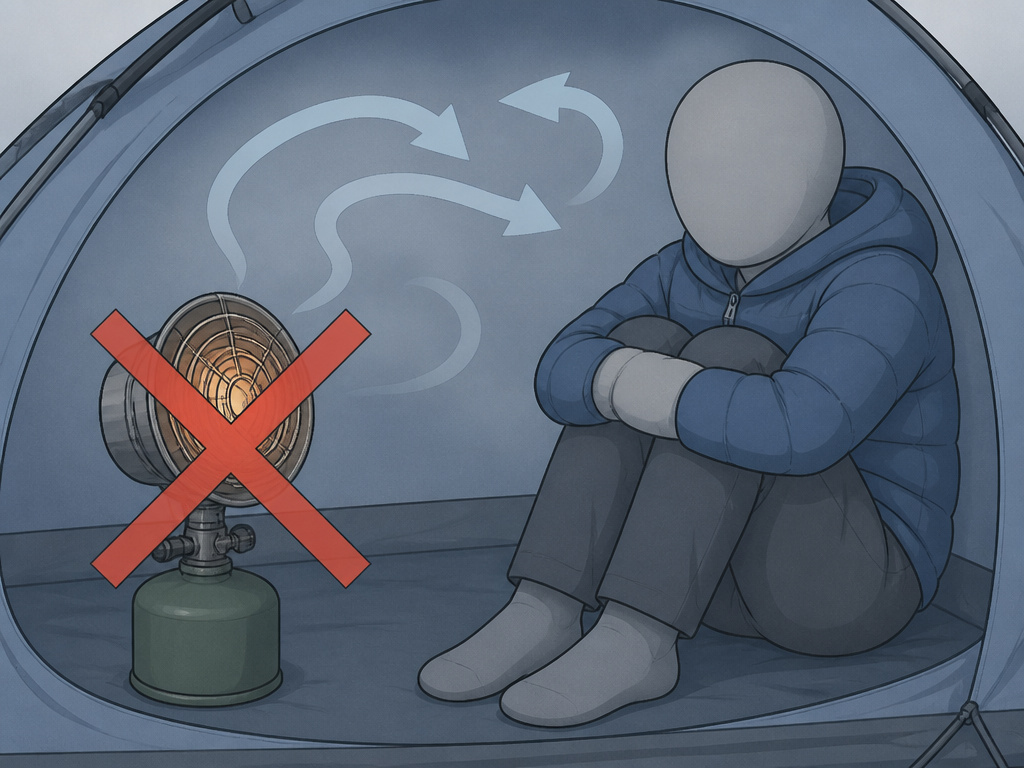
Some conditions amplify the risks beyond what any safety feature can mitigate. Knowing when to say “no” is as important as knowing how to use one.
High-Altitude Camping tops the list. The official CPSC carbon monoxide safety center explicitly warns the risk of CO poisoning increases at altitude. Thinner air leads to incomplete combustion, generating more CO. Above 5,000 feet, I seriously reconsider my need for combustion heat.
Windy Conditions can defeat an ODS. The pilot flame is tiny. A strong gust through a vent can blow it out, causing the heater to shut off. In a worst-case scenario, if the gas valve doesn’t fully seal, raw propane can leak. If you’re in a storm-resistant tent in a gale, the internal drafts make any portable heater unreliable.
Ultra-Small or Single-Wall Tents lack the air volume to dilute gases. A backpacking tent under 30 square feet is a terrible place for combustion. Oxygen plummets too fast. If you’re going light and cold, focus on your sleep system, not a heater. Even a portable hot tent for hiking is designed for a stove with a flue, not a radiant propane unit.
Before you start: Carbon monoxide is odorless and colorless. Early symptoms, headache, dizziness, nausea, mimic altitude sickness or fatigue. If you feel unwell with a heater running, treat it as a CO emergency immediately: shut off the heater and get to fresh air.
My Personal Gear Checklist for Heater Nights
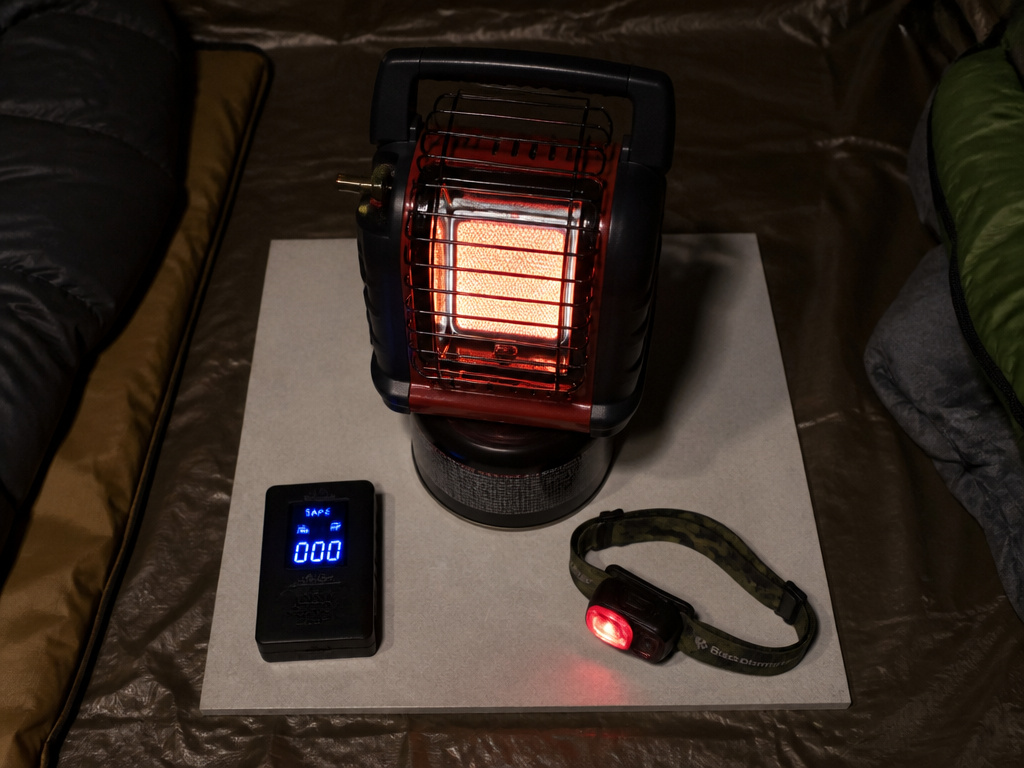
A heater is just one component. This is the supporting gear that builds a safe system. I pack every item, every time.
- A Digital CO Detector: The Kidde Nighthawk KN-COPP-B-LPM with a 10-year sealed battery. I won’t trust cheap AAA batteries that can die in the cold.
- Fire-Rated Cement Board: A 12″x12″ square. It’s a leveling plate, a spark shield, and a thermal barrier all in one.
- A 3-Foot Clear Radius: Every piece of gear, backpack, puffy jacket, spare socks, gets moved outside this circle. Synthetic fabric melts and ignites with shocking speed.
- A Reliable Headlamp: With a red light mode for checking the heater’s pilot and the detector’s readout without blinding myself or my partner.
- A Robust Sleep System as Backup: My heater can fail. My sleep kit cannot. This means a bag rated 10°F below the forecast low, a sleeping pad with an R-value of 5 or higher, and base layers. This is part of a complete camping gear list mindset.
Think of this as part of your overall strategy, just like choosing the right tent lighting or knowing when you might need a tent cooling system. Redundancy is everything when the temperature drops.
Frequently Asked Questions
Can you use a Mr. Heater Buddy in a tent?
Yes, but only the specific “Buddy” series models (like the Little Buddy MH4B) that are certified for indoor use and feature an ODS and tip-over switch. You must still follow all ventilation rules and never run it while sleeping. The larger Big Buddy model is too powerful for most nylon tents.
How much ventilation is truly enough?
You need active cross-flow. Open at least two vents on opposite sides of the tent. You should feel a slight draft. If the air inside is completely still, it’s not enough. In a mountaineering tent, you must manually open multiple snow vents; “breathable” fabric is not ventilation.
Do catalytic heaters produce carbon monoxide?
Yes, all combustion produces some CO. Catalytic heaters burn fuel more completely, so they typically produce less than radiant burners. However, they still consume oxygen and must be certified for indoor use with an ODS to be considered tent-safe.
Is it safe to use a heater in a car or campervan?
The risks are even higher. Vehicles are more airtight than tents. The CPSC report specifically notes deaths in campers and vehicles. Never run a portable combustion heater while sleeping in a vehicle unless it is a permanently installed unit with a sealed external vent.
What about safer alternatives like a hot water bottle?
These are excellent, low-risk options for personal warmth. A hot water bottle in your sleeping bag provides hours of heat with zero combustion risk. An electric blanket powered by a large portable power station is another great option if you have the battery capacity.
Before You Go
Tent heaters are powerful tools, not magical warmth bubbles. A certified, ODS-equipped propane heater, used with disciplined cross-ventilation and a working digital CO detector, can transform a frigid night. An uncertified heater in a sealed space is a gamble the cold, hard data says you will lose.
Your primary heat source is always your sleeping bag and pad. The heater is a luxury for taking the edge off. Treat it with the same focused respect you give a camp stove, understand its fuel, maintain its clearances, and always have a backup plan.
Warmth is a wonderful thing, but it’s never worth the risk of not waking up to see the morning frost on your tent. Check the label, follow the protocol, and when in doubt, layer up and turn it off.
