
Is It Legal To Live In A Tent On Your Own Land? A Full Guide
This post contains affiliate links. As an Amazon Associate, we earn from qualifying purchases.
You can live in a tent on your own land only if your local zoning and building codes allow it, which most do not for anything beyond temporary recreational camping. The legal barrier isn’t ownership, it’s the local government’s power to define a “dwelling unit,” which requires permanent foundations, minimum square footage, and approved sanitation systems that a tent cannot provide.
Most people assume owning the dirt means they can do anything on it. That assumption gets you a visit from a code enforcement officer holding a violation notice. The legal system sees land use as a community issue, not a private one.
This guide walks through the specific laws, the exact phrases code officers look for, and the few paths that might let you make a tent home legal. We’ll cover zoning definitions, the critical Supreme Court cases that back them, and what happened in one Texas town when someone tried.
Key Takeaways
- Zoning laws, not property rights, control permanent habitation. The 1926 Supreme Court case Village of Euclid v. Ambler Realty Co. cemented this municipal power.
- A “dwelling unit” is legally defined by features a tent lacks: a permanent foundation, minimum square footage (often 150+ sq ft), and approved plumbing/septic.
- Code enforcement distinguishes “camping” from “unlawful residency” by hunting for patterns of permanence: utility hookups, mail delivery, or staying beyond a set number of consecutive days.
- In rural Texas counties like Kendall or Gillespie, you might fly under the radar, but cities like Kerrville explicitly prohibit using a tent as a full-time residence.
- Your only official routes are a Conditional Use Permit or a Temporary Use Permit, which involve public hearings, fees, and strict conditions like time limits and occupancy caps.
The Legal Framework: It’s Not About Land Ownership
Ownership grants you rights to possess and exclude others. It does not grant you the right to use that land in any way you see fit if that use impacts public health, safety, or general welfare. This is the core principle of zoning, upheld by the U.S. Supreme Court in Village of Euclid v. Ambler Realty Co.. Your county or city holds the authority to regulate land use through ordinances.
Common mistake: Assuming “my land, my rules” applies to permanent habitation, most municipal codes define a dwelling unit as having a permanent foundation, sleeping, cooking, and sanitation facilities, which a tent cannot meet. Violating this brings a “Notice of Violation” first, then daily fines.
In Texas, this authority is spelled out in the Local Government Code Chapter 211. The Texas Penal Code §48.05 deals with public camping, but local ordinances fill in the details for private property. When Kerrville’s Planning and Development Director, Drew Paxton, was asked about full-time tent living, his answer was clear: camping is permitted, but using a tent as a dwelling unit is not. A tent is not a legal dwelling under building codes that require minimum square footage and sanitation.
TL;DR: You own the land, but the local government owns the rulebook for how you can use it. Their definition of a “house” automatically excludes a tent.
What Legally Defines a ‘Dwelling’ Versus ‘Camping’?
This is the line that matters. Cross it, and you go from a recreational camper to an unlawful resident in the eyes of the law.
| Factor | “Camping” (Usually Allowed) | “Dwelling” / Unlawful Residency (Usually Prohibited) |
|---|---|---|
| Duration | Short-term, intermittent (e.g., weekends). | Continuous, long-term habitation. |
| Utilities | None, or portable battery/solar. | Permanent connections to grid power, water, or sewer. |
| Sanitation | Portable toilet or no fixed facility. | Requires permitted septic system or sewer hookup. |
| Structure | Temporary, non-permanent (tent, tarp). | Permanent foundation, meets building code for weatherproofing. |
| Intent | Recreation, temporary shelter. | Primary residence, receiving mail, using a street address. |
The shift happens when code enforcement observes patterns of permanence. Running an extension cord from your house to the tent for a weekend is camping. That same cord left plugged in for three weeks signals residency. Getting an Amazon delivery to your tent address? That’s a pattern.
The legal distinction turns entirely on these observable facts. For a detailed look at how these property rights and zoning laws interact, the LegalClarity property rights guide provides a thorough analysis.
The One Document You Must Read First
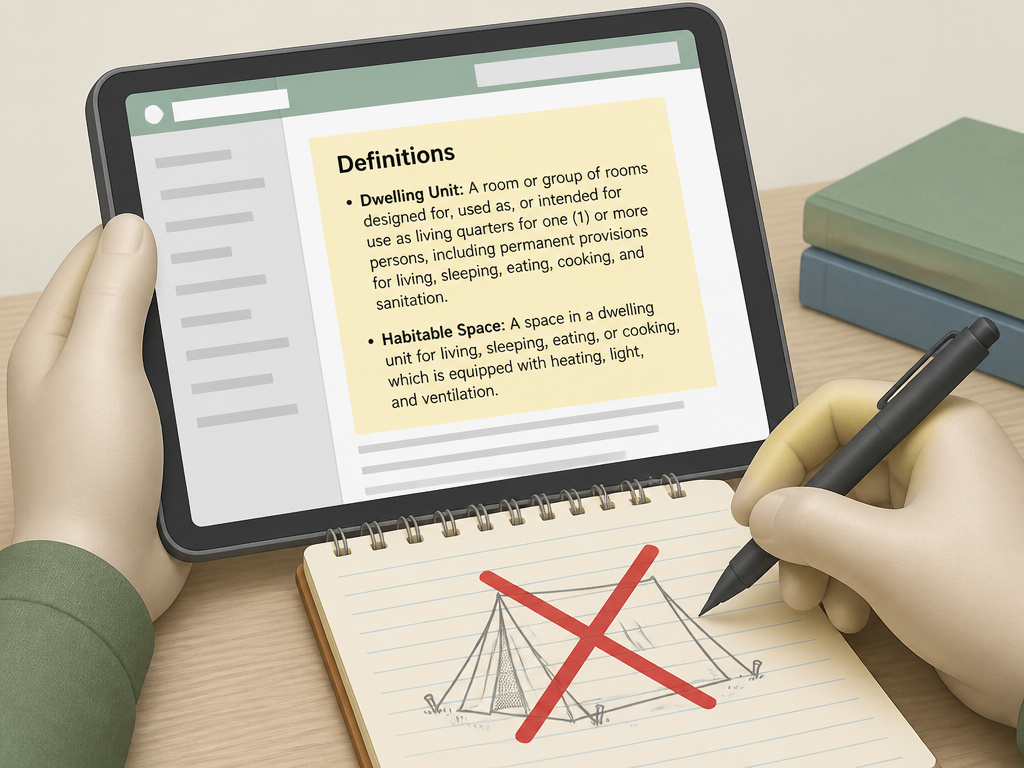
Do not ask neighbors. Do not guess. Go straight to your county or city’s online municipal code. Search for “Zoning Ordinance” or “Land Development Code.”
- Find your zoning district. Use the county’s GIS parcel viewer. Plug in your address or parcel number. It will tell you if you’re zoned R-1 (Single-Family Residential), A-1 (Agricultural), or something else. This designation dictates everything.
- Open the ordinance for that district. Find the chapter corresponding to your zoning code.
- Search for keywords. Use the document’s search function (Ctrl+F) for:
- “Dwelling unit” definition
- “Habitable space” or “habitable room”
- “Camping”
- “Temporary use”
- “Recreational vehicle”
The “Definitions” section at the front of the ordinance is your goldmine. It will state the minimum square footage for a dwelling (often 150-200 square feet), requirements for ceiling height, and mandates for permanent plumbing, heating, and electrical. A tent fails all these by design.
“A tent is not considered a legal dwelling unit under applicable building codes, which require minimum square footage and adequate sanitation facilities.”. Drew Paxton, Planning and Development Director, Kerrville, Texas.
If your ordinance is silent on camping, it might be permissible. But silence on dwellings is not permission, it’s a void usually filled by the state’s building code, which also requires those permanent features.
State-by-State Nuances and the BLM Wild Card
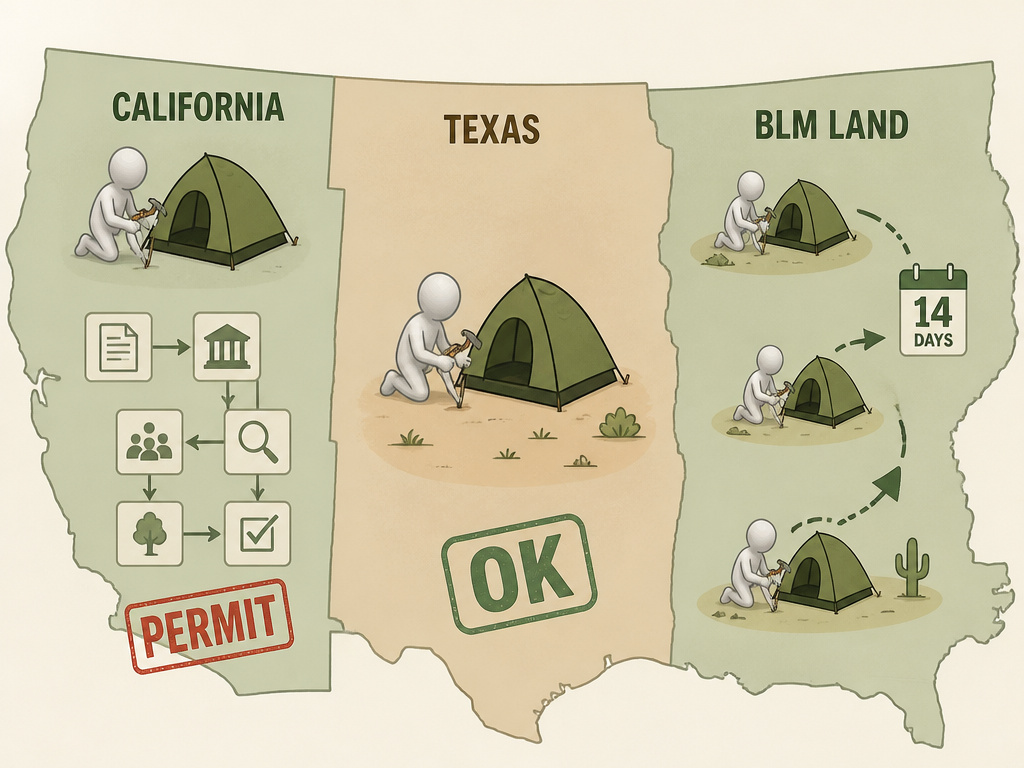
Laws vary wildly. Some states grant more deference to rural landowners; others have stringent statewide building codes.
- Texas: Local control is strong. Rural counties (Kendall, Gillespie) may have less oversight than cities (Kerrville, San Antonio). The state gives municipalities broad power under Chapter 211.
- California: State and local laws are tightly woven. Even on private land, county health departments require approved sanitation for any long-term occupancy. The California land use camping laws explain the complex interplay between state housing codes and local camping limits.
- Federal Land (BLM): This is a different universe. On Bureau of Land Management areas, you can camp for up to 14 consecutive days in one spot. Then you must move at least 25 miles away and cannot return for 28 days. This is dispersed camping, not living. Some Long-Term Visitor Areas (LTVAs) offer seasonal permits.
The BLM rule highlights the core issue: every jurisdiction draws a line between temporary recreation and permanent living. Your goal is to find where that line is drawn for your parcel.
How to Seek Permission: Conditional and Temporary Use Permits
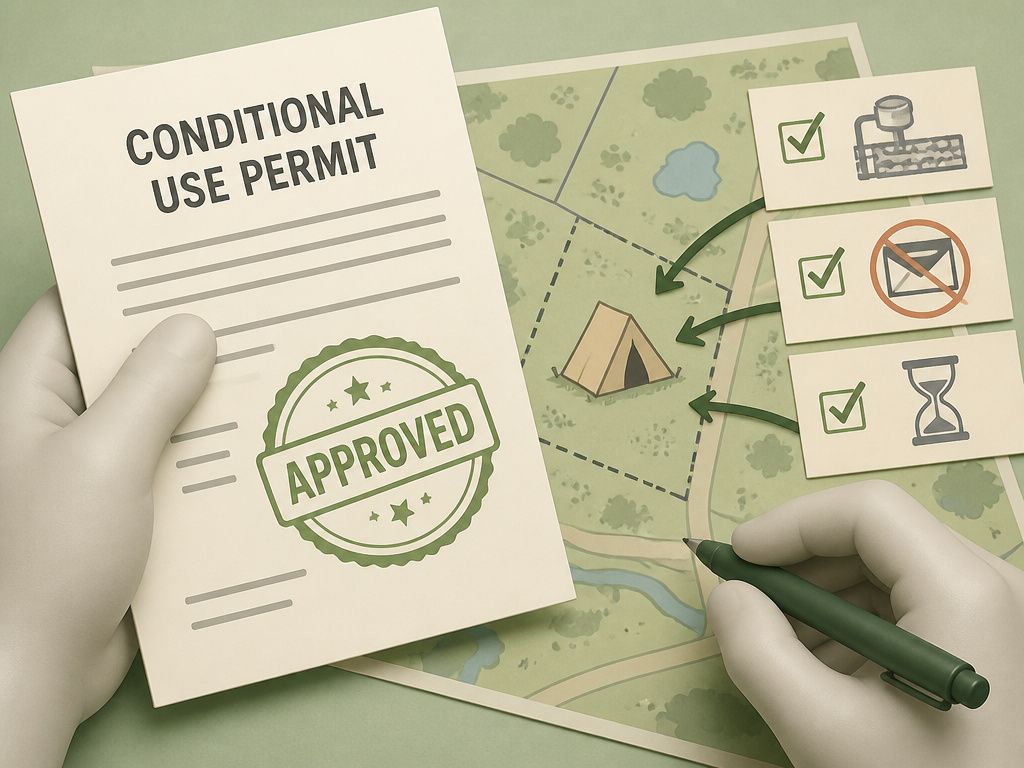
If your zoning code outright bans dwelling in a tent, all is not lost. Many jurisdictions have an exception process: the Conditional Use Permit (CUP) or Temporary Use Permit (TUP).
Applying for one is a deliberate, public, and often expensive process. It is not a guarantee.
| Permit Type | What It Is | Typical Process & Conditions |
|---|---|---|
| Conditional Use Permit (CUP) | Allows a use not normally permitted in a zoning district, subject to conditions. | Application fee ($500-$2000+), public hearing before a planning commission, possible conditions like time limits, occupancy caps, specific sanitation plans, landscaping buffers. |
| Temporary Use Permit (TUP) | Allows a temporary activity for a fixed period. | Simpler application, lower fee, but strict expiration (e.g., 6 months, 1 year). Often non-renewable or with limited renewals. |
You must prove your tent living won’t harm the public health, safety, or welfare of the neighborhood. You’ll likely need engineered plans for a septic system or proof of portable toilet service. You may need to agree to not receive mail at the property.
I won’t recommend trying for a CUP in a densely populated residential zone. The neighbors will show up at the hearing. In a rural agricultural zone with few adjacent parcels, your odds improve from impossible to merely difficult.
These permits are your only legal path to long-term tent living in a prohibited area. They turn a violation into a regulated, inspected use.
The Real-World Consequences of Getting It Wrong
Code enforcement doesn’t usually start with fines. It starts with a complaint, often from a neighbor who sees your semi-permanent setup.
The officer arrives looking for evidence of “living,” not “camping.” They note the extension cord running from your house. They see the package from Chewy on your fold-out table. They count the days your car has been parked in the same spot.
The first notice is typically a “Courtesy Warning” or “Notice of Violation.” It gives you a timeframe, often 10 to 30 days, to cease the violating use. That means dismantling your living setup.
If you don’t comply, the fines start. They are usually daily and can accumulate quickly into the thousands. In extreme cases, the city can place a lien on your property for unpaid fines or even seek a court order for abatement (they remove the tent).
The physical hassle is one thing. The legal record is another. A zoning violation on your property history can complicate future building permits, refinancing, or selling the land.
TL;DR: The consequence isn’t just a fine; it’s a paper trail that can block future plans for a real house on the same lot.
Making a Tent Livable Within the Rules
If your research shows temporary camping is allowed, you can optimize for comfort while carefully avoiding “patterns of permanence.” The goal is to live lightly enough that you remain a camper in the eyes of the law.
- Choose the right shelter. You need durability and space for long-term comfort, not just a weekend. Look at durable canvas tents designed for extended use. Their heavy-duty fabric and robust frames withstand sun and rain far better than nylon.
- Invest in off-grid systems. A portable solar generator, a high-quality cooler or 12V fridge, and a portable camping toilet are essential. The key is that everything must be movable and not permanently attached.
- Manage your waste legally. This is the biggest hurdle. A simple bucket toilet with biodegradable bags might work for a weekend. For longer, you need a service that regularly pumps out a portable waste tank or a permitted compost toilet system. Never dig a latrine without checking county health department rules.
- Plan for climate control. For summer, a portable air conditioner designed for tent use can be a lifesaver. For winter, a properly installed wood stove in a canvas tent with a stove jack is the only safe heating option. Never use a propane heater not rated for indoor tent use.
- Maintain a low profile. Keep your site tidy. Store gear inside or under a tarp. Avoid creating permanent-looking structures like decks or sheds. Use battery-powered lights instead of running permanent wires.
Having a backup plan is non-negotiable. Know where you’ll go if you get the 30-day notice. This could be a friend’s land, an RV park that allows tents, or a more permissive county.
What About RVs, Yurts, and Tiny Houses?
People often pivot to these when tents hit a legal wall. The rules are different, but the principle is the same: if it’s used as a dwelling, it must meet dwelling codes.
- RVs and Trailers: Many zoning codes treat these the same as tents for full-time living, prohibited outside of designated RV parks. Kerrville’s rules specifically restrict how long someone may live in an RV on their own land. The threshold is often 30 days.
- Yurts: These fall into a gray area. If it’s on a temporary platform, it’s often classified as a “temporary structure” and subject to the same rules as a tent. If it’s on a permanent foundation with utilities, it’s a dwelling and must meet all building codes.
- Tiny Houses on Wheels (THOWs): If it’s on wheels, it’s usually regulated as an RV. If it’s on a foundation, it’s a house and must meet the same minimum square footage and utility requirements as any other house, which most tiny houses fail.
The common thread is intent of use. An RV used for weekend getaways is fine. That same RV, parked in the same spot with hookups for six months, becomes an unlawful dwelling. Enforcement looks at the pattern, not the object.
Frequently Asked Questions
What’s the difference between camping and living in a tent?
The law looks for “patterns of permanence.” Camping is temporary and recreational, you’re there for a weekend with a portable cooler and a sleeping bag. Living means you’ve established a household: receiving mail, using the property address for bills, running permanent utilities, and staying continuously for weeks or months. The latter requires a dwelling permit a tent cannot get.
Can I live in a tent on my own land in Texas?
It depends entirely on your local city or county zoning. In rural counties with minimal zoning, you might not be bothered. In incorporated cities like Kerrville, the answer from officials is no, a tent cannot be a legal dwelling unit because it doesn’t meet building code requirements for square footage or sanitation. Always check your specific municipal code first.
What is a Conditional Use Permit?
Conditional Use Permit is a legal exception granted by your local planning commission that allows a land use not normally permitted in your zoning district. For tent living, you’d have to apply, pay a fee, attend a public hearing, and agree to specific conditions like a time limit, approved waste disposal plan, and occupancy cap. It’s difficult to obtain for a tent in a residential area.
How do I find my local zoning laws?
Search online for “[Your County Name] zoning ordinance” or “[Your City Name] municipal code.” Use the county’s online property parcel map to find your zoning designation (like R-1 or A-1), then find the corresponding chapter in the code. The “Definitions” section is the most important part to read.
What happens if I get caught living in a tent illegally?
You’ll likely first receive a “Notice of Violation” giving you a deadline (often 10-30 days) to stop. If you don’t comply, daily fines start accruing. Continued violation can lead to a lien on your property or a court order requiring you to remove the tent. It creates a legal headache that can complicate selling or building on the land later.
Before You Go
Living in a tent on your own land isn’t a simple question of yes or no. It’s a question of local law. Your county’s zoning ordinance holds the real answer. Before you buy land for this purpose, pull that document and read the definitions of “dwelling unit,” “camping,” and “temporary structure.” Look for the minimum square footage requirement, it’s the number that will disqualify a tent every time.
If you’re determined, your paths are narrow: find unincorporated land with no zoning, secure a Conditional Use Permit, or stay mobile enough that you never cross the line from camper to resident. For most, the dream crashes into the reality of building codes and sanitation regulations. The land is yours. The right to call a tent on it your home usually is not.
