
DnD Tent Rules: Do Small Creatures Fit More? 5e & Pathfinder
This post contains affiliate links. As an Amazon Associate, we earn from qualifying purchases.
Small creatures in D&D 5e and Pathfinder do not inherently fit more people into a tent because tent capacity is an abstraction based on creature size category, not physical dimensions. A Pathfinder “Small tent” holds one Medium creature, a “Medium tent” holds two, a “Large tent” holds four, and a “Pavilion tent” holds ten—these capacities assume Medium-sized occupants. The real question is whether a smaller creature’s gear and spatial needs allow you to pack more bodies into the same floor area, and the answer hinges on the gap between game rules and actual tent specifications.
Most players get this wrong because they mix real-world logic with game mechanics. You picture a halfling taking up less space, so surely you can cram more halflings into a tent. The game doesn’t work that way. Tents are priced and rated in gold pieces for a game-balance reason, not as precise simulations of canvas and poles.
Here’s how tent capacity actually works across both game systems, where the rules diverge from reality, and how to calculate what your party truly needs for a comfortable night’s rest.
Key Takeaways
- Pathfinder RPG has explicit tent capacities in the Advanced Player’s Guide: Small (1 Medium), Medium (2), Large (4), Pavilion (10). These are fixed game terms.
- D&D 5e has no official tent capacity rules, leaving it to DM adjudication based on real-world tent specs and the common-sense principle that a Small creature occupies the same 5-foot square as a Medium one.
- Manufacturer tent ratings are notoriously optimistic. A real-world “3-person” tent fits two average sleepers with gear; a “2-person” tent fits two 20-inch sleeping pads with no spare floor space.
- Floor area is the real metric. Each sleeper needs about 15 square feet to lie flat. Calculate your party’s total needed area, then find a tent that exceeds it.
- Small creatures don’t reduce the floor area needed per person, but their lower gear volume and height can make a given tent feel less cramped.
How Do Tent Sizes Actually Work in Pathfinder?
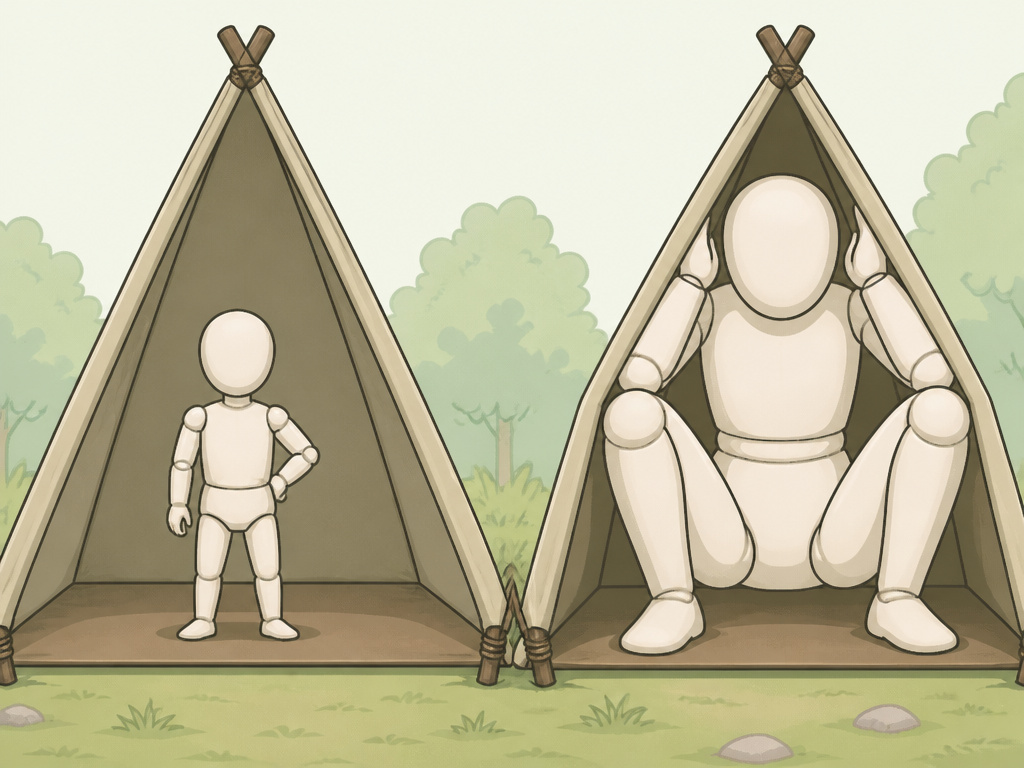
Pathfinder provides the clearest rules. The Advanced Player’s Guide (page 183) lists tent prices and capacities as game items. These are not suggestions—they are mechanical definitions.
A Small tent costs 10 gp and holds one Medium creature. A Medium tent holds two, a Large tent holds four, and a Pavilion tent holds ten. The pavilion’s capacity assumes a fire pit or similar large item is inside; without one, it can hold more.
The system is abstract. A “Small tent” doesn’t mean a tent for Small creatures. It means a tent with the game-item property “Small,” which holds one creature of size Medium. This is a classic case of game terminology overriding literal description.
| Tent (Pathfinder RPG) | Cost | Official Capacity (Medium creatures) | Comfortable Real-World Capacity |
|---|---|---|---|
| Small Tent | 10 gp | 1 | 1 (cozy for one with gear) |
| Medium Tent | 15 gp | 2 | 1 (or 2 with no gear) |
| Large Tent | 30 gp | 4 | 2–3 (with gear) |
| Pavilion Tent | 100 gp | 10 | 6–8 (without central fire pit) |
The comfortable real-world capacity column is where the disconnect happens. A Pathfinder Large tent is supposed to sleep four Medium characters. In the real world, a tent marketed for four people typically fits four 20-inch sleeping pads with no room for anything else. Backpacks, loot, and personal space push the comfortable number down to two or three. This is why experienced campers always advise sizing up.
TL;DR: Pathfinder tents are game items with fixed capacities. A “Small tent” holds one Medium creature, not one Small creature. To match real comfort, treat the game’s capacity as a maximum, not a recommendation.
The 5e Rules for Small Creatures (It’s Not About Size)
Dungeons & Dragons 5e is silent on tents. The Player’s Handbook has no tent item with a defined capacity. This leaves you with real-world physics and a few relevant creature-size rules.
In 5e, both Small and Medium creatures occupy a 5-foot square in combat. A halfling takes up the same floor space as a human. The differences are in carrying capacity and movement.
Small creatures can carry as much as Medium creatures. They can also move through the space of any creature that is two sizes larger or smaller than themselves. This means a halfling can move through a human’s space, but that doesn’t mean two halflings can occupy the same 5-foot square.
This matters for tents because the limiting factor is floor area, not height. A 5-foot square is 25 square feet. Two creatures need 50 square feet just to stand without touching. Lying down requires about 15 square feet per person. So, while a halfling might be shorter, they still need the same horizontal real estate to sleep.
When choosing a tent in a 5e game, you’re left cross-referencing real-world specs. Many popular two-person backpacking shelters list a floor area around 28-30 square feet. That’s barely enough for two 20-inch-wide pads (40 inches total, or 3.3 feet) placed side-by-side, leaving no aisle. For a party with gear, you’re looking at a three-person tent or larger.
TL;DR: D&D 5e provides no tent rules. Small and Medium creatures need the same floor area. Use real-world tent dimensions and the 15 sq ft per person rule to decide what fits.
The Real-World Math: Sleeping Pads and Floor Area
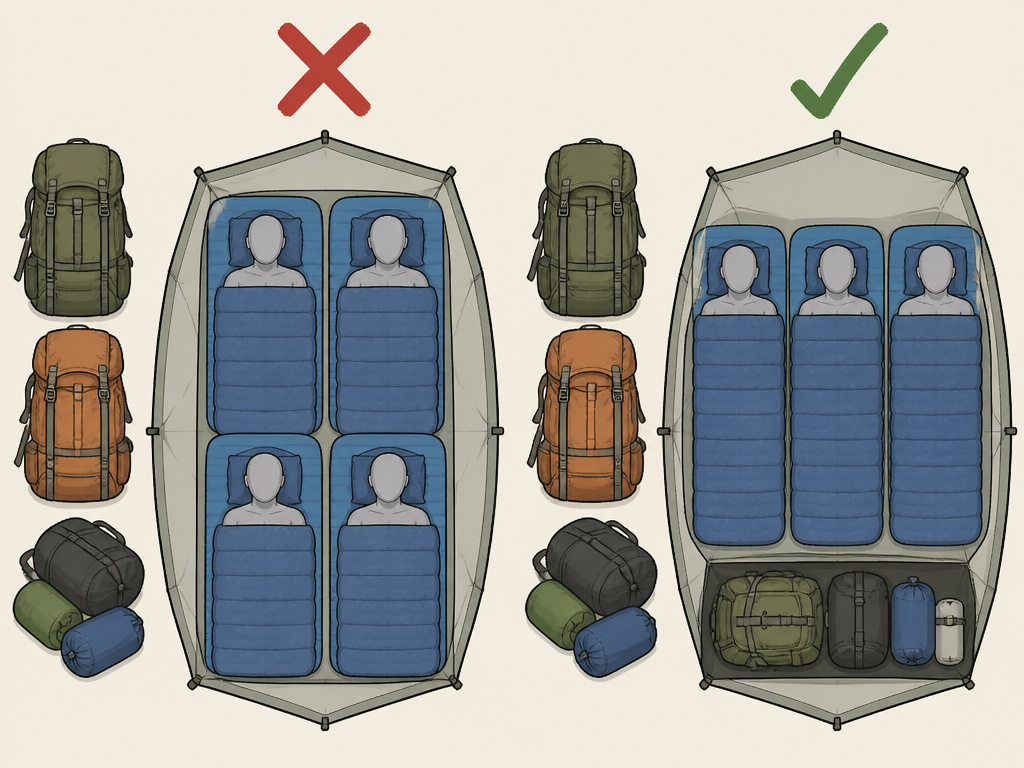
Game abstractions meet reality when you unroll a sleeping pad. This is where the “person” rating of a tent falls apart.
A standard regular-width sleeping pad is 20 inches across. A wide pad is 25 inches. Manufacturers determine tent capacity by lining up the maximum number of 20-inch pads that can fit wall-to-wall on the tent’s floor. No space is allotted for gear, walking, or even turning over without elbowing your neighbor.
Common mistake: Assuming a “4-person” tent sleeps four adults comfortably — it sleeps four 20-inch pads in a grid. Backpacks go in the vestibule or on your feet. In reality, that tent comfortably sleeps two to three people with gear.
Here is the translation from marketing to reality:
| Tent Market Rating | Sleeping Pad Capacity (20″ wide) | Realistic Comfort Capacity (with gear) | Recommended For |
|---|---|---|---|
| 1-Person | 1 pad | 1 person | Solo campers; very tight fit. |
| 2-Person | 2 pads side-by-side | 1 person (or 2 with no gear) | A single occupant with gear, or a very cozy couple using ultralight two-person tents. |
| 3-Person | 3 pads in a row | 2 people | Two people with gear, or three in a pinch. Fits two 25-inch wide pads. |
| 4-Person | 4 pads in a 2×2 grid | 2–3 people | Two people with ample gear, or three without. |
| 6-Person | 6 pads in a 2×3 grid | 4–5 people | A family or small party. |
The formula is simple: Take the manufacturer’s “person” rating and subtract one. That’s your comfortable, gear-included capacity. A 3-person tent for two. A 4-person tent for three.
This math is brutal but honest. It applies directly to your D&D party. If you have four Medium characters, you don’t want a tent rated for four people. You want one rated for five or six. This is why many adventurers might opt for a pavilion tent or multiple smaller shelters.
TL;DR: A tent’s “person” rating is the maximum number of 20-inch pads it can hold. For comfort, subtract one. Four adventurers need a tent rated for five or six people.
Does a Party of Small Creatures Need a Smaller Tent?
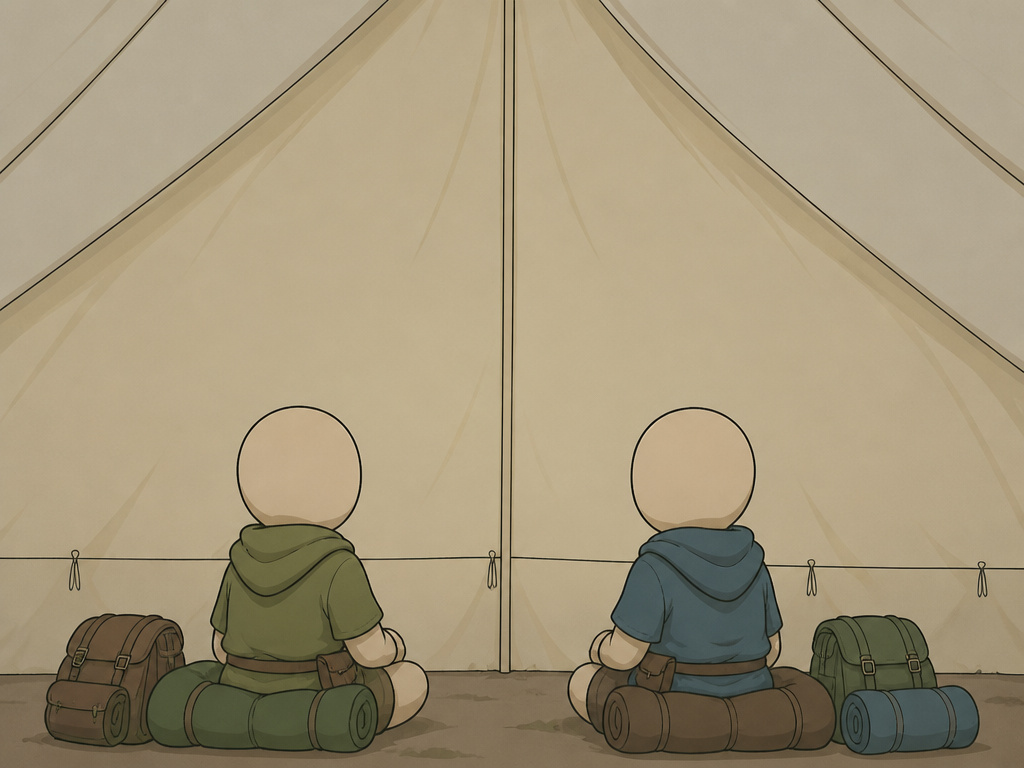
No. A party of four halflings needs the same floor area as a party of four humans. The 15 square feet per person rule doesn’t shrink because the person is shorter.
Where Small creatures get an advantage is in volume and headroom. A tent rated for four humans has a peak height designed for someone around six feet tall. A group of halflings averaging three-and-a-half feet tall won’t use the upper half of that space. This makes the tent feel cavernous and provides extra vertical space for stacking gear, which can free up floor area.
Their smaller stature also means smaller gear. A halfling’s backpack, bedroll, and other essentials are presumably scaled down. This reduces the gear footprint inside the tent. You might fit four halflings and their scaled-down kits into a tent that would only fit three humans with their bulkier gear.
I learned this the hard way packing for a family trip. We used a 4-person dome tent for two adults and two young kids. The kids’ smaller sleeping bags and tiny packs left so much extra room we could have fit a fifth. Floor area was identical, but the freed-up volume changed everything.
However, this is a tabletop role-playing game, not a physics simulator. Most DMs won’t make you calculate the cubic footage of a gnome’s backpack versus a goliath’s. The practical takeaway is this: while the rules don’t grant Small creatures more tent space, a permissive DM might allow a Small party to use a tent one size category smaller than a Medium party would require, on the logic of reduced gear bulk.
TL;DR: Small creatures need the same floor area but less vertical space and smaller gear. A lenient DM might let a Small party use a smaller-rated tent, but by strict rules, they don’t fit more bodies into a given tent.
How to Actually Calculate Your Party’s Tent Needs
Forget the “person” rating on the tag. Use this method instead.
- Count your party members by size. Separate Small and Medium. In both D&D 5e and Pathfinder, both sizes need the same floor area for sleeping.
- Calculate total floor area needed. Multiply your total party count by 15 square feet. This is your minimum floor area for everyone to lie down.
- Example: 2 Medium + 2 Small = 4 creatures. 4 x 15 sq ft = 60 sq ft minimum.
- Add gear buffer. Add 20-30% more area for backpacks, loot, and a modicum of personal space.
- Example: 60 sq ft + 30% = 78 sq ft target floor area.
- Find a tent that meets or exceeds your target area. Compare your calculated number to the tent’s actual published floor dimensions (length x width).
- Apply the Pathfinder item rules if using that system. If you’re in a Pathfinder game, the item’s capacity (Small, Medium, Large, Pavilion) is the final word. A Large tent holds four Medium creatures, period, even if its real-world dimensions could theoretically hold more.
This process sidesteps marketing and focuses on geometry. It also reveals why so many compact tent models feel cramped. A tent with a 28 sq ft floor might be sold as a 2-person model, but 28 sq ft / 15 sq ft per person = 1.87 people. It’s mathematically a 1-person tent with a guest.
Common mistake: Choosing a tent based only on its “person” rating — you’ll end up with a shelter that fits your party like a sardine can. Always check the actual length and width dimensions.
For a party that values comfort and has the gold to spare, sizing up is always the better investment. The weight penalty for a larger tent is often worth the ability to sleep without someone’s elbow in your ribs.
TL;DR: Multiply your party size by 15 sq ft, add 30% for gear, then find a tent whose floor area beats that number. That’s your real capacity.
Frequently Asked Questions
Does D&D 5e have official rules for tent capacity?
No. The 5th edition rules are silent on how many creatures fit in a tent. Capacity is left to DM discretion, typically based on real-world tent sizes and the common-sense principle that every creature needs space to lie down.
Can two Small creatures fit in a space meant for one Medium creature?
Not by the rules. In both D&D 5e and Pathfinder, a space (like a tent spot) that can hold one Medium creature can hold one Small creature. The rules don’t allow stacking or sharing a space based on size alone. However, a DM might rule that a tent described as “cramped for a human” could comfortably fit two halflings.
What is the most cost-effective tent for a standard 4-person adventuring party?
In Pathfinder, a Large tent (30 gp) holds four Medium creatures officially. In the real world, a 4-person tent is miserably tight for four adults with gear. For a balanced approach, a 6-person dome tent or a Pavilion tent offers space for gear and is a better investment for a recurring camp.
Do tents provide insulation against cold?
No. Tents are not insulated. The primary purpose of a tent is to block wind and rain. In cold weather, insulation comes from sleeping bags, pads, and wearing clothes to bed. The main difference with a 4-season tent is its ability to withstand snow load, not to provide warmth.
How do I handle tents for Large or larger creatures?
The rules break down here. A Large creature occupies a 10-foot square (100 sq ft). No standard tent covers that area. You would need a custom pavilion, a magical shelter like Leomund’s Tiny Hut, or the creature sleeps outside. This is a pure DM call.
Before You Go
Tent capacity in tabletop RPGs is a collision of game abstraction and real-world gear logic. Pathfinder gives you firm, simple rules: Small tent for one, Medium for two, Large for four. D&D 5e leaves it to you and your DM to figure out, using the 15-square-feet-per-person rule and the sobering reality of manufacturer ratings.
Small creatures don’t get a mechanical bonus to tent occupancy. Their advantage is situational—less gear bulk, less need for headroom—which a good DM might reward. But when you’re shopping, either in-game or for your own camping trip, ignore the “person” count on the label. Grab a tape measure, do the math, and buy the tent that gives you room to breathe. Your back and your party will thank you.
