
What Is a Hot Tent? The Ultimate Guide to Heated Shelters
This post contains affiliate links. As an Amazon Associate, we earn from qualifying purchases.
A hot tent is a four-season shelter with a specialized, heat-resistant stove jack that allows a wood-burning stove pipe to pass safely through the fabric. This creates a heated interior space for comfortable winter camping. Unlike standard tents, they use breathable materials like canvas or poly-cotton to manage the moisture generated by both the stove and its occupants.
I remember my first night in a hot tent, a borrowed canvas bell tent in the Sierra backcountry. Outside, the wind howled and the temperature plummeted. Inside, my breath fogged in the lamplight as I fumbled with kindling, my fingers numb. Then, the first orange glow from the Winnerwell Nomad stove door. Twenty minutes later, I was peeling off layers, my wet socks steaming on a line strung overhead. That’s the alchemy of a hot tent: it turns a survival scenario into a sanctuary.
But that warmth comes with responsibility. I’ve also seen the aftermath of a poorly managed stove, a friend’s Luxe Hercules 6P with a perfect, pipe-shaped scorch mark on its side where the damper was left open too long. A hot tent isn’t just gear you buy; it’s a system you learn to operate. Let’s break down how they work, what you need to know, and how to stay safe so your winter stories are about cozy mornings, not close calls.
Key Takeaways
- The stove jack is the non-negotiable feature, a reinforced opening that must seal tightly around a scorching hot pipe.
- Draft control is your primary safety tool; a wide-open damper can turn your stove into a forge and your tent into tinder in minutes.
- You must use breathable fabric like canvas or poly-cotton; synthetic nylon traps moisture, leading to a soaking wet interior.
- Active ventilation is mandatory. Always keep a vent or window cracked to feed the fire oxygen and vent deadly carbon monoxide.
- Your setup order is sacred: pitch the tent completely and tension it before you even think about cutting the jack or bringing the stove inside.
How Does a Hot Tent Actually Work?
At its core, a hot tent is a simple yet brilliant hack on camping physics. You bring the fire inside, but you do it safely by engineering a path for its smoke and a way to handle its byproducts.
The stove jack is the linchpin. It’s typically a layered panel of silicone-coated fiberglass or a heavy-duty fabric sleeve sewn into the tent wall or roof. Its job is to create a seal around the 3 to 5-inch diameter stove pipe while resisting temperatures that can exceed 500°F. A poor-quality jack will melt, degrade, or leak.
A hot tent system integrates a wood-burning stove within a breathable shelter via a specialized stove jack. This allows for internal heat generation while managing combustion byproducts and moisture vapor through controlled ventilation and permeable materials like canvas, fundamentally altering the camper’s relationship with cold environments.
The fabric is just as critical. Traditional canvas and modern poly-cotton blends are breathable. They allow the water vapor produced by the stove and your breathing to pass through the fabric before it condenses on the cold interior walls. A non-breathable nylon tent turns into a sauna, and you’ll wake up to a ceiling raining condensation onto your down sleeping bag.
| Component | Its Critical Job | What Goes Wrong If It Fails |
|---|---|---|
| Stove Jack | Seals the pipe; resists extreme heat and weather. | Melts or burns, allowing rain/snow in and breaking the fire barrier. |
| Tent Fabric | Allows moisture vapor to escape (breathes). | Condensation soaks insulation, promotes mold, and creates interior frost. |
| Stove Damper | Controls oxygen flow into the firebox. | Wide open = overfire and tent fire. Closed = smoke backdraft and CO risk. |
| Ventilation | Provides fresh air for combustion and occupants. | Stove dies from lack of oxygen; odorless carbon monoxide builds up. |
TL;DR: The stove jack lets the fire in, the breathable fabric lets moisture out, and your management of the stove’s air intake dictates everything from comfort to catastrophe.
What Are the Different Types of Hot Tents?
Your camping style dictates your tent. Choosing wrong means either lugging a palace on your back or shivering in a closet you drove to.
- Ultralight Backpacking Tents: Think silicone-nylon shells under 5 pounds, like those from Luxe Outdoor or Six Moon Designs. They pair with tiny titanium stoves. Perfect for the solo winter mountaineer moving camp daily, but space and durability are trade-offs. For dedicated options, our review of lightweight hot tents covers the best models for the trail.
- Canvas Bell & Wall Tents: The classic, like a sturdy Tentipi or White Duck. Heavy 10oz army duck canvas is incredibly breathable and durable. These are basecamp tents you drive to, with high peaks and room for a crowd. Ideal for extended hunting trips or group outings where weight is no object.
- Poly-Cotton Blend Tents: A modern sweet spot. Brands like OneTigris and Pomoly use these blends. They’re lighter than pure canvas, more breathable than nylon, and resist mildew. They’re the go-to for car campers who want four-season versatility without the heft of traditional canvas.
- Hybrid Tents with Optional Jacks: Some four-season mountaineering tents offer an add-on stove jack kit. It’s versatile, but the jack is often an afterthought, less robust than a dedicated hot tent’s. It’s a solution for the alpinist who occasionally wants heat, not for someone who plans to use a stove regularly.
| Tent Type | Best Use Case | Primary Limitation |
|---|---|---|
| Ultralight Backpacking | Solo/duo alpine trips where every ounce counts. | Minimal living space; less robust in sustained severe weather. |
| Canvas Bell/Wall Tent | Drive-in basecamps, group trips, maximum durability. | Very heavy (60-100+ lbs); requires careful drying before storage. |
| Poly-Cotton Blend | Car camping with a balance of weight, breathability, and comfort. | Not suitable for true backpacking; less traditional “feel” than canvas. |
| Hybrid (Optional Jack) | Mountaineers needing a primary 4-season tent that can occasionally host a stove. | The stove jack is often the weakest point; not optimized for long-term heat. |
How Do You Set Up a Hot Tent Safely?
This sequence is non-negotiable. I learned the hard way on a blustery November trip with a new Seek Outside Cimarron. Eager to get warm, I started cutting the stove jack before the tent was fully tensioned. When I finally tightened the guylines, the fabric shifted, and the jack was off-center by two inches. My stove pipe ended up angled, resting against the silicone coating, which left a permanent, worrying scorch mark.
Before you start: A wood stove operates at temperatures that can instantly ignite fabric and melt synthetic materials. The primary hazards are 1) Tent Fire from contact with the stove or pipe, mitigated by strict clearance zones and a proper hearth pad, and 2) Carbon Monoxide Poisoning from incomplete combustion, mitigated by constant ventilation and a working CO detector placed at sleeping height.
Step 1: Pitch the Tent Completely on Clear, Flat Ground
Pitch the entire tent and tension all guylines. The fabric must be taut to find the stove jack’s true center point. Choose a site clear of dry grass, pine needles, and overhanging branches. A flat spot is crucial, a sloped floor can cause your stove to tilt, making logs roll dangerously or burn unevenly.
Step 2: Cut the Stove Jack Opening with an ‘X’
The jack panel will have a marked center. Do not cut a circle. Follow the wisdom of seasoned campers: cut a small “X”, just smaller than your pipe’s diameter.
Grab your stove pipe and you’re going to put it on the center of where the stove Jack is… make a small X because once you cut too much you can’t go back… cut away a little bit more… until the stove pipe goes through just like that and what that does because it creates a really tight seal.
Test-fit the pipe. Trim the X arms minimally until the pipe slides through with a snug, friction-fit. This tight seal is your best defense against wind-driven rain or snow sneaking in.
Step 3: Assemble the Stove Outside, Then Place It
Assemble all stove and pipe sections outside to keep ash off your tent floor. Position the stove inside so the pipe rises as vertically as possible through the jack. Maintain the manufacturer’s clearance (often 12-18 inches) from any tent wall. Always use a non-combustible hearth pad, a sheet of aluminum or a dedicated fireproof mat like the one from TMS.
Step 4: Connect the Pipe and Secure the System
Slide the pipe through the jack. Connect all pipe sections, using locking bands to secure them. Attach a spark arrestor cap to the top exterior pipe. This prevents embers from escaping and landing on your tent roof, a critical step often overlooked.
Step 5: Master the Draft Control on Your First Fire
This is the moment of truth. Your stove’s damper, a sliding plate on the door or pipe, controls oxygen flow.
Open the damper fully to light the fire and establish a strong draft. Once you have a good bed of coals and the wood is charred, start closing it down. Your goal is a quiet, subdued crackle.
Just a couple things that are really important safety tips when you’re running a wood stove… you have to control the draft… if you don’t… your stove can get red hot your pipe get red hot and the next thing you know is your tent burned down to the ground.
A roaring, sucking sound means too much air and an overfiring stove. On my Pomoly Dobby stove, I watch my Kidde Nighthawk CO detector. If I see the PPM reading creep above 10, I know I need more air flow; if the fire is roaring, I close the damper. Your first few fires are for learning this balance.
What Are the Absolute Safety Rules?
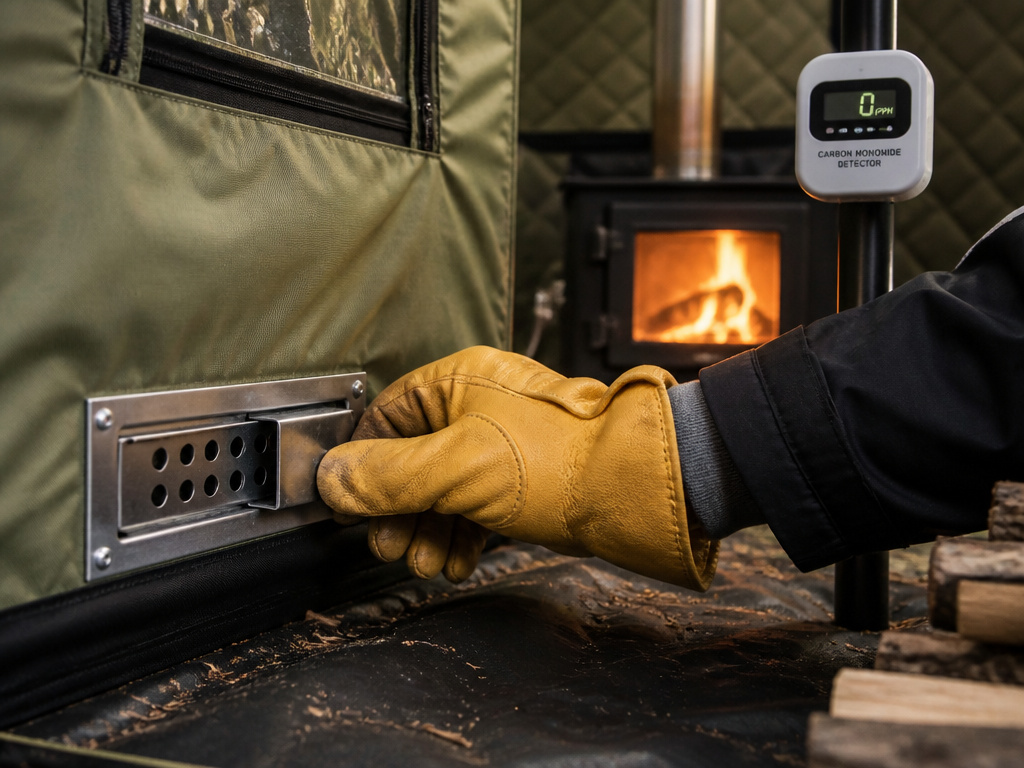
This is where generic advice ends and real-world consequences begin. These rules are written in scorched fabric and close calls.
- Ventilation is a constant requirement. You need an air source for combustion and to vent carbon monoxide. Keep at least one vent or window cracked open, preferably on the side opposite the stove, to create a cross-flow. Your CO detector is a last-resort alarm, not a management tool. I use a Kidde Nighthawk (model KN-COPP-B-LPM) for its digital readout.
- Respect the clearance zones religiously. The stove and pipe get hot enough to cause third-degree burns in seconds. Maintain the stated clearance from tent walls, contact will melt a hole instantly. Keep all gear, boots, and people outside this zone. A spark screen on the stove door is a wise addition to your camping gear essentials.
- Never leave a burning stove unattended. The temptation to run out for more wood is high, but a shifting log or a sudden draft change can send flames where they shouldn’t be. If you leave the tent, extinguish the fire first.
- Use only dry, seasoned hardwood. My go-to is kiln-dried oak or maple. Avoid softwoods like pine, they burn hot and fast but create gummy, flammable creosote that coats your pipe and is a major fire hazard. Never burn treated wood, plywood, or trash.
- Extinguish the fire completely before sleep or departure. Let the stove and ashes cool fully outside the tent. Store cold ashes in a metal container. Going to sleep with a smoldering fire risks carbon monoxide buildup and stray sparks.
Common mistake: Cranking the stove with all vents sealed for maximum heat, within an hour, moisture-saturated air will hit the cold ceiling, condense, and begin dripping on you and your gear. Always maintain a cross-breeze.
How Does a Hot Tent Change the Winter Experience?
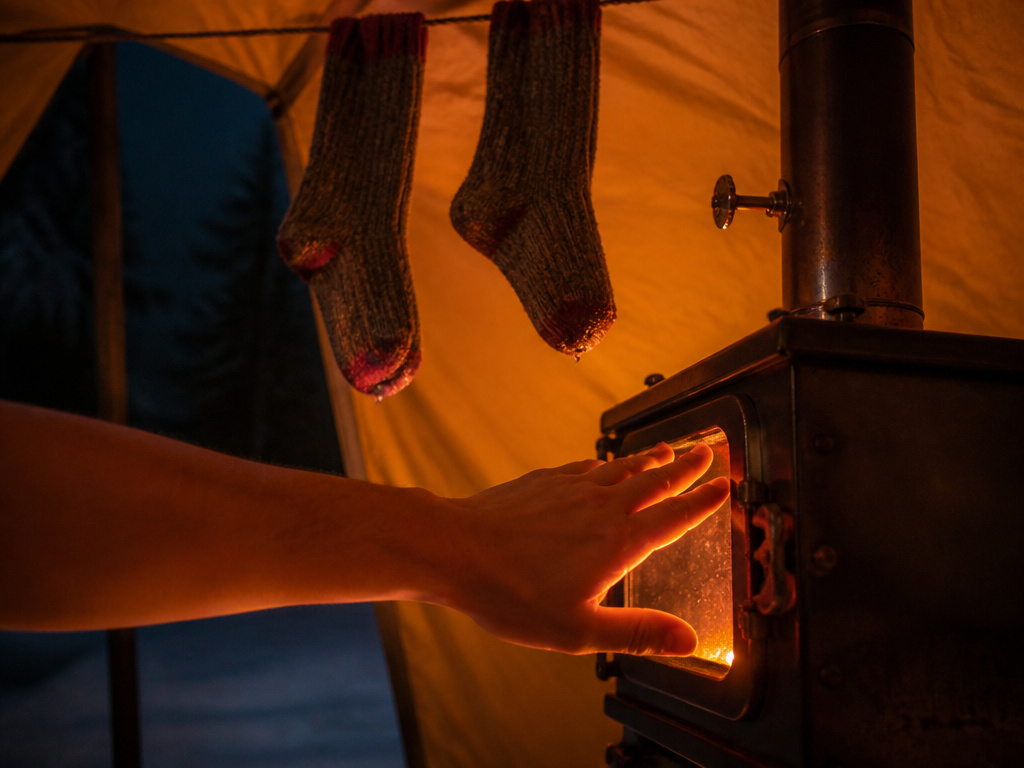
It’s a paradigm shift. Winter camping usually means retreating into your sleeping bag the moment you stop moving. A hot tent flips that script. You’re actively adding heat, changing a defensive posture into an offensive one.
The warmth is dry and radiant. It comes directly from the stove’s metal surfaces. This lets you dry soaked gloves and socks overnight. I’ve woken to my merino wool base layers stiff and crackling dry. You can cook a proper meal inside, change clothes without a frantic dance, and simply live in the space.
The psychological boost is immense. After a long day of breaking trail in a freezing wind, the ability to retreat to a warm, dry sanctuary transforms the entire trip. It extends your season and your stamina. For those venturing into severe conditions, pairing your heated shelter with reliable storm-worthy tents designed for high winds is a wise strategy for comprehensive protection.
But it demands respect. That cozy heat is generated by a contained fire. Your vigilance is the price of admission. Learning the sound of a correctly damped fire, the smell of different woods burning, and the feel of the tent’s atmosphere is part of the skill.
TL;DR: A hot tent turns winter camping from an endurance test into a comfortable, expansive experience, but it trades passive insulation for active fire management, requiring constant attention and skill.
Frequently Asked Questions
Can you add a stove jack to a regular tent?
Technically, yes, with aftermarket kits. Practically, it’s a terrible idea unless the tent fabric is explicitly rated for high heat (like canvas or poly-cotton). Adding a jack to a standard nylon tent risks melting the fabric and causing a fire. True heated canvas shelters are engineered from the ground up for this purpose.
How warm can a hot tent get?
With a well-managed stove, interior temperatures of 60–75°F are easily achievable while it’s below freezing outside. The limit often comes from wanting to avoid excessive fuel consumption or overheating. Smaller tents heat faster but also cool quicker once the fire dies.
Are hot tents safe from carbon monoxide poisoning?
They are safe only if operated correctly. The three pillars are: 1) Always use a certified CO detector with a fresh battery, 2) Maintain active ventilation at all times, and 3) Ensure your stovepipe connections are tight and your fire is burning efficiently (a smoldering, oxygen-starved fire produces more CO).
What size stove do I need for my tent?
Match the stove’s heat output (usually in BTU/hr) to your tent’s volume. A small backpacking stove like the Winnerwell Flatfold is perfect for a 4-person portable hot tents, while a large canvas wall tent needs a bigger unit like a Guide Gear Stove. A stove too small won’t heat the space; one too large will be impossible to control and will overheat the tent.
Is a hot tent worth the weight and hassle?
For winter camping, absolutely. The comfort, ability to dry gear, and morale boost are transformative. For summer or three-season camping, the extra weight and setup complexity are hard to justify. It’s a specialized tool for a specific season.
How do I maintain a canvas hot tent?
The key is ensuring it’s completely dry before packing it away long-term. Never store a damp canvas tent, as mildew will destroy it. If you pack it up slightly damp, hang it to dry fully at home as soon as possible. Periodically treat the seams and fabric with a waterproofing agent designed for canvas.
The Bottom Line
A hot tent redefines winter. It turns a season of endurance into one of exploration, offering a warmth that feels earned and deeply satisfying. But that reward is built on a foundation of knowledge and respect. The stove jack is just a hole; the real magic, and the real risk, lies in your understanding of draft, ventilation, and clearance.
Start with the mechanics. Practice setting up your stove and managing a fire in your backyard before you head into the backcountry. Invest in the right safety gear: a quality CO detector like the Kidde Nighthawk, a fire extinguisher, and a proper non-combustible hearth pad. Your choice between a rugged canvas camping tent and a modern synthetic blend should hinge on whether you’re car-camping or backpacking.
The reward is undeniable: sipping coffee from your cot as dawn breaks on a frozen lake, your gear dry and your spirits high, all thanks to a well-tended fire inside your shelter. It’s a timeless way to camp, connecting you to generations of outdoorspeople who mastered the cold not by hiding from it, but by bringing a piece of the hearth with them. For final touches that elevate the experience, from organization to comfort, our curated camping accessory recommendations can help you build the perfect winter kit.
