
What Is A Tent Made Of | The ISO 5912 Specs That Matter
This post contains affiliate links. As an Amazon Associate, we earn from qualifying purchases.
A tent is made of three primary components: a shell fabric (nylon, polyester, or canvas), a structural frame (aluminum or fiberglass poles), and a waterproof coating (silicone or polyurethane). The specific material grades, like 70-denier nylon with a 5,000mm hydrostatic head coating, are dictated by international standards like ISO 5912, which categorize tents by weight and weather performance.
Most buyers get this wrong. They see “waterproof” and think a monsoon won’t touch them, or see “lightweight” and assume it’s just as tough as the heavier model. The real story is in the fabric’s tear strength, the coating’s thickness, and the pole’s alloy, numbers most spec sheets hide in the fine print.
This guide decodes those numbers. We’ll walk through the ISO 5912 standard that defines what “all-weather” actually means, compare common fabrics head-to-head, and show you how to spot a quality shelter before you ever pitch it.
Key Takeaways
- The ISO 5912:2020 standard is the global blueprint, splitting tents into weight categories (A/B) and three performance levels that dictate fabric tear strength and waterproofing.
- Nylon stretches and absorbs water, making it strong but heavier when wet. Polyester holds its shape and dries fast, but can be less tear-resistant at the same denier.
- A hydrostatic head rating under 1,500mm is for sunshades. True rain protection starts at 3,000mm, and expedition tents hit 10,000mm or more.
- Pole material matters more than count. A 9mm diameter aluminum 7001-T6 alloy pole withstands more force than a thicker, cheaper fiberglass one.
- Seam sealing is non-negotiable. An unsealed seam is a guaranteed leak path, regardless of the fabric’s waterproof rating.
The ISO 5912 Fabric Specs Decoded
Forget marketing terms like “expedition-ready.” The real measure of a tent’s guts is the International Organization for Standardization’s document ISO 5912:2020. This isn’t a suggestion, it’s the engineering rulebook manufacturers follow, whether they advertise it or not. It defines everything from how much force a stitch must hold to how many Pascals of water pressure the fabric must resist before leaking.
The standard first splits tents into two categories by weight. Category A tents are lightweight, clocking in at 2.5 kilograms or less per sleeping berth. Category B tents are heavier. Then, it assigns one of three performance levels that dictate the required material specs.
According to ISO 5912:2020, a Level 1 tent fabric (for fair weather) must resist a tear force of at least 10 Newtons. A Level 3 tent (for mountaineering) must resist 25 Newtons, that’s two and a half times the strength for the same thickness of material.
Level 1 is for infrequent, fair-weather use. The fabrics are lighter, with minimum tear resistance and waterproofing. Level 2 handles moderate weather and poor conditions, but not extremes. Level 3 is the benchmark for all-weather, expedition, and mountaineering tents. The jump from Level 2 to Level 3 is where you see the biggest spec increases, and price jumps.
Here’s how those levels translate to the numbers on a hypothetical spec sheet for a Category B, Level 3 tent outer shell:
| Property | Test Method | Minimum Requirement (Cat. B, Level 3) | What It Means For You |
|---|---|---|---|
| Tear Resistance | ISO 13937-2 | 25 N (uncoated fabric) | The force needed to start a rip. 25N means a small snag from a branch is less likely to become a giant tear. |
| Breaking Strength | ISO 13934-2 | 500 N | The force needed to pull the fabric apart. 500N is substantial—it’s about the weight of a full keg of beer. |
| Water Resistance | ISO 811 | 30,000 Pa (~3,000 mm) | The water pressure the coating can withstand before leaking. 3,000mm handles heavy, wind-driven rain. |
| Cold Crack Resistance | ISO 4675 | No cracks at -10°C | The plastic window material won’t become brittle and shatter in freezing temperatures. |
TL;DR: ISO 5912 Level dictates real durability. Level 1 fabric tears at 10N of force; Level 3 fabric holds until 25N. Always check which level a tent is built to, not just its marketing category.
Tent Fabric Showdown: Nylon vs. Polyester vs. Canvas
You have three main contenders for the shell, and the best pick isn’t about “quality”, it’s about the trade-off you’re willing to make between weight, strength, and weather behavior.
Nylon (usually Nylon 6 or Nylon 66) is the go-to for backpacking and high-performance shelters. Its fibers stretch, which gives it incredible tear strength for its weight. That elasticity also helps it absorb impact energy from wind gusts without failing. The catch? Nylon absorbs water. A nylon tent left in the rain will gain weight as the fibers soak it up, and it will sag. You must re-tension the guylines after a downpour.
Polyester doesn’t stretch like nylon. It holds its shape when wet, so it won’t sag and doesn’t require retensioning. It also dries faster and is generally more resistant to UV degradation over long seasons in the sun. The trade-off is that, at the same denier (fiber thickness), polyester can be slightly less tear-resistant than nylon. It’s the choice for family car-camping tents and many three-season models where consistent performance in humid or wet conditions is key.
Canvas (typically cotton or poly-cotton blend) is a different beast. It’s heavy, but it breathes exceptionally well, reducing condensation. It’s also highly durable and naturally resistant to UV. Modern canvas tents often use a poly-cotton blend, which adds mildew resistance and reduces the soaked-weight problem of pure cotton. These are the shelters for base camps, long-term stays, and overlanders who aren’t counting grams.
Common mistake: Choosing a tent based only on “denier” (D). A 70D polyester is not equivalent to a 70D nylon in stretch or strength. Denier measures fiber thickness, not material science.
The Science of Staying Dry: Coatings and Ratings
The fabric is just the canvas. The waterproofing is the paint. Almost all tent fabrics are inherently water-permeable. Keeping you dry is the job of a coating applied to the underside or, in the case of silicone, sometimes both sides.
There are two main coating types. Polyurethane (PU) is the common, cost-effective option. It’s applied as a liquid layer. Silicone is the premium choice. It’s typically applied to the outer side of the fabric (siliconized nylon, or “silnylon”) and creates a harder, more durable water-repellent finish that also increases tear strength.
The measure of a coating’s effectiveness is its Hydrostatic Head (HH) rating, measured in millimeters. Imagine placing a vertical tube over a piece of coated fabric and filling it with water. The HH rating is the height of the water column it supports before water droplets push through. A higher number equals better resistance to prolonged, pressurized rain.
- < 1,500 mm: Suitable for sun shelters, very light breeze blocks. Will leak in sustained rain.
- 1,500 – 3,000 mm: Standard for three-season tents. Handles average rainfall.
- 3,000 – 5,000 mm: Good for extended trips and known wet climates.
- 5,000 – 10,000+ mm: Expedition-level. For storm conditions where wind drives rain against the fly with significant force.
The ISO 5912 standard uses Pascals (Pa). The conversion is roughly 1 mm = 9.81 Pa. So its Level 3 requirement of 30,000 Pa translates to about a 3,000 mm hydrostatic head. This is the benchmark for true waterproof tents you can trust in a storm.
TL;DR: A silicone coating outperforms PU in durability and tear strength. For real rain, ignore any tent with a hydrostatic head rating under 3,000mm.
Poles, Clips, and the Bones of Your Shelter
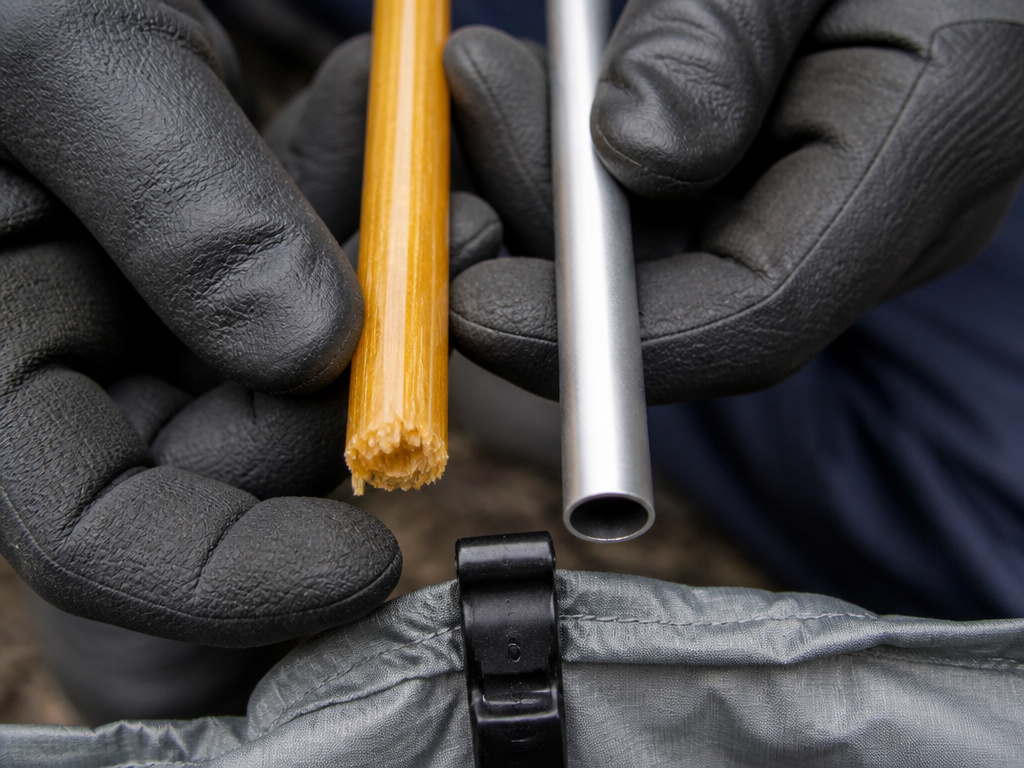
The fabric keeps the weather out. The poles determine whether your tent stays upright. The two common materials are fiberglass and aluminum alloy.
Fiberglass poles are inexpensive and flexible. They’re common on entry-level tents. They’re also heavier for their strength and can splinter if over-stressed, creating dangerous shards. Aluminum alloy poles, specifically grades like 7001-T6 or 6061, are the professional standard. They are stronger, lighter, and more durable. They bend under extreme load instead of snapping, and can often be field-straightened in a pinch.
Pole diameter matters. Thicker isn’t always stronger if the material is inferior, but as a rule, a 9mm aluminum pole is far more resilient than an 11mm fiberglass one. The connection system is equally important. Sleeves (fabric tunnels the poles slide through) offer the most stable, aerodynamic pitch. Clips are faster to set up and allow for better airflow between the fly and inner tent. High-end wind-resistant tents often use a hybrid system for maximum stability.
The Chinese national standard GBZ27735-2022 outlines similar requirements for tent poles, emphasizing bending strength and corrosion resistance, which mirrors the intent of the international standards.
Stitching It All Together: Zippers, Seams, and Floors
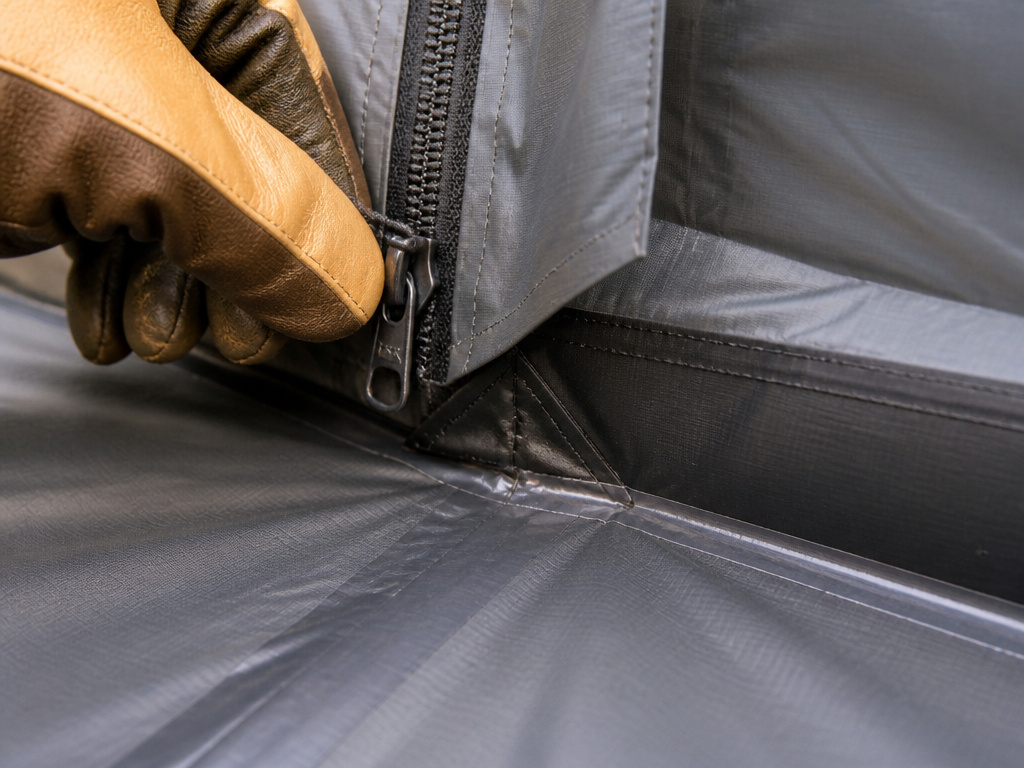
The best fabric and poles are let down by bad details. This is where cheap tents fail first.
Zippers are a major point of friction and failure. Look for brand names like YKK. Coil zippers are lighter and more flexible than tooth zippers, but can be harder to operate with cold, wet hands. A storm flap, a fabric cover over the zipper track, is essential for storm-worthy shelters to prevent wind-driven rain from sneaking in.
Seam sealing is non-negotiable. Every needle hole is a potential leak. Factory tape-sealed seams (where a waterproof tape is heat-applied over the stitch line) are best. Some tents come with seams that need to be sealed by the user with a liquid sealant, a messy but critical task if you want to stay dry.
The floor material is often a heavier, more durable fabric than the walls. ISO 5912 specifies its own puncture resistance test (10N to 20N). A bathtub floor, where the floor material curves up the sides, is the gold standard for preventing ground water ingress. The floor’s hydrostatic head rating is often higher than the walls; expedition tents may have floors rated up to 10,000mm.
What Your Tent Is Really Made For: Matching Specs to Use
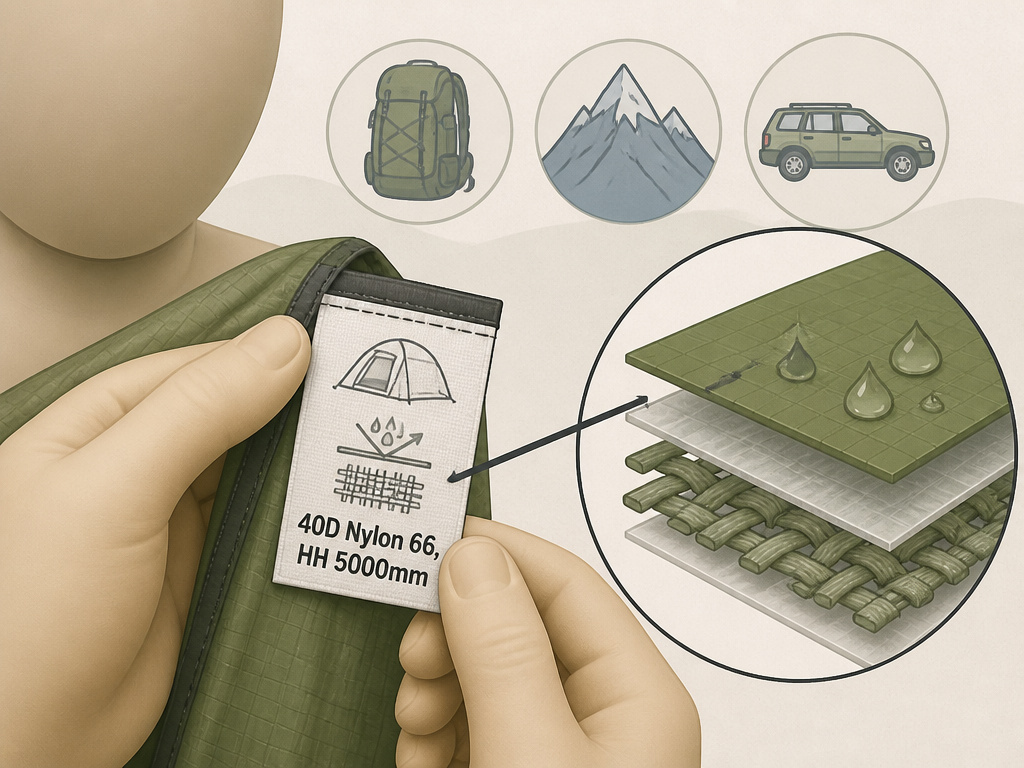
Now you can read the hieroglyphics. A spec that reads “40D Nylon 66, Silicone/PU hybrid coating, HH 5000mm, 7001-T6 8.5mm poles” tells a story. It’s a lightweight, strong, storm-ready backpacking tent.
Use this framework to match a tent to your actual needs:
- Backyard / Festival: Polyester, PU coating (~1,500mm HH), fiberglass poles. Weight and compactness are low priorities.
- Weekend Backpacking: Nylon or polyester, silicone or PU coating (3,000mm HH), aluminum poles. Balance weight and weather protection.
- Through-Hiking / Ultralight: Ultra-high-denier nylon or Dyneema Composite Fabric, silicone coating, minimal pole structure. Every gram is scrutinized. Our guide to ultralight tent fabrics details the extreme materials used here.
- Mountaineering / Winter: Robust nylon or polyester, silicone coating (5,000mm+ HH), robust aluminum pole system, full-coverage fly. This is ISO 5912 Level 3 territory.
- Base Camp / Overlanding: Canvas or poly-cotton blend, often with features like a stove jack material for a wood stove. Durability and comfort trump weight.
Brands often specialize. Naturehike tent fabrics typically offer solid silicone-coated nylon at a value price. Marmot tent construction frequently uses premium materials and meticulous detail work, reflected in the cost.
Frequently Asked Questions
What is the most durable tent material?
For long-term durability against abrasion, UV, and weather, a heavy-duty poly-cotton canvas is toughest. For high strength-to-weight ratio, silicone-coated nylon (like 70D Nylon 66) is the most durable backpacking fabric. Durability always depends on the specific denier and coating, not just the base material name.
Is a higher denier (D) always better?
Not necessarily. Higher denier means thicker, heavier fibers and a more durable fabric, but also more weight. A 20D silicone-coated nylon can be more tear-resistant than a 40D uncoated polyester. The coating and weave (like ripstop) matter as much as the denier number.
Can a tent be 100% waterproof?
Technically, no fabric is 100% waterproof indefinitely under all conditions. Waterproof ratings (hydrostatic head) measure resistance under specific pressure. A well-built tent with a 5,000mm HH coating, taped seams, and a bathtub floor is functionally waterproof in even extreme rain, but the term “waterproof” in marketing should always be questioned against the actual mm rating.
How long do tent waterproof coatings last?
polyurethane (PU) coating degrades with exposure to UV, heat, and moisture, often showing signs of sticky delamination after 3-5 years of regular use. Silicone coatings are far more durable and can last the lifetime of the tent with proper care. Re-waterproofing sprays can revive the water repellency (beading) of the outer surface, but cannot fix a failed inner coating.
What’s the difference between water-resistant and waterproof?
Water-resistant means the fabric can repel light, brief rain (like a windbreaker). Waterproof means it has a coating rated to withstand a specific water pressure (like a rainfly). Any tent marketed for camping should have a waterproof rating; if it only says “water-resistant,” assume it’s for sun shade only.
The Bottom Line
Choosing a tent isn’t about finding the “best” material. It’s about understanding the trade-offs encoded in the ISO 5912 specs, the tear strength, the hydrostatic head, the pole alloy. A spec sheet is a promise written in numbers. Ignore the marketing poetry about “conquering the elements.” Look for the 30,000 Pa water resistance, the 25N tear strength, the 7001-T6 pole designation. Those are the signatures of a shelter that won’t just look good in the driveway, but will hold fast when the wind picks up and the rain comes in sideways. Your job is to match those numbers to the worst weather you ever plan to see.
