
What Does Pitching a Tent Mean? Literal & Slang Definitions
This post contains affiliate links. As an Amazon Associate, we earn from qualifying purchases.
To pitch a tent literally means to set up a portable shelter for camping by assembling its poles, attaching the fabric, and securing it to the ground with stakes. The phrase also carries a common slang meaning, referring informally to a male erection. The key to using the term correctly is understanding context, camping talk versus casual, often humorous, conversation.
People get this wrong by assuming the slang meaning is the only one, or by using the slang in a formal or mixed company setting where it creates awkwardness. It’s a classic example of an idiom where the setting dictates everything.
This guide breaks down both meanings with clear examples, walks you through the actual physical steps of pitching a tent, and explains how to navigate the phrase without causing confusion.
Key Takeaways
- The literal meaning involves the physical assembly and securing of a camping tent.
- The slang meaning is informal and refers to a male erection.
- Context is everything: use the literal meaning around campsites and outdoor gear; the slang is for informal, often humorous, settings.
- Misusing the slang, especially in professional or mixed company, leads to immediate social discomfort.
- Knowing how to actually pitch a tent makes the idiom’s origin obvious and grounds the conversation.
The Core Literal Definition
According to the Collins English Dictionary, to “pitch” a tent is to set it up in position for use. This is the original, practical definition. It’s a sequence of physical actions you perform upon arriving at a campsite.
The process involves unpacking your shelter, assembling its skeleton, usually flexible poles, and fixing the structure to the earth. You start with a bag of fabric and end with a secure, livable space.
The literal act of pitching a tent, as defined by primary sources like the Collins Dictionary, is “to set up (a tent) in position for use.” This involves assembling poles, attaching fabric, and securing the shelter with stakes and guylines.
TL;DR: Literally, pitching a tent is the hands-on process of assembling and securing your camping shelter.
The Physical Steps in Detail
The specific steps vary by tent design, but the core sequence is universal. Modern dome or tunnel tents follow this basic pattern.
- Site Selection and Preparation. Find a flat spot clear of rocks, roots, and overhead hazards. Lay out your tent’s footprint or groundsheet. Skipping this step means sleeping on a lump or waking up in a puddle if it rains.
- Lay Out and Assemble. Unroll or unfold the tent body. Connect the pole segments if necessary. For many popular tent models, you then thread the poles through sleeves or snap them into clips on the tent’s exterior.
- Raise the Structure. Insert each pole end into a grommet or socket at the tent’s corner. The tension should make the structure pop up. For stand-up tents or larger family models, you might need a second person to lift a central hub.
- Secure the Base. Attach the tent’s corner loops to stakes. Drive the stakes into the ground at a 45-degree angle away from the tent. This angle provides maximum holding power. In soft soil, push them in by hand or foot. For hard ground, use a mallet or a large rock.
- Add the Rainfly and Guylines. Drape the waterproof rainfly over the tent, aligning the doors. Clip or tie it down. Finally, attach the guylines to the fly’s reinforced points and stake them out. This step is non-negotiable in wind, it keeps the tent from collapsing.
| Tent Type | Key Pitching Difference | Best For |
|---|---|---|
| Pop-Up Beach Tents | Springs open pre-assembled | Quick sun shelter, no stakes needed |
| Backpacking Tents | Ultra-lightweight poles, minimal steps | Hikers minimizing weight and time |
| Car Camping Tents | Multiple poles, larger footprints | Drive-up sites with more space and gear |
| Family Cabin Tents | Vertical walls, complex pole hubs | Groups needing maximum interior room |
The goal is a taut, stable structure. A poorly pitched tent sags, collects rain, and flaps loudly in the breeze. A well-pitched one is weather-ready and quiet.
The Slang Meaning and Its Risks
Outside of camping, “pitching a tent” is widely understood as a humorous or informal euphemism for a male erection, particularly one visible through clothing. The analogy is visual, the raised fabric resembles a tent’s peaked shape.
This meaning dominates casual conversation among friends, in comedies, and online. It’s a slang term, not a medical one.
Common mistake: Using the slang meaning in a context where the literal meaning is expected, like at an outdoor retailer or with a scout troop. The social misstep is instant and memorable. It also doesn’t translate formally; you’d never see it in official documents or medical literature.
The slang usage relies entirely on shared cultural understanding. It’s a figurative leap from a physical action to a physical state. Because of its inherent informality and potential for embarrassment, you must gauge your audience carefully.
I once made the error of asking a mixed group at a community camping workshop if everyone was “ready to pitch their tents.” The awkward silence lasted just a second too long. I now use “set up” or “assemble” when demonstrating gear in public.
TL;DR: The slang refers to an erection. It’s for informal settings only, and misjudging the context guarantees an awkward moment.
How Context Changes Everything
The same three words can mean two utterly different things based on who’s speaking and where.
- At an outdoor store: “Can you show me how to pitch this tent?” → Literal, instructional.
- In a comedy film: “He woke up pitching a tent.” → Slang, humorous.
- On a camping blog: “Learn to pitch a tent in under 5 minutes.” → Literal, educational.
- In teen banter: “Nice tent.” → Slang, teasing.
The setting provides the clarifying information your brain needs to choose the right definition. When the setting is ambiguous, default to the literal meaning to avoid offense. This is especially true when discussing essential camping equipment or planning a trip with new acquaintances.
Why the Idiom Exists and How to Use It
Idioms like this one arise when a common, vivid physical action provides a ready metaphor for something else. Camping is a widespread activity, and the image of a tent suddenly rising is immediately recognizable. The idiom works because the comparison is visually apt.
For English learners, this is a classic example of context-dependent meaning. Your understanding must be flexible.
When to use the literal phrase:
- Any conversation about camping, hiking, or outdoor gear.
- Instructional content (guides, videos, manuals).
- When speaking with park rangers, outdoor guides, or in any official capacity.
When the slang might be appropriate:
- Informal settings among close friends who share that sense of humor.
- In comedic writing or dialogue.
- Almost never in professional, mixed, or unfamiliar social groups.
Common mistake: Assuming everyone in a camping context will know you mean the slang, they likely won’t, and you’ll look foolish. At a campsite, tents are always literal.
If you’re writing or speaking about the outdoors, stick to verbs like “set up,” “assemble,” or “install.” They are unambiguous. Save the idiom for when you are deliberately invoking its double meaning for effect, and you are certain your audience will appreciate it.
A Step-by-Step Guide to Actually Pitching a Tent
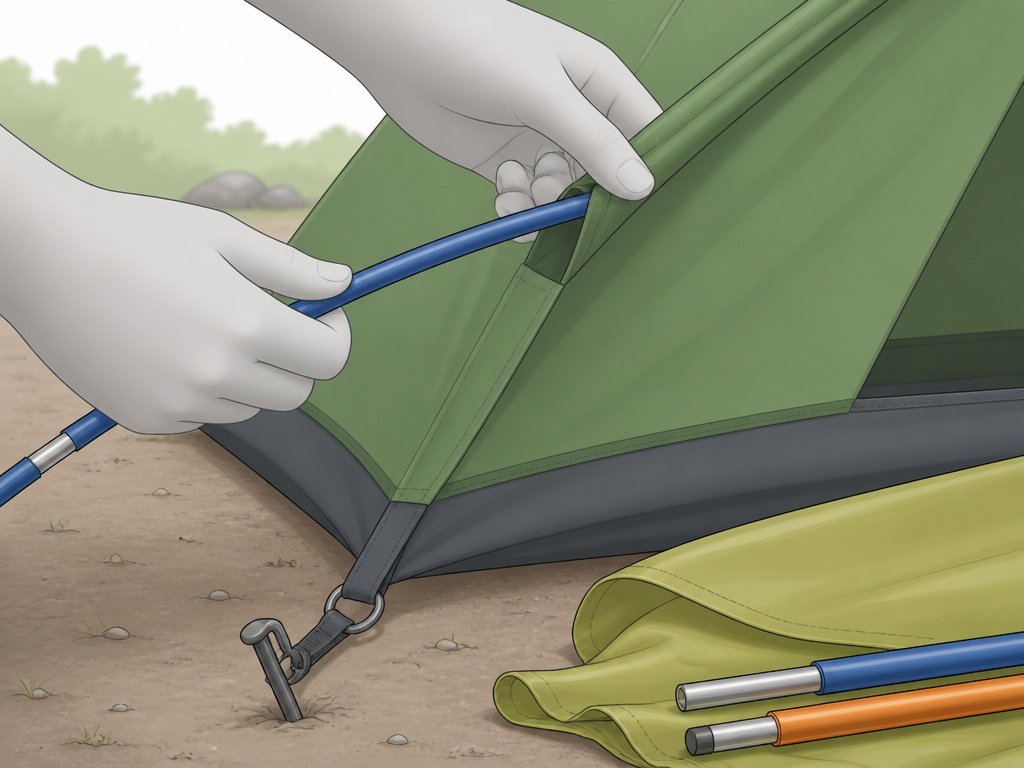
Knowing the physical process demystifies the idiom. Let’s walk through a standard pitch for a modern dome tent, the kind you might take on a weekend trip to Michigan camping sites.
Before you start: Clear your site of sharp objects. Check that all parts are present: tent body, rainfly, poles, stakes, and guylines. Wind can turn a loose tent into a runaway kite, stake a corner immediately if a gust comes up.
- Unpack and Layout. Remove the tent from its stuff sack. Spread the tent body out flat on your chosen site, door facing your desired direction. Unfold the poles.
- Assemble the Poles. Connect the pole segments together. They usually snap or slide into place. Modern poles are often color-coded to match the tent’s attachment points.
- Thread and Raise. Thread each pole through the corresponding sleeve or clip it to the exterior connectors. Gently bend the poles and insert each end into the foot grommet at the tent’s corner. The tent will begin to stand.
- Stake It Down. Pull the tent floor taut and stake out the four corners. Use a rock if the ground is hard. For maximum hold, stakes should be driven fully vertical into most soil types.
- Attach the Rainfly. Drape the rainfly over the erected tent. Align the doors and windows. Connect all the buckles or clips from the fly to the tent body.
- Tension and Guy Out. Adjust the tension on the rainfly straps. It should be snug, not drum-tight. Attach the guylines to the fly’s reinforced points and stake them out at a 45-degree angle. If a tree limb is handy, you can run a guyline over a trekking pole propped against it for superior wind resistance.
- Final Check. Walk around the tent. Ensure no fabric is sagging onto the inner tent wall (this causes condensation). Give the structure a gentle shake, it should feel solid, not wobbly.
Following these steps turns a bag of fabric into a secure shelter. It’s a satisfying skill. For more detailed reviews on specific shelters, from budget tents under $100 to more robust mid-range tent models, check our dedicated gear guides.
Frequently Asked Questions
Is “pitching a tent” always a sexual reference?
No. In outdoor and general contexts, it almost always means literally setting up a camping shelter. The slang meaning is specific to informal, often humorous situations.
What’s the difference between “pitching” and “setting up” a tent?
There is no practical difference. “Pitching” is the traditional term, while “setting up” is more modern and generic. Use them interchangeably when talking about camping.
Can the slang meaning cause offense?
Yes, easily. Using it in a mixed group, professional setting, or with people you don’t know well is risky. It’s considered crude humor. When in doubt, use the literal term or say “set up.”
Where did the slang meaning originate?
It’s a visual metaphor from the mid-20th century, comparing the shape of a taut tent to the visible outline of an erection under clothing. It’s an example of slang borrowing a mundane term for a taboo subject.
How do I teach someone to pitch a tent without it being awkward?
Use clear, technical language. Say “assemble the tent,” “insert the poles,” and “secure the stakes.” Demonstrating the actual steps focuses the conversation on the task, not the idiom.
The Bottom Line
“Pitching a tent” sits squarely at the intersection of practical skill and linguistic nuance. Its literal meaning is a fundamental outdoor task, transforming a pack of nylon and aluminum into a home under the stars. Its slang meaning is a piece of informal, visual shorthand that requires careful contextual handling.
The smart approach is to master the literal. Learn how to efficiently set up your shelter, whether it’s a simple pop-up beach tent or a more complex family camping tent. That knowledge gives you confidence at the campsite and anchors the idiom in reality.
When you hear or use the phrase elsewhere, let context be your guide. Among friends laughing at a comedy, the slang might fit. Everywhere else, especially when your tent camping gear is actually involved, assume the discussion is about poles, stakes, and rainflies. That way, you’re always on solid ground.
