
Tent Shapes Guide: How to Choose the Right Camping Shelter
This post contains affiliate links. As an Amazon Associate, we earn from qualifying purchases.
Tent shape is the three-dimensional form created by its poles and fabric, defining its storm-worthiness, space, and pack size. The five core types are ridge, dome, tunnel, pyramid, and bell. Your choice determines whether you sleep soundly in a gale or spend the night wrestling a flapping, stressed shelter.
Most people shop by capacity or color. I used to do that. Then I spent a miserable night in a borrowed ridge tent on a coastal bluff, listening to every gust threaten to fold the flat walls inward. The shape was wrong for the wind, and no amount of guylines could fix that fundamental engineering flaw.
This isn’t about aesthetics. It’s about matching geometry to geography. We’ll look beyond marketing to the specs that matter, from military arctic standards to humanitarian relief guidelines, so you can pick a shelter that works with the weather, not against it.
Key Takeaways
- Ridge Tents are simple A-frames ideal for fair-weather car camping, but their flat panels are liabilities in wind.
- Dome Tents are the versatile, self-supporting all-rounders, handling wind from any direction, making them the default for three-season backpacking.
- Tunnel Tents offer the best space-to-weight ratio and excel at shedding snow, perfect for basecamping and winter conditions.
- Pyramid Tents are minimalist storm shelters, using a single pole and steep walls to deflect wind and snow with unmatched stability.
- Bell Tents provide palatial headroom and floor space for car camping or glamping, but their vertical walls act like sails in any breeze.
What Are the Fundamental Tent Shapes?
Forget “4-person” or “instant cabin.” Those are features. Shape is the foundation. It dictates how wind flows over the structure, where snow accumulates, and how much usable space you actually get inside your sleeping bag.
According to the official UN agency tent use document, a family shelter must withstand wind speeds peaking at 75 km/h (Force 8) and its fabric must retain 95% of its tensile strength after 1500 hours of UV exposure. A dome or pyramid shape inherently meets these specs by dissipating force; a poorly designed box tent will not.
The Ridge Tent: Simple, Spacious, and Wind-Shy
The classic A-frame is the tent from storybooks. Two vertical end poles support a horizontal ridgepole, creating a triangular prism with steep, flat side walls.
I learned to hate this shape on a beach trip with a vintage canvas model. The forecast predicted 15 km/h breezes. By midnight, a sustained 35 km/h wind was hammering the coast. Each gust hit the tent’s broadside like a slap, causing the entire structure to shudder and groan. I was outside every hour retensioning lines, my hands numb, because the flat walls had no aerodynamic curve to deflect the wind. That’s the trade-off for its simple, spacious rectangle of a floor.
When to Choose One: You’re car camping in a sheltered, forested site with predictable, mild weather. The straightforward pitch and efficient interior volume are genuine perks.
When to Skip It: You expect any significant or shifting wind, are camping above the treeline, or need a quick setup. That large, flat surface area is a fundamental weakness in exposed conditions.
The Dome Tent: The Backpacker’s Trusted Workhorse
Cross two flexible poles over the top of a tent body and you have a dome. This self-supporting, geodesic-inspired shape is the default for modern backpacking tent shapes because it handles multidirectional weather without a fuss.
My trust in this geometry was forged in a 2018 Big Agnes Copper Spur HV UL2. A sudden squall on a Colorado plateau sent spinning, 50 km/h gusts from every direction. The tent just shrugged, its rounded profile presenting no flat face to the wind. The stress did reveal a weakness, though: a permanent 3-inch tear developed along a fly seam where the 10D nylon stretched thin. Now, I look for backpacking tent configurations with 20D polyester flies and bonded, not just sewn, guyline points for better load distribution.
| Shape | Core Strength | Key Weakness | Ideal User |
|---|---|---|---|
| Ridge | Simple pitch, maximum headroom in center | Poor aerodynamics, flat walls catch wind | Fair-weather car camper |
| Dome | All-round weather resistance, fast setup | Can pool heavy snow, less space-efficient | Three-season backpacker |
| Tunnel | Excellent space-to-weight, superb snow shed | Must be oriented into the wind, longer pack size | Winter camper, family basecamper |
| Pyramid | Ultimate storm/wind resistance, minimal weight | Low usable volume near sloped walls | Mountaineer, ultralight purist |
| Bell | Massive interior volume and headroom | Very heavy, poor wind resistance | Glamping enthusiast, drive-up camper |
TL;DR: For versatile, set-it-and-forget-it shelter on most trails, a dome is your safest bet.
Is a Tunnel Tent Just a Long Dome?
Not at all. A tunnel uses three or more flexible poles in parallel sleeves to create a long, arched tube. This design delivers an incredible amount of livable space for its weight and is a champion at shedding snow.
The real magic is in the snow load. On a late-season Sierra trip, I woke to a foot of wet, heavy snow on my Hilleberg Nammatj 3 GT. A dome would have developed a worrying sag. I simply pushed the curved ceiling from inside, and the entire load slid off with a whoomp. That semi-cylindrical profile has no flat spot for accumulation. For families or basecamping, this space efficiency is why tent silhouettes for backpacking often evolve into tunnel designs for larger groups.
Common mistake: Pitching a tunnel tent without orienting it correctly. If you set its broadside to the prevailing wind, it will flap violently and stress the poles. Always point the narrow end into the wind for a quiet, stable night.
The Pyramid Tent: Alpine-Grade Storm Defense
Think of a pyramid tent as the sports car of shelters: incredibly efficient for its purpose, but you wouldn’t want to live in one full-time. A single central pole (often a trekking pole) supports a square or hexagonal sheet of fabric, with the corners staked out to create steep, sloping sides.
This geometry is proven in the harshest conditions. The U.S. military’s MIL-T-12354E specification defines a “pole-supported six-sided pyramidal tent” for arctic use. The steep walls do two things brilliantly: they deflect wind up and over, and they shed snow instantly. The trade-off is livable space. While the floor area is large, the walls slope in so aggressively that you can only sit up in the dead center. For ultralight tent shapes, it’s unbeatable, my Hyperlite Mountain Gear Ultamid 2 weighs under 600 grams without the inner tent.
When It Shines: High-wind environments above treeline, winter mountaineering, or any trip where minimizing weight and maximizing storm resistance are the only priorities.
When It Fails: Trips where you’ll spend rainy days inside or need to use the entire floor area. All that dead space around the edges feels lonely and cold.
Why Are Bell Tents So Popular for Glamping?
A bell tent uses a single central pole to support a conical roof over a circular wall that is nearly vertical. This creates a vast, usable interior where you can stand up almost anywhere, perfect for fitting cots, chairs, and even wood stoves.
That vertical wall is also its Achilles’ heel. It catches wind like a sail. I’ve watched a bell tent in a meadow puff in and out like a bellows in a moderate breeze. In any real wind, every one of its many guy lines must be taut. They are also heavy; traditional canvas models like the Luna Canvas Bell Tents can weigh 40–60 kg, as noted in the humanitarian relief tent manual. This is purely a car-to-campsite shelter.
Best For: Drive-up glamping, festival camping, or any scenario where maximum comfort and space trump all concerns about weight, pack size, or weather exposure.
Worst For: Backpacking, windy coastal or alpine sites, or trips where you can’t dedicate 30 minutes to a perfect, multi-stake pitch.
How Do I Match a Tent Shape to My Adventure?
The right shape isn’t the one with the best marketing. It’s the one that aligns with your primary threat: weather, weight, or space.
Car Camping & Festival Goers
Your shelter travels in the car. Priority goes to comfort, space, and easy setup. Storm performance is a secondary concern for most sheltered campgrounds.
Top Pick: Bell Tent or Large Tunnel. A bell tent is a movable palace. A large family tunnel offers separate rooms and a huge communal area. Both are poor in high wind, but for a wooded or field site, they’re ideal. Be wary of hybrid “cabin domes” with vertical walls, they often lack the reinforced structure to handle the crosswinds they catch.
I made this mistake with a Coleman Instant Cabin. Its near-vertical walls turned it into a wobbly box in a field with 40 km/h gusts. The dome-style pole joints weren’t reinforced for that lateral stress, and I spent the night bracing a corner with my backpack.
Backpacking & Thru-Hiking
Every ounce and cubic inch matters. Your shelter must handle unpredictable mountain weather, set up fast in rain, and not break your back.
Top Pick: Dome or Semi-Geodesic Dome. This is the sweet spot. Modern lightweight two-person tents use sophisticated pole geometries to create a stable, stormworthy shelter under 2 kg. For solo trips, solo tent shapes like a small dome or a trekking-pole pyramid are most efficient. While tunnel tents offer great space, their longer packed length can be awkward on a backpack.
Winter & Severe Weather Camping
The enemies are relentless wind and heavy snow load. Stability and snow shedding are non-negotiable. The official USAP tent specifications for Antarctic deployments focus on these exact traits.
Top Pick: Pyramid or Reinforced Tunnel. A true pyramid is the gold standard for wind deflection. For expeditions where you’ll be confined inside during storms, a robust tunnel tent provides more livable space while still shedding snow effectively. Avoid domes for heavy snow unless they have a very steep pitch.
Ultralight & Fast-Packing
The goal is absolute minimum weight and volume, often sacrificing comfort and bug protection. This is where shelter becomes a system, not just a tent.
Top Pick: Pyramid (Mid) or Tarp. A pyramid tent made from Dyneema can weigh under 500g. The next step is a tarp shelter shape, which is just a shaped piece of fabric. This requires skill and offers no bug protection, but it’s the lightest option. Many ultralight two-person models are minimalist pyramids.
What Technical Specs Separate Good Tents from Failures?
Shape gets you 80% of the way. The remaining 20% is in the details that determine if a well-shaped tent will fail you.
Pole Material is Everything: Aluminum alloy poles (especially 7001-series) flex and rebound. Fiberglass poles snap, often with a sickening pop that means a cold, drafty night. The UNOCHA family tent logistics guide notes that poles most frequently fail at joints and spikes. Look for reinforced joints and continuous pole sleeves that distribute stress along the entire length, not just at clip points.
Floor Area & Real Headroom: Don’t trust “4-person” labels. The humanitarian standard mandates at least 3.5 m² per person. For a true two-person tent, look for at least 7 m². Also, check that at least a third of that area has a head height of 1.8m so you can actually sit up.
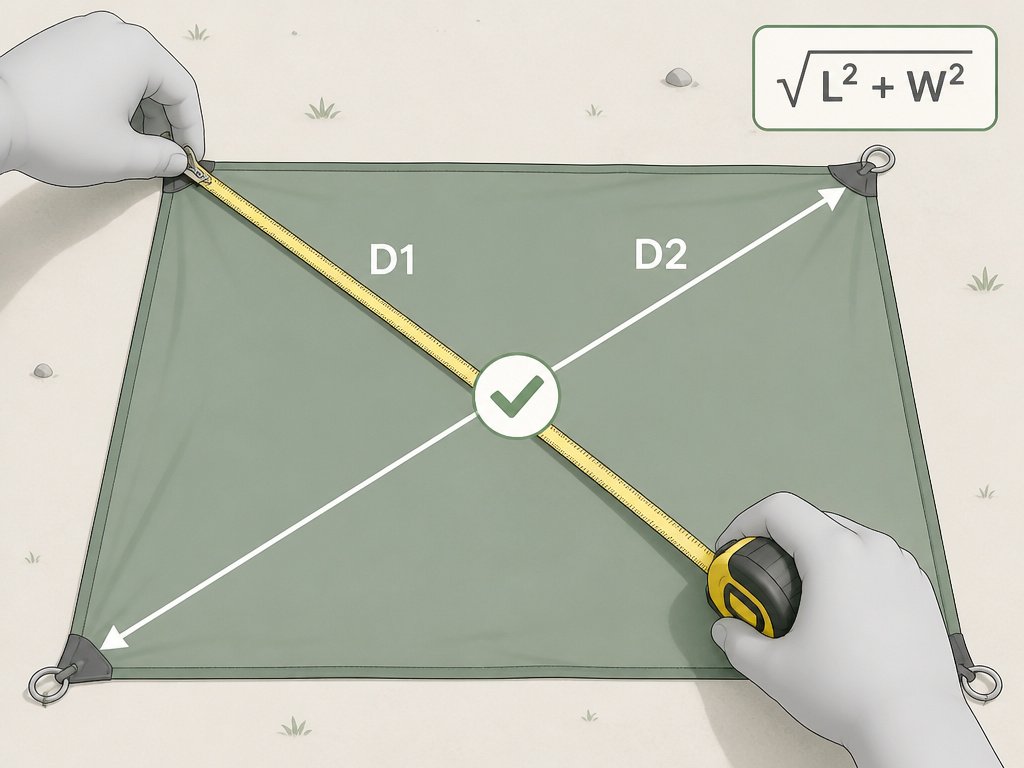
The Forgotten Step: Squaring Your Tent. An un-squared tent handles stress unevenly. The industry tent installation handbook provides the formula: Diagonal = √(Length² + Width²). Measure corner-to-corner both ways and adjust until equal. An un-squared tunnel under asymmetric snow load can buckle a pole at its midpoint, not just at a joint.
- Clear and Flatten Your Site: Remove every rock and pine cone. One forgotten cone under your pad acts as a cold bridge, sucking heat away all night. I learned this the hard way in the Ochocos.
- Lay Out and Orient: Unroll the footprint or tent body. Point the door away from the expected wind or weather.
- Assemble Poles Gently: Feed them smoothly; forcing a bent section can crack it later.
- Raise the Structure: Follow the specific sequence for your shape. For domes, cross the poles. For tunnels, raise one arch at a time.
- Stake Corners, Then Tauten: Stake the four main corners first, pulling the floor taut but not over-tightened.
- Attach the Rainfly: Ensure it’s aligned and not touching the inner tent anywhere, as contact wicks water inside.
- Guy Out Every Line: This is the step everyone skips. Guy lines are primary stabilizers, not just for storms. Attach and tension them all.
- Square It: Use the diagonal formula. A squared tent distributes wind and weight forces evenly across its entire frame.
Before you start: A poorly pitched tent is a safety hazard. In high winds, a collapsed pole can tear the fly, leading to rapid heat loss and wet gear. In snow, an uneven pitch concentrates load, risking a buckle. Always use all provided stakes and guylines.
TL;DR: Stake it, fly it, guy it, square it. Skipping any step turns your shelter into a liability.
Frequently Asked Questions
What is the most stable tent shape for high winds?
true pyramid tent is the most stable. Its steep, sloping sides deflect wind upward, and the single central pole or trekking pole creates a structure with no broad, flat panels to catch gusts. This is why it’s specified in military arctic standards.
Can I use a dome tent for snow camping?
Domes are adequate for light, dry snow. However, heavy, wet snow can accumulate in the center of the curved roof, causing poles to bow dangerously. For serious or prolonged snow camping, a tunnel or pyramid tent is superior because their steeper pitches encourage snow to slide off completely.
What’s the real difference between a tunnel and dome tent?
tunnel tent uses multiple parallel arched poles to create a long tube, offering more usable space per pound. A dome uses crossing poles to create a self-supporting half-sphere. Tunnels excel in space efficiency and snow shedding but must be oriented into the wind. Domes handle wind from any direction and pitch faster.
How much floor space is enough per person?
minimum of 3.5 square meters (about 37.5 square feet) per person is the standard for humanitarian family tents. This allows room for a sleeping pad, personal gear, and minimal movement. For camping tents for two, look for at least 7 square meters.
Why does my new tent leak when it rains?
Waterproof fabric is only one part of the system. Most leaks come from seams, areas where the fly is stretched taut against a stitch line, or, most commonly, when the inner tent touches the fly, which wicks water inside. Also, damp ropes and canvas will shrink when they dry, potentially pulling seams apart if the tent is stored tightly while wet.
Are bell tents good for backpacking?
Almost never. Traditional canvas bell tents weigh 40–60 kg. Even modern nylon versions are bulky and heavy compared to compact tent designs. Their vertical walls are highly susceptible to wind, requiring extensive guying that’s often impossible on a backcountry site.
The Bottom Line
Choosing a tent shape is the most important gear decision you’ll make after selecting your boots. It’s the difference between a shelter that protects you and one you have to protect from the weather.
For most backpackers, a dome remains the versatile, trustworthy choice. If space is your priority for basecamping, look to a tunnel. When the forecast turns severe, trust a pyramid. And if car-camping comfort is the goal, a bell tent can’t be beat. Remember to check the real specs behind the shape, the pole material, the seam sealing, the wind rating. Then, pitch it right. That careful match of geometry to terrain is what turns a piece of fabric into a reliable home under the stars.
