
Can You Bring A Tent On A Plane | The One Rule TSA Misses
This post contains affiliate links. As an Amazon Associate, we earn from qualifying purchases.
Yes, you can bring a tent on a plane in either your carry-on or checked luggage. Tent stakes and poles must go in checked baggage, not your carry-on. The TSA officer at the checkpoint has the final say, and your airline’s size and weight limits override the general permission.
Most people think the TSA’s green light is the only rule. They pack their tent, strap it to their backpack, and walk into the airport. Then the check-in agent points to a loose strap dangling near the conveyor belt. That’s when the real rules start.
This guide walks through the official TSA and FAA regulations, the silent airline policies that catch travelers off guard, and the packing method that gets your gear from the tarmac to the trailhead without a hitch.
Key Takeaways
- Tent stakes are never allowed in carry-on bags—TSA classifies them as potential weapons.
- Strapping a tent to the outside of your luggage risks a mandatory repack; loose straps can jam baggage conveyor systems.
- A camping stove must be completely purged of fuel and cleaned of vapors; some airlines refuse used stoves outright.
- Your airline’s checked bag size and weight limits are the final authority, not the TSA’s general allowance.
- Pack tent poles bundled and wrapped inside your checked bag to prevent them from puncturing the luggage or other items.
What TSA and FAA Rules Actually Say
The rules come from two different agencies with two different jobs. The Transportation Security Administration (TSA) handles security. The Federal Aviation Administration (FAA) handles safety. You need to satisfy both.
According to the TSA’s official item listing, tents are allowed in both carry-on and checked bags. Tent stakes must be placed in checked baggage. Tent poles are generally allowed in either, but the final decision rests with the TSA officer at the checkpoint.
The TSA’s page is your primary source. It was last updated in June 2022, and it’s clear. The FAA’s rules, found in their PackSafe outdoor equipment guide, focus on hazardous materials. Their concern is anything that can generate toxic fumes, start a fire, or explode at altitude. This is where your camping stove becomes a problem, even if it’s empty.
TL;DR: The TSA says yes to tents but no to stakes in carry-ons. The FAA says no to any fuel residue in stoves. Your airline can say no to anything that doesn’t fit their size chart.
The One Rule Almost Everyone Misses
You read the TSA page. You pack your stakes in your checked bag. You think you’re clear. Then you get to the check-in counter with your backpack and a tent strapped to the outside.
This is the mistake.
Airlines operate the baggage conveyor belts that move your luggage. Loose straps, dangling cords, or external attachments are a massive entanglement risk. Systems are designed for smooth, bag-shaped objects, not a web of nylon webbing. From a baggage handler’s perspective, your tent strap looks like a wrench about to be thrown into the gears.
Common mistake: Strapping a tent to the outside of checked luggage — the loose straps catch in conveyor belts, and the airline will require you to repack it on the spot, often into a plastic bag they provide.
Community forums are full of travelers who learned this the hard way. The consensus advice is to either pack the tent inside a larger duffel or use an airport bag-wrap service. Wrapping it in a heavy-duty plastic bag and securing it with duct tape is the field-expedient version. The goal is zero loose parts.
| Packing Method | Risk | Airline Reaction |
|---|---|---|
| Tent strapped outside | High – strap entanglement | Mandatory repack |
| Tent inside main duffel | Low – standard bag shape | Accepted |
| Tent in plastic bag wrap | Low – contained, no loose parts | Accepted (may incur a fee) |
| Tent as a second item | Medium – extra bag fee applies | Accepted if within size/weight limits |
The lesson isn’t about security. It’s about physics. A conveyor belt doesn’t care about TSA rules.
Packing Your Tent for Airport Security
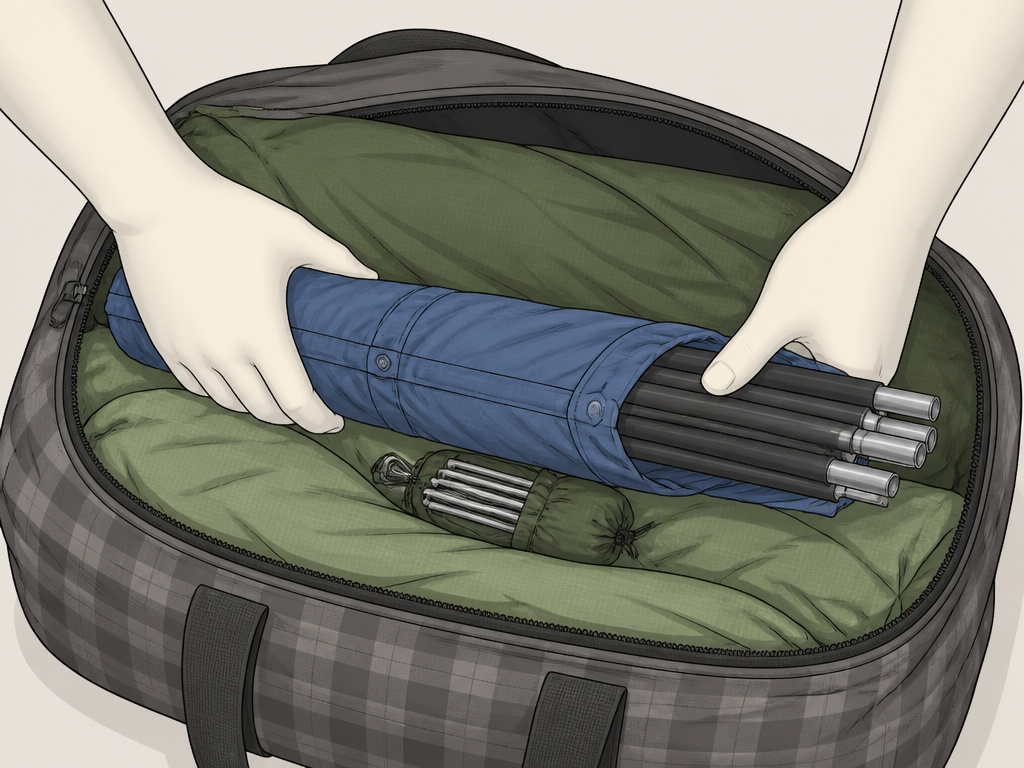
Your goal is to present a single, tidy, compliant package. The method changes based on your tent’s size and your baggage strategy.
For a compact, ultralight backpacking tent, your carry-on backpack is the best place. It stays with you, eliminating the risk of loss. Make sure the packed tent fits within your airline’s carry-on dimensions. Roll it tightly and stuff it at the bottom of your pack. This is the ideal scenario for many solo backpacking tents and lightweight tarp shelters.
For larger two-person backpacking tents or family dome tents, checked luggage is the only practical choice. Here’s the sequence that works:
- Separate the sharps. Gather every tent stake, pole tip, or guylines with metal adjusters. Place them all in the middle of your checked duffel bag, wrapped in a shirt or towel. This isolates them and prevents puncture.
- Bundle the poles. Collapse all tent poles and use a rubber band or zip tie to keep them together. Wrap this bundle in more clothing or a foam sleeve. Place them lengthwise in your duffel.
- Pack the tent body. Stuff the tent fabric, rainfly, and footprint around the pole bundle. This fills dead space and cushions the poles.
- Seal the deal. Close the duffel, ensuring no straps are dangling. If you have external compression straps, buckle them tight so they lie flat.
If your checked bag is already full, consider using a dedicated gear bag like a duffel bag as a personal item for just the tent. Just remember, it will count as your one personal item if you try to carry it on.
TL;DR: Stakes go wrapped in the middle of your checked bag. Poles get bundled and padded. The tent fabric fills the gaps. Nothing dangles.
Navigating Airline Policies and Size Limits
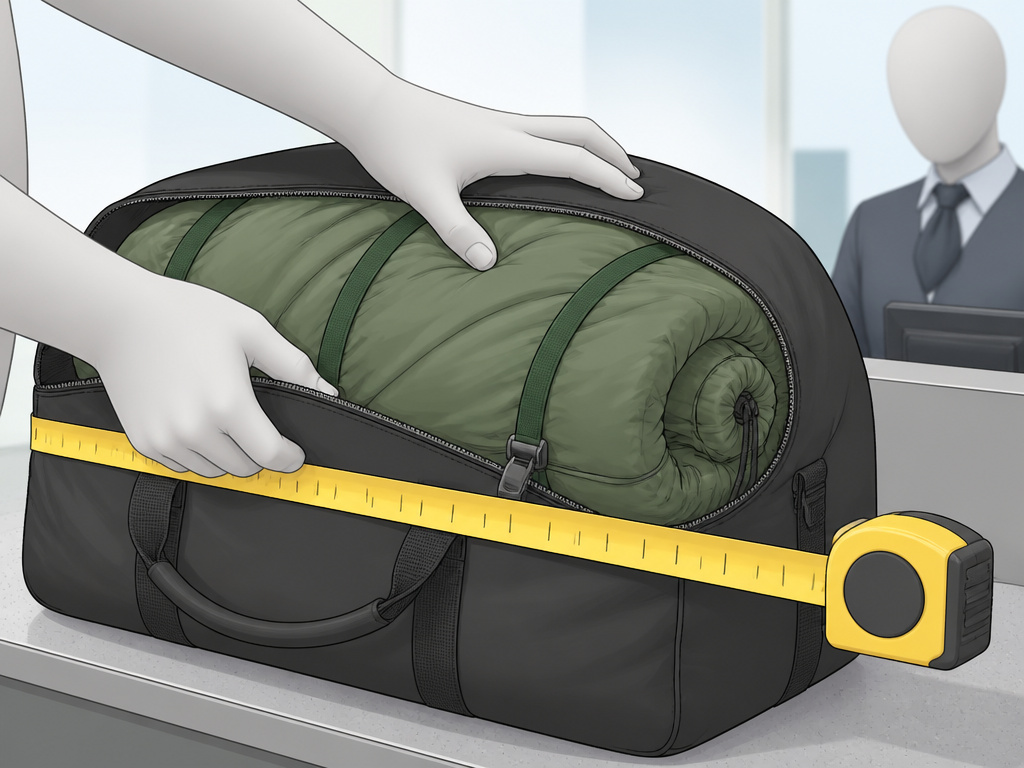
The TSA lets it through security. The FAA clears it as non-hazardous. Then your airline charges you a $100 oversized baggage fee. Their rules are the final gate.
Airlines publish precise dimensions and weight limits for both carry-on and checked bags. A typical U.S. domestic carry-on limit is 22″ x 14″ x 9″. A standard checked bag limit is 62 linear inches (length + width + height) and 50 pounds. Your packed tent must fit within these constraints.
This is where tent design matters. A packed ultralight backpacking tent might be the size of a football. A large family car-camping tent could fill an entire large duffel on its own. Before you fly, check your airline’s website for their “baggage allowance” page. Don’t guess.
I once watched a couple at Denver International try to check a massive canvas tent in a bulky, unpadded bag. It was over the 62-inch limit. The agent made them pay the oversized fee, then watched as they awkwardly tried to re-stuff it into a second, smaller duffel they had in their car. They saved the fee but started their vacation frustrated and late.
Some airlines also have specific policies about sporting equipment. While a tent usually falls under general baggage, it’s worth a call to their customer service if you’re carrying something unusually large or heavy. “Generally allowed” doesn’t mean “free.”
Camping Stoves and Other Hazardous Gear
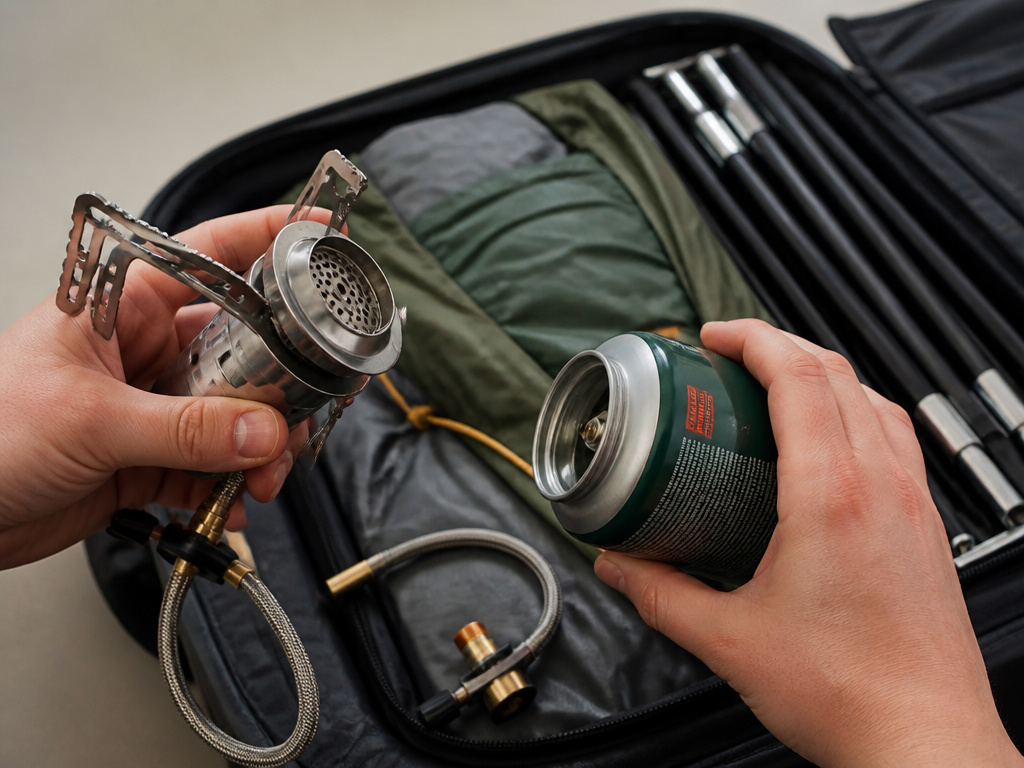
Tents are simple. Camping stoves are where you can get into real trouble. The FAA’s PackSafe document for tents states the rule clearly: stoves and equipment must be completely purged of fuel and cleaned of all vapors or residue.
“Completely purged” means no liquid fuel sloshes inside. It also means no lingering smell of fuel. A TSA officer or airline agent who smells even a faint odor of gasoline or propane can deny the item. They have that discretion.
- Disconnect and empty the fuel canister. For canister stoves, this is easy. Ensure the canister is entirely separate and empty.
- Flush the fuel line. For liquid-fuel stoves, this requires running the stove until it dies from lack of fuel, then disassembling and wiping the fuel tank and lines.
- Air it out. Leave the stove uncapped in a well-ventilated area for a day or two before packing.
The kicker? Some airlines, as noted in the FAA guidance, may not accept used camping equipment that has had fuel in it, even if purged. Their concern is residual vapors. Always check your airline’s specific hazardous materials policy online before you assume your stove is okay.
| Item | Carry-On | Checked Baggage | Critical Rule |
|---|---|---|---|
| Tent | Allowed | Allowed | Must fit airline size limits |
| Tent Stakes | Prohibited | Allowed | Must be securely packed to prevent puncture |
| Tent Poles | Generally Allowed | Allowed | Final decision rests with TSA officer |
| Camping Stove | Prohibited | Allowed if empty | Must be completely purged of fuel and vapors; airline approval may be required |
| Bear Spray | Prohibited | Prohibited | Cannot fly; buy at destination |
| Hiking Poles | Prohibited | Allowed | Must be collapsed and packed |
TL;DR: Your stove must smell like metal, not fuel. If it smells like fuel, it stays home.
Frequently Asked Questions
Can I carry my tent on the plane?
Yes, if it fits within your airline’s carry-on size limits. A compact backpacking tent stuffed into a backpack is fine. Remember, tent stakes are never allowed in your carry-on—they must be in your checked bag.
Where do I pack tent stakes and poles?
Pack them in your checked luggage. Stakes are prohibited in carry-ons. Poles are generally allowed in carry-ons, but a TSA officer can deny them if they deem them a potential weapon. To avoid hassle, check them.
What about fuel canisters for my stove?
Empty fuel canisters are allowed in checked baggage if they are completely purged of all fuel and vapor. In practice, it’s safer and easier to buy fuel at your destination. Full or partially full canisters are strictly prohibited on airplanes.
Can I strap my tent to the outside of my backpack as a checked bag?
No. Loose straps are a major entanglement hazard for baggage conveyor systems. Airlines will likely require you to repack it, either into another bag or into a plastic wrapping they provide (often for a fee).
Do I need to declare my tent at the airport?
No. Tents are not a declared item. However, if you are checking a camping stove, be prepared to answer questions about its condition. It’s wise to have it easily accessible in case security wants to inspect it.
Before You Go
Flying with a tent is straightforward if you follow the hierarchy of rules. The TSA says you can, provided stakes are checked. The FAA says your stove must be spotless. Your airline says everything must fit in their box and not tangle their machinery.
Pack with the baggage handlers in mind. No loose ends. No fuel smells. No surprises at the check-in counter. Then your only worry will be finding the perfect spot to pitch it.
