
Can You Use a Tent on the Beach? Understanding Key Regulations
This post contains affiliate links. As an Amazon Associate, we earn from qualifying purchases.
Most beaches allow tents and shade shelters during daylight hours, but overnight camping is almost always banned outside designated campgrounds. The real restrictions are about precise size limits, seasonal bans, and strict sunset curfews. A tent that’s legal in Nags Head could earn you a fine just miles away in North Myrtle Beach.
I’ve lost count of the confused families I’ve seen on the sand, halfway through setting up a gorgeous canopy, only to have a lifeguard politely tell them to take it down. Their faces fall. They spent good money on that shelter, packed it carefully, and now their beach day is starting with a frustrating takedown in the hot sun. It happens because beach tent rules are hyper-local, often counterintuitive, and buried in municipal PDFs.
This isn’t a vague guide. We’re going to walk through the exact, sourced regulations from major beach destinations, using the official documents. You’ll learn how to decode the three numbers that matter most and pick a shelter that provides shade without the citation.
Key Takeaways
- Local ordinances trump everything. Rules can change every time you cross a town line. Always search for “[Your Beach Name] beach regulations” before you pack.
- Size is the first checkpoint. Limits are precise: Gulf Shores enforces a strict 7’x7’x4’ rule, while Nags Head allows up to 12’x12’x10’.
- Seasonal bans are absolute. From May 15 to Labor Day, North Myrtle Beach prohibits all tents, tarps, and cabanas. Myrtle Beach restricts shade to umbrellas under 7.5 feet during the same period.
- Overnight means abandoned. Equipment left after sunset (often just one hour after) will be removed and discarded. You won’t get it back.
- Private property can be a loophole. If you rent a beachfront house, the sand directly in front may fall under the owner’s rules, not the city’s—but you must confirm this.
What Are the Most Common Beach Tent Rules?
People search for a simple yes or no. The reality is a checklist of conditions that vary wildly by location. The foundational rule across almost all public beaches is that overnight camping is prohibited. Your tent is for daytime shade only.
Beach tent regulations are primarily municipal ordinances focused on public safety, equitable access, and conservation. They govern structure dimensions, seasonal availability, and time-of-day use to prevent obstructions, protect wildlife, and manage crowded spaces.
The core regulations you must verify fall into three buckets: dimensional limits, seasonal/time-of-day restrictions, and rules about unattended gear. Ignoring any one of these is the fastest way to have your day interrupted. For example, the popular Neso Grande tent, at 9’x9’, is a fantastic shelter, but it’s immediately illegal on any beach with a 7’x7’ limit. You need to match your gear to your destination’s specific code, not the other way around.
TL;DR: Never assume “beach tent” equals “allowed.” Your first stop should always be the official city or park website.
How Do Size and Dimension Limits Work?
This isn’t a suggestion. It’s a measurement enforced by beach patrol, sometimes with a tape measure. The limits exist because large structures block lifeguard sightlines and monopolize prime sand.
Let’s look at the hard numbers from official sources:
| Beach Destination | Max Footprint (Area) | Max Height | Key Seasonal Note | Source of Rule |
|---|---|---|---|---|
| Gulf Shores, AL | 7 ft x 7 ft | 4 ft | Year-round on public beaches | City of Gulf Shores rules |
| Myrtle Beach, SC | 7.5 ft diameter (umbrella only) | Not specified | Memorial Day to Labor Day | City Shading Device Policy |
| Nags Head, NC | 12 ft x 12 ft | 10 ft | Structures must be 10 ft apart | Nags Head beach FAQ |
| Assateague Island NS | Varies by campsite | Varies | Permitted in designated campgrounds only | NPS beach regulations document |
The table reveals a critical point: a tent legal in one town is contraband in another. Myrtle Beach’s peak-season rule is particularly tricky—only umbrellas under 7.5 feet are allowed. That means even a compact pop-up beach tent is prohibited during the summer, unless it’s a specific “infant tent” under 4’x3’x3’.
Common mistake: Trusting a product’s “beach” label. I once brought a “beach cabana” that was 7’10” square to Gulf Shores. The 10-inch overage was enough for a warning. I now physically measure my gear and write the dimensions on the bag with a marker.
When shopping, you must prioritize footprint and peak height. For restrictive beaches like Gulf Shores, your only real options are a standard umbrella or a very small shade shelter. For more lenient zones, a family beach shelter or a spacious beach tent under 12×12 feet could work.
What Are Seasonal Bans and Daylight-Only Curfews?
The calendar is as important as your tape measure. Many popular destinations impose stricter rules during the peak summer months when crowds are largest.
- North Myrtle Beach, SC: From May 15 through Labor Day, tents, tarps, cabanas, pavilions, and sports-brellas are not allowed on the beach. Full stop.
- Myrtle Beach, SC: From Memorial Day to Labor Day, the umbrella-only rule (7.5 ft diameter max) is in effect.
- Virginia Beach, VA: It is unlawful to have any tent or structure on the beach between 8:00 p.m. and 8:00 a.m. without a permit.
These rules are designed for crowd control and safety. A 10×10 canopy that’s fine for a sparse spring weekend becomes a major obstruction on the Fourth of July.
Before you start: Leaving a tent unattended overnight creates two major hazards. First, high winds can turn it into a dangerous projectile. Second, it can obstruct morning beach cleaning and critical sea turtle nesting surveys. The removal policies are for everyone’s safety.
The sunset curfew is non-negotiable. In Gulf Shores, equipment left one hour after sunset is considered abandoned and will be “removed and disposed of.” Nags Head prohibits unattended gear from 8 p.m. to 6 a.m. This isn’t a gentle suggestion; beach patrols do rounds with trucks to clear the sand. Your expensive beach camping gear will be gone.
Can You Use a Tent on Private Beach Property?
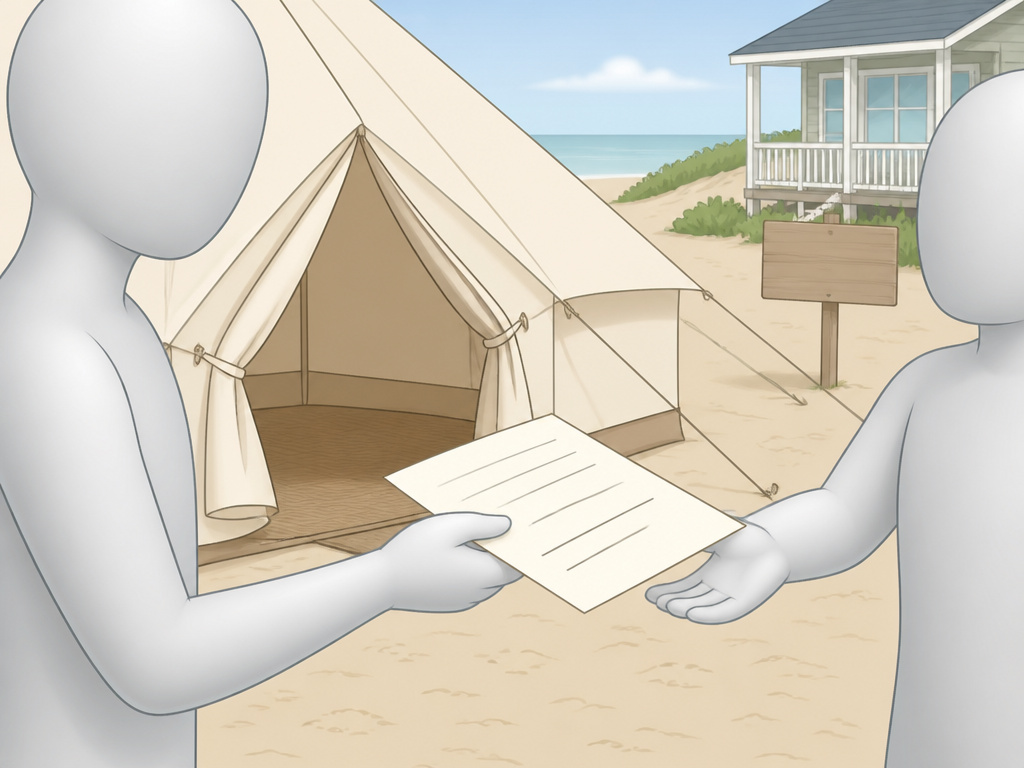
Here’s where it gets interesting. Municipal rules typically apply only to public sand. The Gulf Shores ordinance explicitly states that individual property owners may allow tents on private property north of the city’s pole markers, even if they exceed the 7’x7’ rule.
If you rent a beachfront house, the sand directly in front may be privately owned or under an easement controlled by the owner. This is why you sometimes see massive, beautiful canvas tents in photos—they’re often on private property.
However, this is a limited loophole with big caveats:
- You must get explicit permission from the property owner or rental agency. Do not assume.
- Homeowners’ Associations (HOAs) can have rules stricter than the city’s.
- It does not apply to federal land. On Assateague Island National Seashore, for example, camping is only allowed in designated campgrounds like Oceanside or Bayside, regardless of private holdings within the park.
“I shipped nearly $800 worth of gear straight to the sand for a family reunion,” one beachgoer in a news segment said. That strategy only works if you’ve confirmed the spot is private and the owner is okay with it. Otherwise, it’s a very expensive mistake.
How to Choose and Use a Beach-Legal Shelter
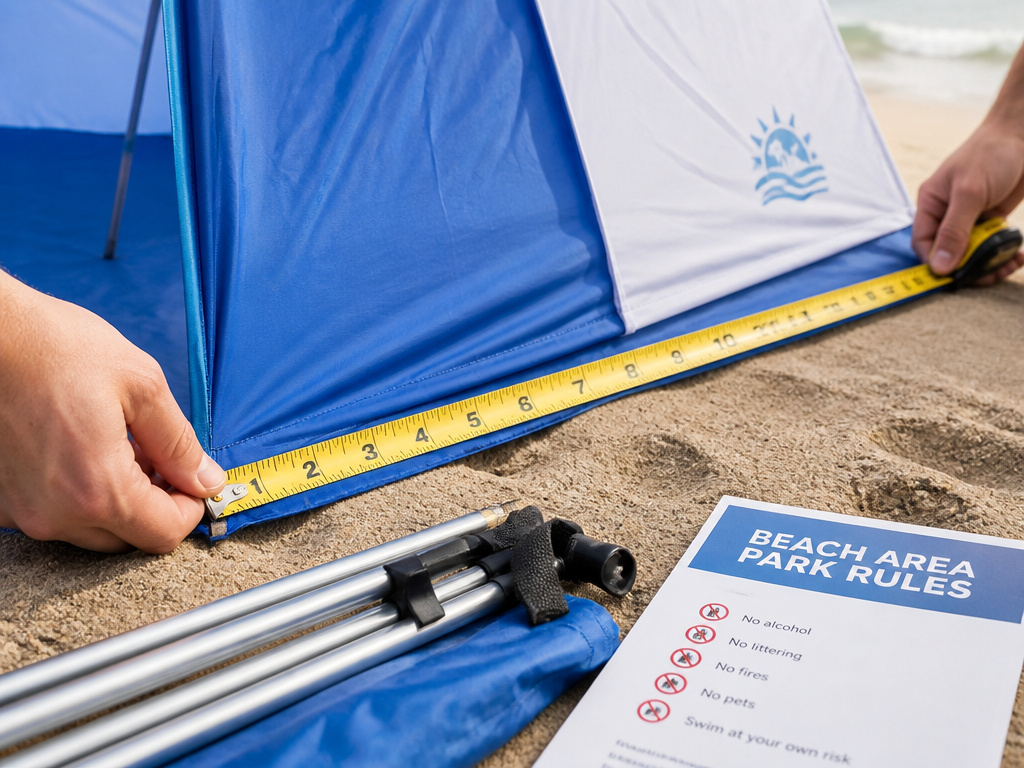
Your goal is shade without the hassle. Follow this sequence to get it right.
- Identify and Verify: Before you buy or pack anything, find the official rules for your exact destination. Bookmark the page on your phone.
- Measure Relentlessly: Marketing lies. A tent listed as “7.5-foot coverage” is likely over 7’x7’ in actual frame size. Measure the packed poles and the erected footprint.
- Prioritize an Umbrella: When in doubt, a single-pole beach umbrella is almost universally allowed. It’s the safest bet for peak season on restrictive beaches. For stability in wind, pair it with proper secure tent stakes.
- Select the Right Tent: Match the tent to the rule.
- For 7’x7’ limits: Look for small, low-profile shelters or specifically designed infant tents.
- For 12’x12’ limits: You have more options, including larger beach sun shelters and canopies. The Neso Grande (9’x9’) fits here.
- For rainy days: Ensure your shelter has a high waterproof rating if forecasts are uncertain.
- Anchor for the Environment: Sand is soft. Use the provided sand bags, or invest in heavy-duty screw-in sand anchors. A flying tent is a violation and a hazard.
- Have a Backup Plan: If you arrive and realize your shelter isn’t compliant, be ready to enjoy the beach with hats, sunscreen, and a blanket. Arguing with beach patrol never ends well.
Frequently Asked Questions
What happens if I leave my tent up overnight?
It will almost certainly be removed and discarded. Beach patrols conduct evening sweeps to clear the sand for safety and cleaning. Collected items are typically treated as abandoned property, and recovery is very difficult, if not impossible.
Can I sleep in a tent on the beach?
No. Overnight camping is prohibited on virtually all public beaches outside of designated campgrounds. Attempting to sleep in a tent will likely result in a fine and removal by police or beach patrol.
Are pop-up canopies considered tents?
Yes. Ordinances use broad terms like “shading device,” “shelter,” or “structure,” which explicitly include pop-up canopies, cabanas, and similar items. They are subject to the same size and seasonal limits.
What’s the penalty for breaking the rules?
Fines can start around $50 for a first offense. The more immediate penalty is being ordered to take the structure down. In cases of unattended overnight gear, the equipment is confiscated without a fine, but you lose your gear.
Do these rules apply to baby tents?
Often, yes, but with a specific exception. Myrtle Beach, for example, allows infant tents only if they are no larger than 4 feet wide, 3 feet deep, and 3 feet high. Always check for a specific “infant tent” clause.
Are there any beaches with no rules?
Extremely few. Even remote beaches often have regulations concerning overnight use or protected wildlife areas. Your safest bet is to always assume rules exist and seek out the official source.
The Bottom Line
A perfect beach day starts the night before, with ten minutes of research. Don’t guess. Pull up the official town or park website, find the section on beach rules, and read the specifics on shading devices.
Know your tent’s true dimensions and match them to your destination’s limits. Remember the three deal-breakers: size, season, and sunset. Get one wrong, and you’re packing up under the watchful eyes of a lifeguard. Get them right, and you’ve got a comfortable, legal haven for the day.
When you’re ready for more than a day trip, explore our guides on the best family camping shelters and essential tent equipment for your next adventure.
