
Tent Fabric Guide: Nylon, Polyester & Canvas Explained
This post contains affiliate links. As an Amazon Associate, we earn from qualifying purchases.
Tents are made from nylon, polyester, or canvas base fabrics, which are then coated with waterproof layers like polyurethane (PU) or silicone. The specific combination—dictated by numbers like denier (thread thickness) and hydrostatic head (water pressure resistance)—determines whether your shelter is a lightweight backpacking haven or a stormproof basecamp fortress.
I’ve pitched tents in everything from a Scottish downpour to a still, alpine dusk. That experience taught me one thing fast: the difference between a miserable, soggy night and a dry, secure one isn’t the brand name on the bag. It’s the fabric. Most people see “waterproof” on a tag and think they’re covered. The truth is in the technical specs most of us skip.
This guide is for anyone who’s tired of marketing fluff. We’ll look at the three core fabrics, decode the jargon on the label, and ground everything in the real-world international standards that separate true backcountry gear from fair-weather fantasy. You’ll learn why I now avoid double-sided silicone for my rough-and-tumble trips, and how a simple number can tell you if a tent floor will survive a night on rocky ground.
Key Takeaways
- Denier measures thread weight, not fabric strength. A 20-denier ripstop nylon with its reinforcing grid can outperform a thicker 40-denier plain weave in a tear test. The construction matters just as much.
- Silicone coatings hate tape. A micro-tear in a silnylon fly is a major field repair headache. Standard adhesive tapes peel right off the slick silicone surface, a lesson I learned the hard way in a hailstorm.
- The ISO 5912 standard has a critical seam rule. For a tent to meet its Level 3 performance rating, the bonded or sewn connections between fabric panels must retain at least 90% of the fabric’s own tensile strength. A weak seam fails first.
- PVC gets brittle in the cold. While an excellent water vapor barrier, polyvinylchloride coatings become dangerously inflexible below freezing, risking cracks during setup or in high winds.
- Your tent floor is built tougher. The ISO standard mandates a groundsheet have double the water penetration resistance (50,000 Pa) of a coated rainfly (25,000 Pa) for the same performance level. It’s engineered to sit in puddles.
Outer tent, coated (Camping tents cat. A, Level 3): Tear resistance: 15 N (ISO 13937-2); Breaking strength: 400 N (ISO 13934-2); Resistance to penetration by water: 25,000 Pa (ISO 811).
— ISO 5912:2020
What Are the Main Tent Fabric Materials?

Your shelter starts with one of three foundational textiles. The coating and weave come later, but the base fabric sets the stage for everything: packability, feel, and inherent strengths.
Nylon is the ultralight champion. Its superpower is an incredible strength-to-weight ratio coupled with natural stretch. A nylon fiber can elongate up to 30% before snapping, letting a lightweight tent absorb a sudden gust rather than rip. The catch? It’s hygroscopic, meaning it absorbs water. An untreated nylon tent will sag dramatically when wet, which is why every nylon shelter you buy has a waterproof coating.
Polyester is the durable, sun-resistant workhorse. It has minimal stretch, so a polyester tent holds its shape perfectly in humidity without sagging. Its real victory is UV resistance; a polyester fabric will outlast an equivalent nylon by years under constant sun. The trade is a slightly heavier feel for the same strength. This is why you’ll find it in most family car-camping tents and many durable models from brands like Coleman or Marmot tent construction.
Canvas, traditionally woven cotton, is the breathable fortress. Modern versions often blend cotton with synthetic fibers. The thick, natural fibers swell when wet, creating a self-sealing barrier at the seams. This breathability drastically reduces condensation, making it ideal for extended stays. The cost is monumental weight and slow drying times. For hot tent materials that must safely accommodate a wood stove, flame-resistant canvas is often the only choice.
Common mistake: Assuming a “bombproof” canvas tent is for every trip. My friend’s vintage bell tent is indeed indestructible, but it weighs over 50lbs and smells like a damp barn if packed wet. I love it for glamping, but I’d never haul it on a trail.
How Do You Read a Tent Fabric Spec Sheet?
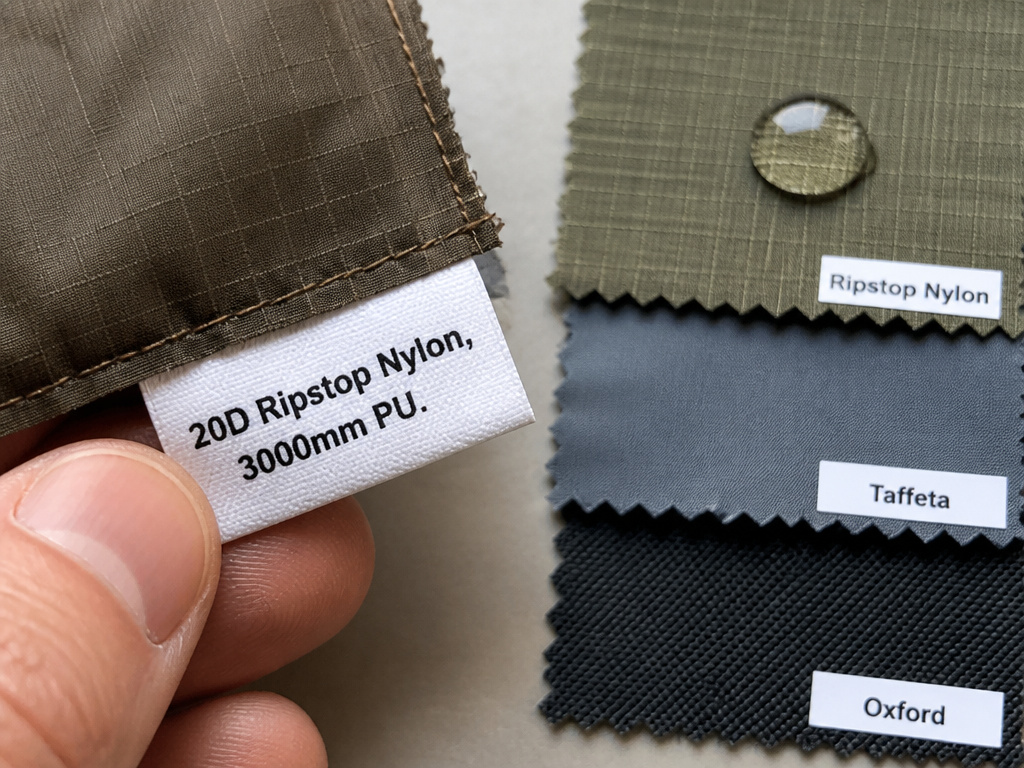
You see codes like “20D Ripstop Nylon, 3000mm PU” on a tag. Here’s what that actually means for your comfort and safety.
Denier (D) is the weight in grams of 9,000 meters of thread. It indicates thickness, not absolute strength. A lower denier (like 10D) is finer and lighter; a higher denier (like 75D) is thicker and burlier. For ultralight tent materials, you’ll see 7D to 20D. For wind-resistant tent fabrics meant for exposed ridges, look for 30D and up.
The Weave Pattern is where engineering meets art.
1. Ripstop: A grid of thicker reinforcement threads woven into the fabric, creating small squares. A tear is stopped at the next grid line. This is the gold standard for balancing low weight and high durability.
2. Taffeta: A simple, plain weave. It’s smooth, often less expensive, and used for tent liners or budget rainflies. It lacks the tear resistance of ripstop.
3. Oxford: A basket-weave where threads are paired. It’s heavy, incredibly tough, and common in the floors of durable tents and traditional canvas tents.
| Weave Type | Primary Use | Texture & Packability | Key Limitation |
|---|---|---|---|
| Ripstop | Rainflies, high-stress panels | Crisp, light, less compressible | Can be noisy in wind |
| Taffeta | Tent bodies, budget flies | Soft, smooth, drapes well | Lower tear strength |
| Oxford | Heavy-duty floors, canvas | Coarse, heavy, extremely tough | Not for weight-conscious use |
The Waterproof Coating is the essential barrier. No base fabric is waterproof alone.
* Polyurethane (PU): The most common coating, applied to the fabric’s inner side. Affordable, effective, and easily repairable with standard seam tape and patches. Most waterproof tent fabrics for family camping use PU.
* Silicone Elastomer: Impregnated into the fabric fibers (creating silnylon or silpoly). It offers a better strength-to-weight ratio and causes water to bead up and roll off spectacularly.
* Polyvinylchloride (PVC): A heavy, laminated film. It’s a superb vapor barrier but environmentally problematic. Its critical flaw is cold-weather performance, where it becomes inflexible and prone to cracking.
TL;DR: Denier hints at bulk, ripstop weave fights tears, and PU coating is the practical, field-repairable choice for most campers.
What Do the ISO 5912 Standards Actually Test?
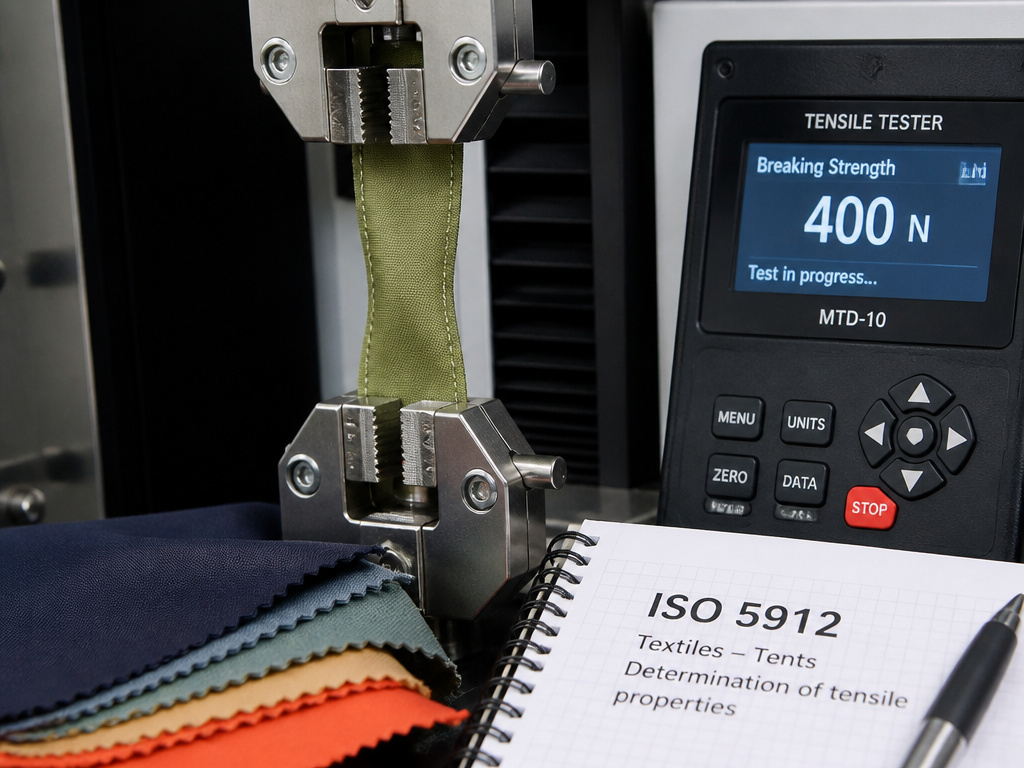
When a brand says “stormworthy,” what does that mean? The ISO 5912:2020 standard provides the answer through measurable, lab-tested metrics. It categorizes tents and sets clear performance benchmarks anyone can understand.
The standard divides tents into Category A (lightweight, typically backpacking) and Category B (heavier duty, like basecamp tents). Each category has three Performance Levels. Level 1 is for infrequent, fair-weather use, while Level 3 is for frequent use in severe conditions. Here’s what those levels demand from the fabric itself.
| Performance Test | Test Method (ISO) | Cat. A, Level 3 (Backpacking) | Cat. B, Level 3 (Basecamp) |
|---|---|---|---|
| Tear Resistance | 13937-2 | 15 Newtons | 20 Newtons |
| Breaking Strength | 13934-2 | 400 Newtons | 500 Newtons |
| Water Penetration (Rainfly) | 811 | 25,000 Pascal | 25,000 Pascal |
| Water Penetration (Groundsheet) | 811 | 50,000 Pascal | 50,000 Pascal |
| Seam Strength Retention | Internal | ≥ 90% of fabric strength | ≥ 90% of fabric strength |
A Newton is a unit of force. 15 N is roughly the force needed to hold 1.5 kilograms against gravity. So, a Level 3 fabric must resist a propagating tear with that force. The breaking strength of 400 N simulates a person leaning or falling against a taut panel.
The groundsheet requirement is double that of the rainfly because it must handle pooling water and abrasion. This is a key reason backpacking tent fabrics often use a higher-denier, higher-rated material for the floor.
The 90% seam rule is crucial. You can have a 500 N fabric, but if the seam stitching or tape fails at 300 N, the seam is the weak link. This rule ensures the entire assembly is uniformly strong, which is non-negotiable for stormproof tent materials.
Which Tent Fabric Is Best for My Camping Style?
The “best” fabric doesn’t exist. The right fabric is the one optimized for your specific type of adventure. A thru-hiker’s ideal is a car camper’s frustration.
For Backpackers & Thru-Hikers: Every gram counts. Prioritize high-strength, low-denier materials.
1. Rainfly: 10D to 30D Silnylon or Silpoly. Silicone treatment offers the best strength-to-weight. The Hyperlite Mountain Gear Ultamid 2 uses 30D DCF, a non-woven laminate, for an extreme balance.
2. Floor: 20D to 40D PU-coated Nylon. You need higher abrasion resistance and a hydrostatic head rating of 3000mm or more.
3. Trade-off: You accept less UV resistance and the fuss of silicone repairs. I learned this on the Tour du Mont Blanc: a tear in my silnylon door couldn’t be patched with tape. Now, for my rough trips, I prefer 20D PU-coated nylon—the 5% weight penalty is worth the ability to make a quick, reliable field repair with Gorilla Tape.
For Family & Car Campers: Durability, stability, and sun resistance are king. Polyester excels here.
1. Primary Fabric: 68D to 150D PU-coated Polyester. This handles kid-level abuse and won’t sag in rain or morning dew. The Coleman Sundome uses a 68D polyester taffeta, a classic for a reason.
2. Key Feature: UV resistance. Polyester inherently lasts longer in the sun, vital for tents that stay pitched for days at a festival.
3. Avoid ultra-light nylons here. The minimal weight saving isn’t worth the reduced durability and potential for wet sag.
For Four-Season & Alpine Camping: Fabrics must withstand wind, snow load, and abrasive snow crystals.
1. Primary Fabric: 40D to 75D PU-coated Nylon Ripstop. The focus is on extreme tear strength and a hydrostatic head rating of 5000mm or more.
2. Critical Detail: All seams must be fully taped, and the fabric should meet a high ISO 5912 Performance Level (Level 3, Category B). This is where performance specs trump marketing.
3. Why not silicone? While strong, silicone-coated fabrics can be too slippery for snow to shed and are harder to repair in freezing conditions.
For Hot Tents & Winter Basecamps: Fire resistance and breathability are paramount.
1. Primary Fabric: Treated Cotton or Poly-Cotton Canvas. It’s breathable to reduce condensation and can be made highly flame-retardant for safe use with stove jack fabrics.
2. ISO Note: For flame-retardancy, ISO 5912 references ISO 6941. A passing material must have an average after-flame time under 6 seconds with no flaming debris.
3. The Reality: These are heavy, specialized shelters for stationary camping, not for hauling up a trail.
Common mistake: Choosing a fabric based on a single feature, like ultra-low weight, without considering the repair profile in your typical conditions. A finicky, high-performance fabric can ruin a trip if you’re not prepared to maintain it.
How Do You Care for and Repair Different Tent Fabrics?
Your tent’s longevity depends heavily on how you maintain its specific materials. The care routine for PU-coated polyester is different from that for silnylon.
For PU-Coated Fabrics (Most Common):
- Clean with a soft sponge, lukewarm water, and a mild, non-detergent soap. Never use harsh cleaners or a washing machine.
- Store completely dry and loosely packed, never compressed in its stuff sack long-term, to prevent the coating from sticking to itself (delaminating).
- Field repairs are straightforward. Clean the area and apply a patch of Tenacious Tape or a similar urethane-based repair tape. It bonds well to the PU surface.
For Silicone-Coated Fabrics (Silnylon/Silpoly):
- Cleaning is similar, but be aware that silicone sheds dirt more easily. A simple rinse often suffices.
- Storage is the same: dry and loose.
- Repair is the critical difference. Adhesive tapes do not bond reliably to the slick silicone surface. For a permanent field repair, you need a silicone-based sealant like Seam Grip SIL. This is a specific, messier process than using a simple tape patch.
For Canvas Tents:
- Always ensure the canvas is bone-dry before storage to prevent mildew. If it gets packed damp, air it out as soon as possible.
- Cleaning may involve a mild bleach solution for mildew stains, but always test in an inconspicuous area first.
- Repairs often involve heavy-duty thread and needles or specialized canvas repair kits, as tape is ineffective on the thick, porous material.
TL;DR: PU is forgiving and easy to patch. Silicone requires specific sealants for repairs. Canvas demands perfect dryness to avoid mildew.
Frequently Asked Questions
What is the most durable tent fabric?
For sheer longevity against abrasion and UV degradation, a high-denier polyester (like 150D or more) with a polyurethane coating is extremely durable. For traditional, breathable durability, heavyweight cotton canvas is unmatched but comes with significant weight and maintenance.
Is nylon or polyester better for a tent?
It depends on your priority. Nylon offers a better strength-to-weight ratio and more stretch, ideal for lightweight, packable backpacking tents. Polyester has better UV resistance and doesn’t absorb water (so no sag), making it better for car-camping or frequently sun-exposed tents.
What does “ripstop” mean?
Ripstop is a weaving technique that incorporates a grid of thicker reinforcement threads into the fabric. This grid acts like a series of small stop signs, preventing a small tear from propagating into a large rip. It allows manufacturers to use lighter, thinner base fabrics while maintaining tear strength.
How waterproof does a tent floor need to be?
The international ISO 5912 standard specifies that a groundsheet for a Level 3 performance tent must resist at least 50,000 Pascals of water pressure, which is double the requirement for the rainfly (25,000 Pa). In practical terms, look for a hydrostatic head rating of 5000mm or higher for the floor to ensure it can handle sitting in a puddle.
Can you repair a hole in a silicone-coated tent?
Yes, but not with standard tent repair tape. The silicone surface rejects the adhesive. You must use a silicone-based sealant like Seam Grip SIL, applied to a patch of silnylon or DCF repair material. It’s a more involved process than a simple tape patch but creates a permanent, flexible bond.
What is the lightest tent fabric?
The lightest commercially available fabrics are 7D to 10D silicone-coated nylon ripstop or Dyneema Composite Fabric (DCF). DCF, a non-woven laminate, is exceptionally strong for its weight but is less packable and more expensive than silnylon.
Before You Go
Choosing a tent fabric is about matching a tool to a job. The numbers—denier, hydrostatic head, and ISO performance levels—are your unbiased guide past the marketing. They tell you what the fabric can actually withstand.
Remember that the coating dictates your relationship with the tent. A PU-coated shelter is a forgiving, easily patched companion. A silicone-coated one is a high-performance partner that demands specific care. And never underestimate the seam; a tent is only as strong as its weakest stitch.
Your next shelter shouldn’t just be “made of nylon.” It should be made of the right nylon, woven and coated for the specific challenges of your favorite landscapes. Now you have the language to find it. For specific recommendations, explore our deep dives on lightweight tarp tents for minimalist trips or heavy rain tents for stormy conditions.
