
Tent Safety With Buddy Heaters: Must-Know Rules for Safe Use
This post contains affiliate links. As an Amazon Associate, we earn from qualifying purchases.
A CSA-certified Buddy heater is safe for indoor tent use only when you maintain a minimum 9-square-inch ventilation opening, place the unit on a stable floor, and never sleep with it running. The oxygen depletion sensor (ODS) shuts off the heater if oxygen drops below 18%, but it does not detect carbon monoxide. Without that vent, carbon monoxide can accumulate to hazardous levels long before the ODS triggers.
Most people think the ODS sensor is a carbon monoxide alarm. It is not. It measures oxygen, and by the time it shuts the heater off, CO levels may already be dangerous. They also treat “ventilation” as a suggestion, cracking a zipper a few inches. The manual specifies a calculated area.
This guide walks through the safety standards, the real data from an all-night test, and the non-negotiable steps to use a Portable Buddy without betting your life on a misunderstood sensor.
Key Takeaways
- The ODS (oxygen depletion sensor) is not a CO detector. It shuts off the heater only when oxygen falls below 18%, which can happen after CO has already reached dangerous concentrations.
- You must have a minimum 9-square-inch permanent vent opening (e.g., 3″x3″) for the Mr. Heater Portable Buddy. A cracked zipper or mesh panel does not count unless you’ve measured it.
- Never store a connected propane cylinder inside a tent, vehicle, or building. The Mr. Heater manual states this voids all safety certifications and creates an explosion risk.
- Use the heater for pre-warming and morning warmth only. The established safe routine is to turn it off before you fall asleep.
- At altitudes above 7,000 feet, the heater may not burn correctly and could shut off unexpectedly due to thin air.
How Buddy Heaters Earn Their “Indoor Safe” Rating
They pass a specific test. The Canadian Standards Association (CSA) International Requirement 4.98 mandates that portable gas heaters sold for indoor/recreational use must have an oxygen depletion system (ODS) that cuts fuel if oxygen drops below 18%. The same standard also requires that in a sealed 500-cubic-foot room, carbon monoxide concentration must not exceed 100 parts per million when oxygen is depleted to that 18% threshold.
The Mr. Heater Portable Buddy’s ODS is a small pilot flame and thermocouple assembly near the burner. If oxygen levels drop, the flame lifts off the thermocouple, which cools and signals the gas valve to close. This is a mechanical, non-electronic safety.
Common mistake: Relying on the ODS as a carbon monoxide monitor, the ODS only senses oxygen depletion. CO can rise to toxic levels in a poorly ventilated space well before oxygen drops to 18%.
The heater also meets the ANSI Z21.11.2 standard for unvented gas heaters, which caps CO emissions. But these certifications assume adequate ventilation is provided. The manual for the MH9BX and MH9B models explicitly states the heater is only for use in enclosures with a window or roof vent. No vent, no safe use.
The 9-Sq-In Vent Rule (and Why It’s Not Optional)
Your tent is not a laboratory test chamber. The CSA and ANSI tests use a controlled, sealed room. Your tent has seams, mesh, and varying air pressure. The manufacturer’s ventilation requirement is your real-world safety margin.
The Mr. Heater manual states you need a minimum of 9 square inches of vent opening for the Portable Buddy. For the smaller MH4B model, it’s 4 square inches. This isn’t a cracked zipper or relying on mesh. You need a dedicated, measurable opening.
A 3×3 inch square is 9 square inches. A 2×2 inch square is only 4. Most tent windows, when fully opened, provide more than this. But you must check. If your tent only has a small peak vent, it might not be enough.
TL;DR: Measure your tent’s vent when fully open. If it’s not at least 9 square inches for a Portable Buddy, you cannot safely run the heater.
| Tent Feature | Typical Vent Area | Meets 9-sq-in Requirement? |
|---|---|---|
| Fully opened double-zip door | 500–800 sq in | Yes |
| Fully opened mesh window | 200–400 sq in | Yes |
| Peak vent (circular) | 15–30 sq in | Yes |
| Partially cracked door (6-inch gap) | ~12 sq in | Barely |
| Mesh panel alone (no open flap) | 0 sq in (no airflow) | No |
The National Fuel Gas Code (NFPA 54) provides the engineering basis: it calls for 4 cubic feet of fresh air per 1,000 BTU per hour. The Portable Buddy is 4,000 or 9,000 BTU. Do the math, and the 9-square-inch vent is the simplified, non-negotiable rule for a reason.
The 12-Hour Enclosed Tent Test
A YouTube creator ran a real-world experiment. He sealed a Mr. Heater Buddy inside an iKamper rooftop tent, ran it on low for 12 hours, and monitored CO and O2 levels with two digital sensors. The results are the most cited dataset in camping forums.
Carbon monoxide peaked at 29 ppm, below the OSHA permissible exposure limit of 50 ppm but above the 9 ppm EPA ambient air quality standard. Oxygen levels dipped to 19.8%, staying above the 19.5% “oxygen-deficient” threshold. After an initial spike, both levels stabilized.
The tent was carpeted, and no one was inside exhaling moisture. The key finding was the initial CO/O2 swing in the first hour. In a fully sealed space, combustion byproducts concentrate fast before diffusion and minor leaks equalize things.
I won’t recommend sleeping with a Buddy heater running based on this one test. The O2 sensor didn’t trip, but 29 ppm of CO is nothing to ignore over an eight-hour sleep. My routine is to warm the tent, turn it off, and sleep under a good bag.
This test is a best-case scenario: a single occupant, a heater on low, a sealed but not perfectly airtight tent. Add a second person, run the heater on high, or use it in a smaller mountaineering tent, and those numbers change. The data proves the safety systems can work, but it doesn’t make the risk zero.
The One Setup Mistake That Voids All Safety
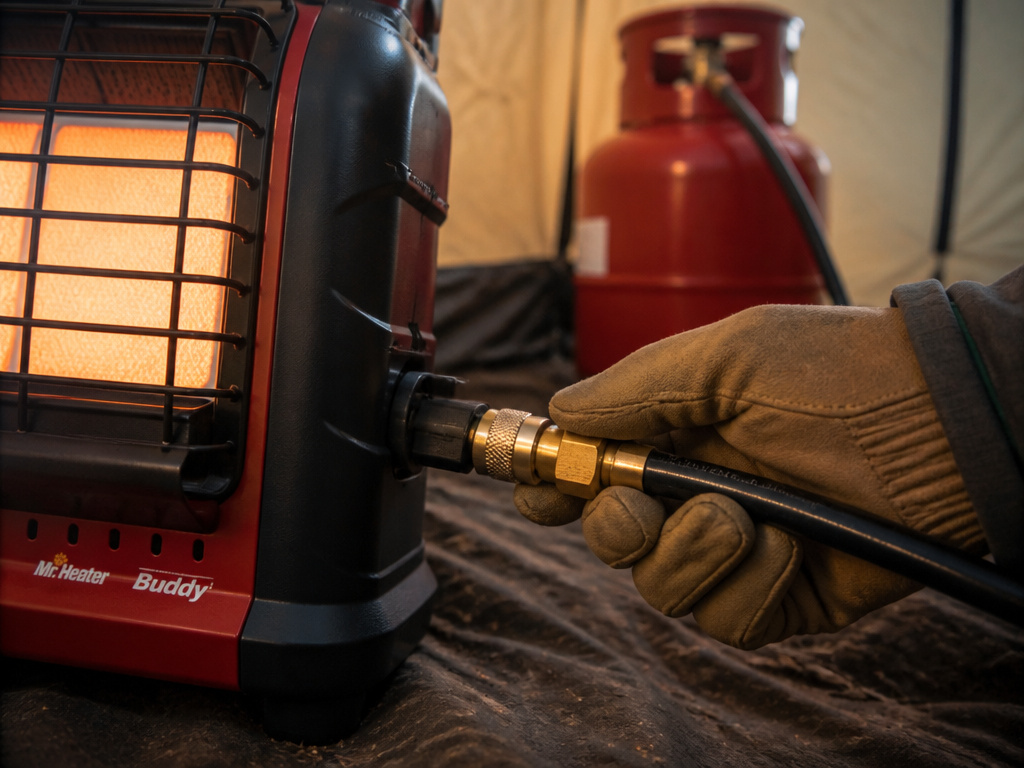
Connecting the heater to a remote propane tank inside the tent. Every manual includes this warning in bold, capital letters: “NEVER bring a refillable propane cylinder indoors.”
The heater itself is certified for indoor use. The 1-pound disposable propane cylinder is technically a “non-refillable” container and is part of that certification when attached directly. The moment you use a hose to connect to a 5, 10, or 20-pound tank, you introduce new failure points: the hose, the filter, the connections.
Common mistake: Running a hose from a large propane tank outside the tent into the heater inside, this bypasses the heater’s built-in regulator and can cause over-pressure, flare-ups, and leaks at the connection inside your living space.
If you use a hose, the Mr. Heater F273704 Buddy series hose is designed for this and includes an integrated regulator. Older hoses like the F273702 require an annual filter replacement (part F273699). Skip that maintenance, and debris can clog the heater’s jet.
Your Pre-Trip Safety Checklist
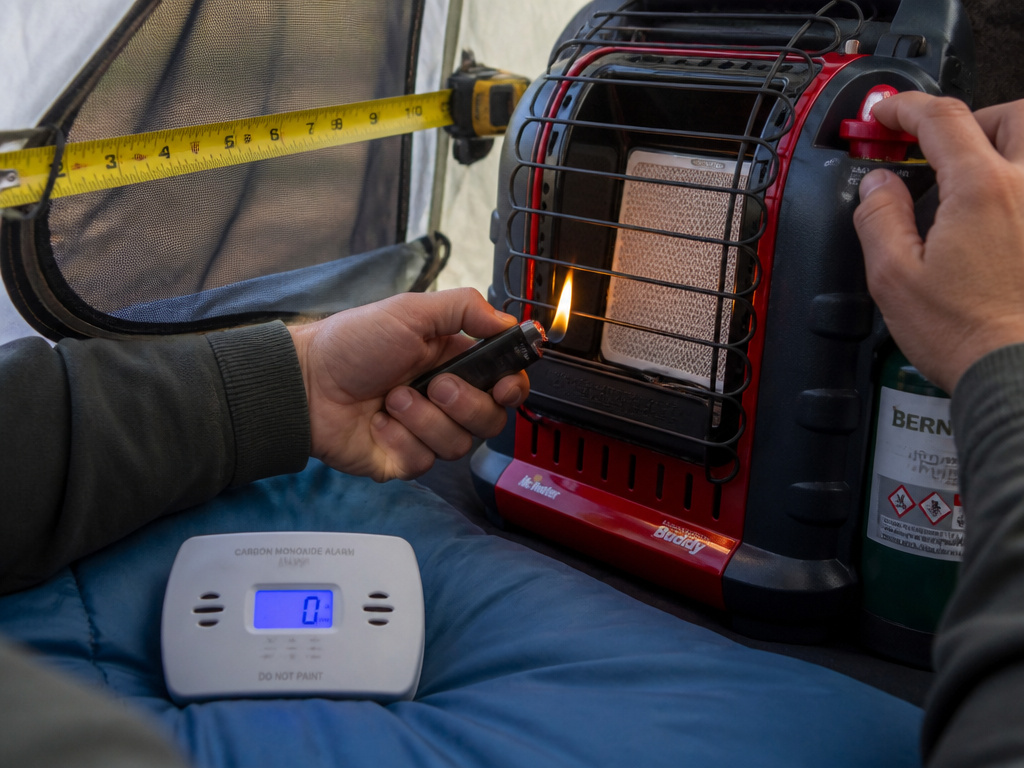
Do these four things before you ever light the heater in a tent.
- Inspect the ODS pilot assembly. Dust, spider webs, or corrosion can block the pilot or thermocouple. A clean blue flame that envelops the thermocouple tip is good. A lazy, yellow flame lifting away is bad.
- Verify your carbon monoxide detector. Use a battery-powered model with a digital readout, not just an alarm. Place it at sleeping bag level. CO is slightly lighter than air. Test it before you leave.
- Calculate your vent area. Open the tent’s vent or window all the way and measure the clear opening in square inches. If it’s a weird shape, approximate. Less than 9 square inches? Don’t use the heater.
- Practice the ignition sequence outdoors. The Piezo igniter can fail. Have a backup lighter. Know how to open the gas valve slowly, listen for the hiss, and spark immediately.
TL;DR: A dirty ODS, a dead CO detector, an undersized vent, or a fumbled light-up are the four failure points that happen before the heater ever gets warm.
Buddy Heater vs. Other Tent Heating Options
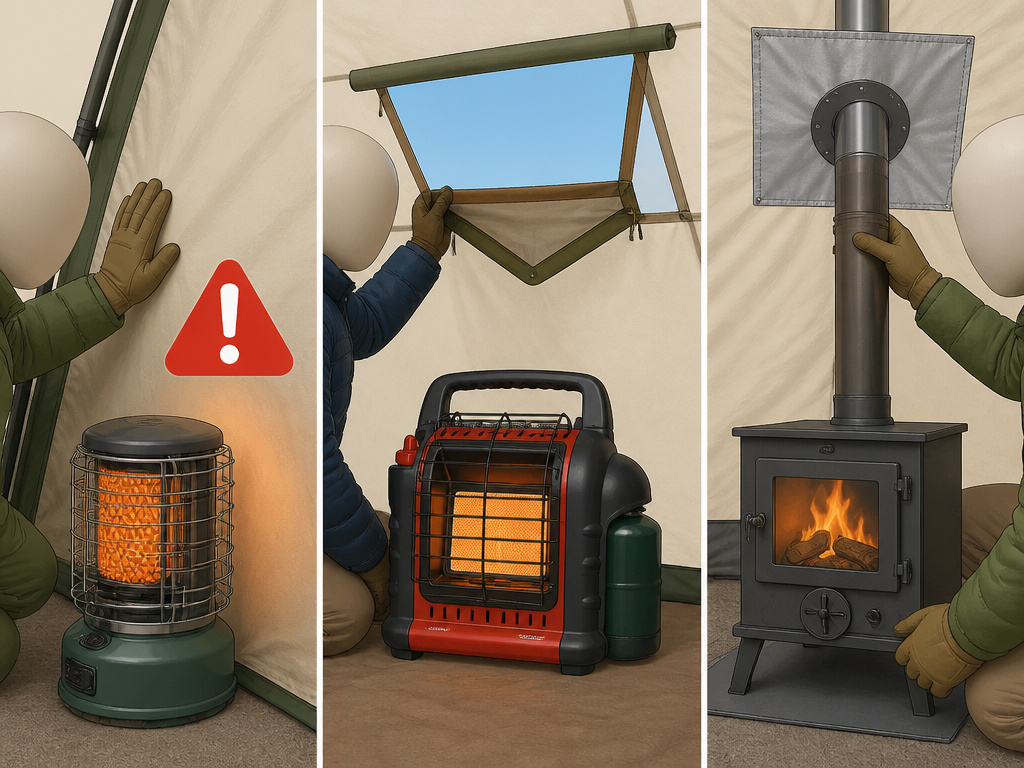
You have three paths for winter camping heat. The Buddy heater sits in the middle.
| Heater Type | Best For | Primary Risk | Ventilation Required? |
|---|---|---|---|
| Catalytic Heater (e.g., Coleman BlackCat) | Long, silent runtime; no electricity | Carbon monoxide (no ODS), flammable surface contact | Absolute minimum – cracks aren’t enough, need cross-flow |
| Buddy Heater (ODS-equipped) | Short-term, reliable radiant heat; indoor-safe certified | CO buildup if vent is inadequate; pilot outage | Yes – 9 sq in minimum |
| Tent Wood Stove | Basecamp, long stays, drying gear | Fire, sparks, CO from poor draft, extreme surface heat | Yes – requires a rated stove jack and chimney |
A wood stove is the gold standard for winter camping tents because it vents combustion gases outside. It’s also a major investment and requires a tent with a stove jack. The Buddy heater is a simpler, portable solution for weekend trips where hauling a hot tent stove isn’t practical.
Electric heaters are safer from a combustion perspective but require massive battery banks or shore power. For most tent campers, propane is the realistic choice.
The Legality You Didn’t Know About
The manufacturer says it’s safe. Your test shows low CO. But it might still be illegal.
The U.S. Army Center for Health Promotion and Preventive Medicine Factsheet 55-007-1005 explicitly prohibits propane heaters in tents. Army Regulation 420-96 bans unvented space heaters in sleeping quarters. Soldier deaths are cited as the reason.
California Health and Safety Code 19882 bans the sale of unvented fuel-burning heaters for use in dwellings, with an exception for electric heaters. While a tent isn’t a dwelling, the legal precedent is clear: authorities treat indoor propane combustion as a last-resort risk.
These rules exist because people make mistakes. They block vents in a storm. They use cracked hoses. They ignore the smell of gas. The Forest Service propane heater safety document for firefighters outlines the same hazards. Your personal risk calculation should start with the law, not end with it.
Frequently Asked Questions
Can you sleep with a Buddy heater on in a tent?
No. The safe practice is to use it to warm the tent before bed and after waking. Turn it off before you fall asleep. Continuous operation for hours in a sealed space, even with a vent, accumulates moisture and risk. Your sleeping bag and pad are for insulation; the heater is for comfort spikes.
Do Buddy heaters cause condensation in tents?
They reduce relative humidity. Propane combustion produces water vapor, but it also heats the air, which lowers relative humidity. In the 12-hour test, humidity dropped from 50% to 20%. Condensation forms when warm, moist air (like your breath) hits a cold surface. A Buddy heater can actually dry the air, but if you seal the tent completely, your breath will still create moisture on the walls.
What happens if you use a Buddy heater above 7,000 feet?
Performance drops. The manual states the heater “may not burn as bright and may shut off” above 7,000 feet. Thin air reduces oxygen availability, which can cause incomplete combustion (producing more CO) and trigger the ODS. If you’re high-altitude camping, pre-warm with the heater but plan to rely on insulation.
Can you use a 20 lb propane tank with a Buddy heater?
Yes, but only with the correct hose. You must use a hose with an integrated regulator, like the Mr. Heater F273704. The tank must remain outside the tent, with the hose fed through a vent or partially closed door. The connection at the heater is a potential leak point, check it with soapy water solution before each use.
How long does a 1 lb propane cylinder last on a Buddy heater?
The MH9BX manual lists 3-6 hours on high, 6-12 hours on low from a 1 lb cylinder. A 20 lb tank lasts 48-110 hours. These are ideal conditions. In temperatures below 20°F, liquid propane doesn’t vaporize as efficiently, and run times can be 30-40% shorter. Always carry a spare.
Before You Go
A Buddy heater’s safety is conditional. The 9-square-inch vent is not a suggestion, it’s the minimum engineering requirement for the oxygen sensor to function as designed. That sensor is a last line of defense, not a permission slip to ignore ventilation.
Treat it like a campfire. You wouldn’t build one inside your tent. You wouldn’t fall asleep next to one without a firebreak. The heater is a tool for extending your season, not a substitute for a proper sleeping bag and a well-chosen four-season shelter. Pack a backup plan, know how your essential camping gear works together, and never let the convenience of heat override the fundamentals of shelter safety.