
How to Use Tent Stakes: Pro Techniques for Any Ground Type
This post contains affiliate links. As an Amazon Associate, we earn from qualifying purchases.
To use tent stakes correctly, drive them vertically or with a minimal lean (under 15 degrees) until only the top hook is exposed, secure the guy line within 2-3 inches of the ground, and tie it off with a tension-locking knot. The old 45-degree angle advice can reduce holding power by up to 30%.
I learned the hard way that a tent is only as secure as its weakest stake. On a trip in New Hampshire’s White Mountains, a sudden squall turned a calm evening into a chaotic mess. The thin, J-shaped shepherd’s hooks that came with my tent, the ones I’d trusted in what looked like firm soil, all six bent into useless ‘U’ shapes under the lateral load. My fly tore loose, flapping violently while I scrambled in the rain. That failure sent me down a rabbit hole of engineering reports and field tests to understand what actually works.
This isn’t about following old scout lore. It’s about physics, soil mechanics, and choosing the right tool so you sleep soundly. Let’s build a foundation that holds.
Key Takeaways
- Drive stakes vertically or with less than a 15-degree lean; the classic 45-degree angle can cut holding power by nearly a third.
- Attach guy lines within 2-3 inches of the ground. A higher attachment creates a lever that pries the stake out with ease.
- Match your stake to the ground: Y-beam stakes (like MSR Groundhogs) for mixed conditions, wide snow/sand stakes for loose material, and shepherd’s hooks only for perfect, calm lawns.
- In sand, snow, or loose soil, your only reliable option is a dead man anchor, burying a stake or stuff sack horizontally.
- The two non-negotiable factors for hold are embedment length and surface area; a longer, wider stake will always outperform a short, skinny one.
Industry analysis of 489 stake pullout tests confirms that after a 15-degree lean, a stake’s holding power drops significantly. The optimal orientation is vertical, with a tolerance of only 10 to 15 degrees from plumb.
Why is the 45-degree stake angle a myth?
Forget the iconic, sharply angled tent peg. That image is based on a misunderstanding of how stakes actually fail under load. The old logic suggested an angled stake would better resist a straight pull, but modern pullout testing tells a different story.
A vertical stake resists pullout through its entire embedded length, translating the guy line’s force into lateral pressure against the surrounding soil. Soil is strongest in compression. An angled stake, however, introduces a bending moment. The top wants to pivot upward, using the embedded portion as a fulcrum. This prying action requires far less force to initiate a failure. According to the industry’s own tent installation safety standards, maintaining a near-vertical orientation is critical for maximizing the “pullout capacity” they spend pages calculating.
TL;DR: Drive it straight. Angling your stake away from the tent is creating a built-in weakness before the wind even arrives.
What are the best tent stakes for different ground conditions?
The flimsy wire hooks bundled with most tents are a recipe for failure anywhere but a manicured backyard. Your choice of stake is your first and most critical adjustment to the real world. I now pack a mixed set: MSR Groundhog stakes (the 8-inch model) for most points, and a couple of MSR Blizzard/Snow stakes for loose terrain.
| Stake Type & Example | Ideal For | Will Fail In | My Field Verdict |
|---|---|---|---|
| Shepherd’s Hook (Stock tent pegs) | Perfect, firm soil; zero wind. | Rocky ground, sand, high winds, frozen earth. | A compromise. I’ve bent a dozen. They’re now my backup’s backup. |
| Y-Beam (MSR Groundhog) | Rocky soil, hardpack, variable conditions, high winds. | Deep, dry sand (it’ll just pull through). | My go-to. The 7075-T9 aluminum alloy and 3-sided design have never bent, even hammered into root-filled Adirondack ground. |
| Snow/Sand Stake (MSR Blizzard) | Loose sand, snow, gravel, beach camping. | Hard, rocky soil (impossible to drive). | Essential for loose terrain. The wide blade provides the surface area that frictionless soil demands. |
Common mistake: Using shepherd’s hooks in high wind or rocky soil. The thin steel (often just 3mm) can’t handle lateral load and will bend permanently, leaving you scrambling in a storm. Upgrade your essential tent camping gear to include at least six Y-beam stakes.
For winter camping or beach trips, the dead man technique is non-negotiable. Bury a snow stake, stick, or even a stuff sack filled with sand horizontally, tie your line to its center, and pack the material on top. The holding power comes from the weight of the material above it, not friction on a shaft.
How do you properly drive and secure a tent stake?
The process is simple, but each skipped step turns your stake from an anchor into a placeholder. Clear the spot first. I learned this in a pine forest. I drove a stake through a thick layer of needles and thought it was secure. A moderate breeze later, it pulled out like a carrot from loose soil. Your stake must bite into the mineral earth beneath any soft duff.
- Position the stake. For a Y-beam, orient it so the “Y” opening faces the tent. If you get this wrong, say, with the spine facing the pull, the guy line can ride up and off the rounded edge under cyclic gusting. I watched a friend’s tent corner slowly detach itself over a night in Joshua Tree because of this.
- Drive it straight. Use a mallet, rock, or boot heel. A proper stake gives a solid thunk; a cheap one feels tinny and shudders. Drive it until only the hook or top inch is exposed. Every inch of embedment matters.
- Attach the line LOW. This is physics, not preference. Secure your guy line no higher than 2-3 inches above the soil. The exposed top of the stake is a lever; a high attachment gives the wind a massive mechanical advantage to pry it out.
-
Tie a knot that locks. A simple wrap will slip. Use a knot that tightens under load but remains adjustable.
- Two Slippery Half Hitches: Quick, reliable, and my default for most guylines.
- Marlin Spike Hitch: Perfect for quick attachment and release, especially useful when fine-tuning tension.
- Clove Hitch: Excellent for a secure, semi-permanent tie on a stake that won’t be moved.
TL;DR: Clear ground, drive straight, attach low, tie tight. This sequence is the bedrock of a stormproof pitch.
What if you can’t drive a stake? Anchor alternatives for rock and sand.
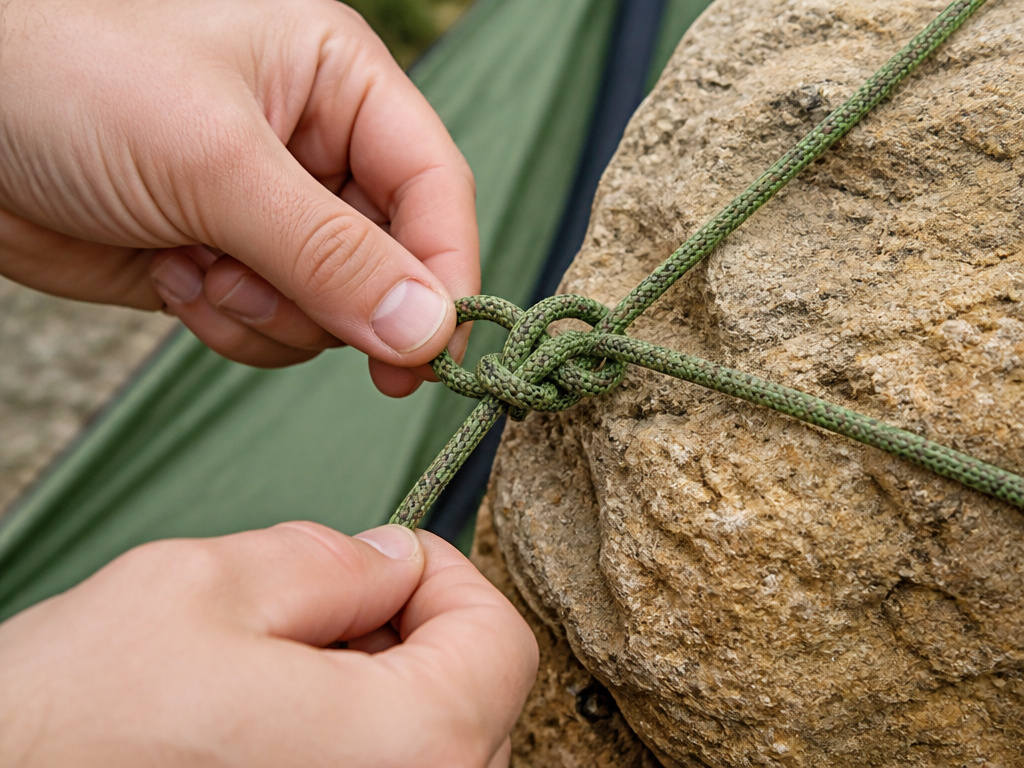
Sometimes, the earth wins. On solid rock, a sandy beach, or a hard wooden platform, standard staking fails. This is where rigging skills save the night.
For solid rock, become a rigger. Find a substantial rock (bigger than a football) and use a killick hitch (anchor hitch) to lash your guy line to it. This knot grips under tension and won’t slip. If you have enough line, a simple girth hitch around the rock itself works too. I’ve secured a full 4-season tent in a Wyoming basin using nothing but a 20-pound sandstone slab, it held for three days of relentless wind.
On a wooden tent platform, you obviously can’t drive stakes. This is where a kit of accessory straps and extra cordage becomes part of your vital tent camping accessories. Use webbing straps with buckles to lash around perimeter boards, or utilize any provided metal rings.
Before you start: Hammering a stake into unknown ground poses a risk of hitting buried utilities or sharp debris. Always clear the area of surface rocks and debris first. If camping in a managed park, ask about utility lines. Never force a stake, if it stops solidly, you’ve likely hit a root or rock; move over 6 inches and try again.
How does guy line geometry affect your tent’s stability?
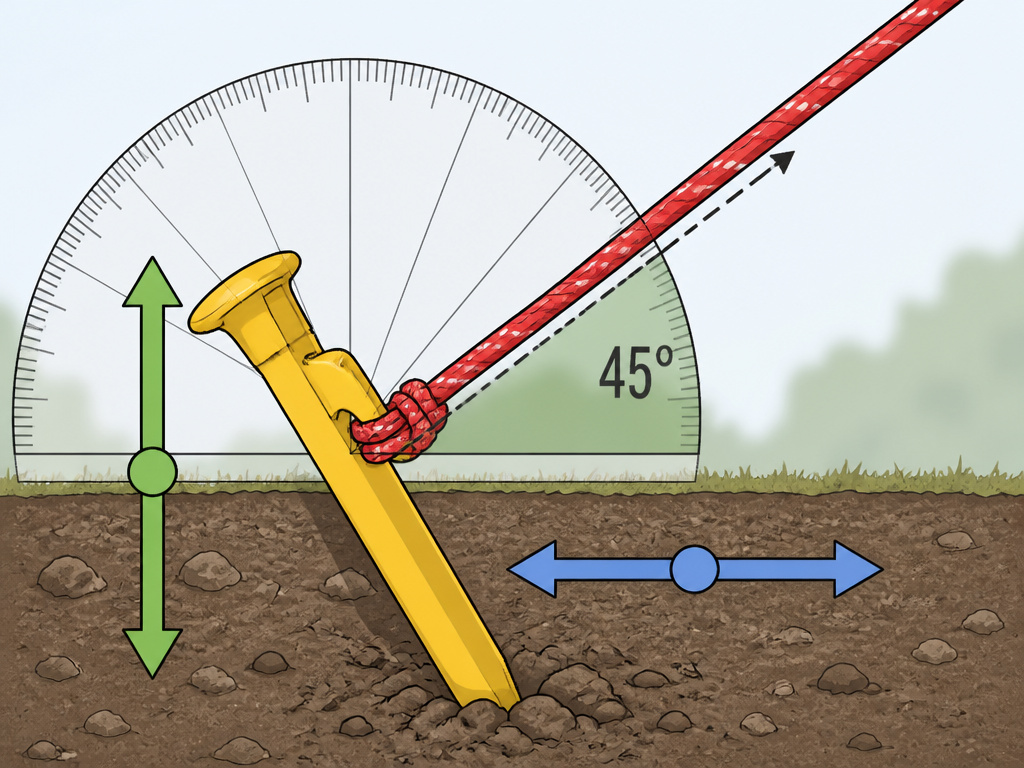
Your stake is only as good as the line pulling on it. A poorly routed guy line can defeat a perfectly placed anchor. The angle where the line meets the stake is a force multiplier.
The ideal pull angle to resist wind uplift is about 45 degrees from the ground. This balances vertical and lateral forces. Most dome tents have short guy lines that create a very steep angle, which is why they often include secondary low-point grommets for storm guying. In high wind, attaching a line to that low point and running it out at a shallow angle creates a downward force, pressing the tent body into the ground, a mandatory step for any tents for high winds.
For larger shelters like stand-up height tents or durable canvas tents, this geometry is even more critical. A long guy line run at a proper 45-degree angle from a high point creates a wide, stable footprint that can handle gusty conditions. This principle is scaled up in the industry tentage installation manual, which details how proper guying angles are calculated for large structures.
What are the essential knots for securing a tent?
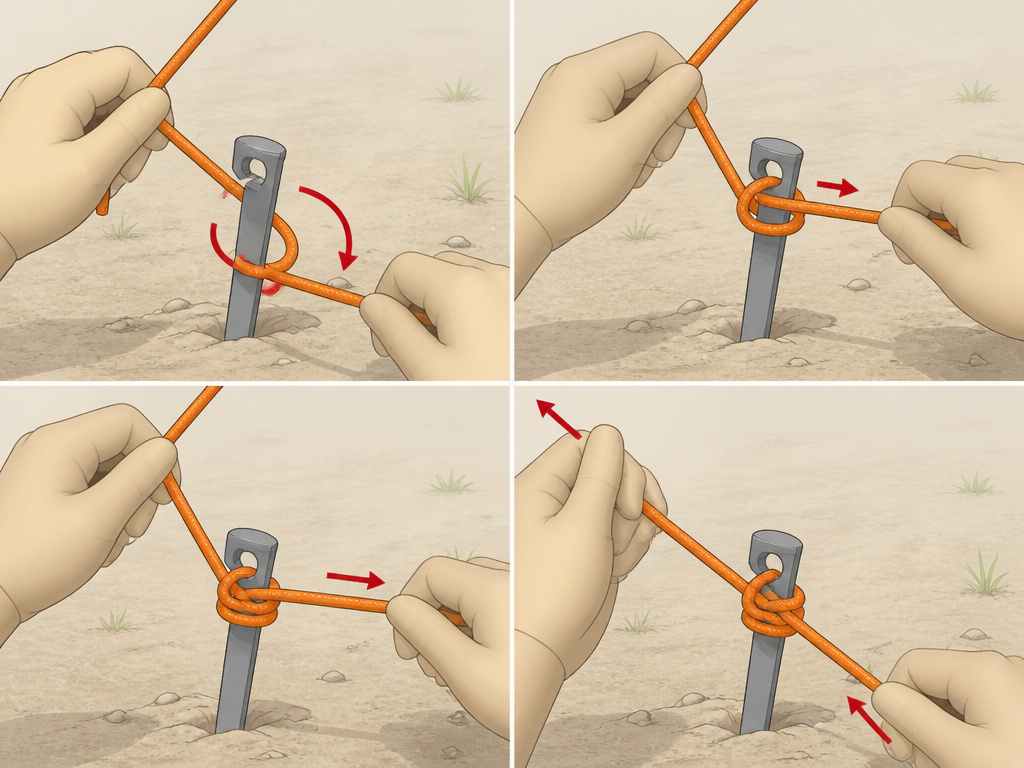
You don’t need a sailor’s repertoire. You need three knots that work with cold, tired hands.
- Two Slippery Half Hitches: For general attachment. It’s secure, adjustable, and easy to untie after being loaded.
- Marlin Spike Hitch: For quick attachment/release. Make a loop, poke a bight of the standing line through, and slide the stake through. Pull tight to lock.
- Clove Hitch: For a secure, set-and-forget tie. It grips well and is easy to inspect.
Practice the clove hitch and the two slippery half hitches until they’re muscle memory. For creating a fixed loop to girth-hitch a rock or tree, a bowline is the gold standard, it won’t slip or jam. Pair these skills with the right camping gear recommendations, and a stressful setup in fading light becomes a calm, routine process.
How do you troubleshoot a stake that’s pulling out?
You’re pitched, the wind picks up, and you see a stake creeping. Don’t just hammer it deeper.
First, diagnose the failure. Is the guy line tied too high on the stake? Re-tie it within 2 inches of the ground. Is the stake leaning past 15 degrees? Pull it and re-drive it vertically. Has the soil around it turned to a loose, crumbly mess? The stake has already failed; move it to virgin ground at least a foot away. In persistently soft soil, immediately switch to a dead man anchor or a double-stake setup.
If a secondary stake in a double staking arrangement is placed too close behind the primary, it will have limited resistance because the earth in front of it collapses into the void created by the first stake. The Virginia Tech staking guide suggests a distance equal to one-third of the stake’s embedment depth.
For a stake that won’t go in, don’t sacrifice it. You’ve hit a root or rock. Move over and try again. This is why carrying a few extra heavy-duty stakes is wise. If you’re in mud and the stake pulls out cleanly, find a stick or rock to jam into the hole alongside the stake to increase friction. In a true pinch, tie off to a nearby tree, a heavy log, or even a secured piece of gear.
Frequently Asked Questions
How deep should a tent stake go?
Drive it until only the hook or eyelet is above ground. For a standard 7-9 inch stake, aim for 6-8 inches of embedment. In soft soil, go as deep as the stake allows. The goal is to maximize the length of shaft in contact with solid, compacted earth.
Can I use sticks as tent stakes?
Yes, as a field expedient. Find green, thumb-thick sticks about 10-12 inches long. Sharpen one end and carve a notch near the top to hold the line. They work in soft soil but offer poor holding power in wind compared to a metal Y-beam and are not suitable for stormproof tent features or severe weather.
Why do my tent stakes keep pulling out in the wind?
The three most common reasons are: 1) The stake wasn’t driven deep enough, 2) The guy line is attached too high on the stake (creating a long lever), or 3) The stake was angled too sharply (over 15 degrees). Check these first. If the soil is loose, you likely need snow stakes or a dead man anchor.
What’s the best all-around tent stake?
For mixed conditions, the MSR Groundhog (or similar Y-beam design) is the most reliable single stake. It resists bending and offers good surface area. For a complete kit, carry a mix: several Y-beams for main points and a couple of wide snow stakes for loose ground or as part of your winter camping tent options kit.
How do I secure a tent on a wooden platform?
You need a strap-based system. Use 1-inch webbing straps with ladder-lock or cam buckles to lash around the platform’s perimeter boards. Many campgrounds provide metal rings or loops. Always carry a few 5-foot lengths of cord and some carabiners specifically for platform sites.
The Bottom Line
Staking a tent feels trivial until a midnight gust turns your shelter into a chaotic kite. The difference between solid sleep and a frantic, rain-soaked repair comes down to a few inches of embedded metal and the angle of a cord. Ditch the 45-degree myth for good. Drive stakes straight and deep, tie the line low, and let the soil type dictate your stake choice. For loose ground, master the dead man anchor before you need it. Your tent is a system, and the stakes are its literal foundation. Get that right, and you’ve built a shelter that stands, whether you’re in a family tent with tall ceilings or a minimalist backpacking tent. Now go pitch something solid.
