
What Are Pop Up Tents? A Guide to Instant Camping Shelters
This post contains affiliate links. As an Amazon Associate, we earn from qualifying purchases.
Pop up tents are camping shelters with pre-attached, spring-loaded fiberglass poles that snap into shape when released from their bag, offering a setup time measured in seconds. They trade durability and weather protection for that convenience, using lightweight polyester fabric and a simplified pole structure that struggles in high winds and heavy rain.
The universal mistake is buying one for the wrong trip. People see the 30-second setup and imagine a weekend in the mountains. That’s a recipe for a wet, broken, miserable night. These are tools for specific jobs, not universal shelters.
This guide covers how they work, where they excel, where they fail, and the real skills you need beyond the marketing hype.
Key Takeaways
- Setup is genuinely under two minutes, but folding it back into the bag is the real test of patience and technique.
- Single-skin models without a separate rainfly trap condensation like a plastic bag, leaving you damp even without rain.
- The pre-attached fiberglass poles are the tent’s Achilles’ heel; a strong gust can snap them, and replacements are often impossible to find.
- They are perfect for festivals, beach days, and backyard sleepovers where weather is predictable and stakes are low.
- For any trip where weather is a real concern, a traditional car camping tents is a smarter, more durable investment.
How Do Pop Up Tents Actually Work?
The magic is in the poles. Unlike a traditional tent where you assemble a skeleton of separate poles, a pop-up tent’s poles are permanently sewn into the fabric. They are made of flexible fiberglass and are pre-bent into the tent’s shape. A heavy-duty elastic cord runs through the center of each pole segment, keeping them connected under tension.
When packed, the tent is folded flat and the poles are coiled into a tight circle, held in place by a strap or clip. Releasing that strap allows the elastic tension in the cord to snap the poles back to their pre-formed shape. The tent literally pops up. You then stake down the corners and maybe attach a rainfly if it has one.
A pop-up tent is a single-unit shelter with an integrated, elasticated pole frame that self-deploys when released from its constrained packing state. The design prioritizes rapid deployment over structural resilience and long-term weatherproofing.
The entire process takes less time than reading this paragraph. That speed is the entire value proposition. The trade-off is that every component is optimized for that one function, not for durability or storm resistance.
The 3-Step Setup (and the 7-Step Struggle to Pack It)
Setting up is idiot-proof. The struggle comes later.
Step 1: Find Your Spot. Clear the ground of sharp sticks and rocks. This matters more than with a standard tent because the thin polyester floor has almost no padding. A pine cone underneath feels like a rock by midnight.
Step 2: Unclip and Toss. Remove the tent from its round bag. Undo the single clip or Velcro strap. Then, literally toss the tent into the air away from you, or step back and let it go. It will snap into its full shape mid-air and land ready. Do not try to “help” it unfold, you’ll tangle the poles.
Step 3: Stake Immediately. Before you admire your work, stake down all four corners. An unstaked pop-up tent is a giant sail. A 15 mph gust can pick it up and send it cartwheeling across a field, bending poles on the first impact.
Packing it up is where the marketing videos end and reality begins. The technique is non-intuitive.
- Collapse the tent by pushing opposite walls together until it forms a disc.
- Fold that disc in half. You now have a taco shape.
- Twist the taco into a figure-eight. This is the crucial step everyone misses. You’re not just folding; you’re twisting the pole structure against its natural coil.
- Fold the figure-eight in on itself to form a circle.
- Compress the circle down, wrestling the elastic tension the entire time.
- Slide the now-compressed circle into the storage bag.
- Finally, secure the clip or strap. If you skip this, the tent will explode out of the bag in your car trunk.
TL;DR: Setup is a 30-second toss. Repacking is a 5-minute wrestling match that requires a specific figure-eight twist to defeat the spring-loaded poles.
The 5 Trade-Offs You Accept for That Speed
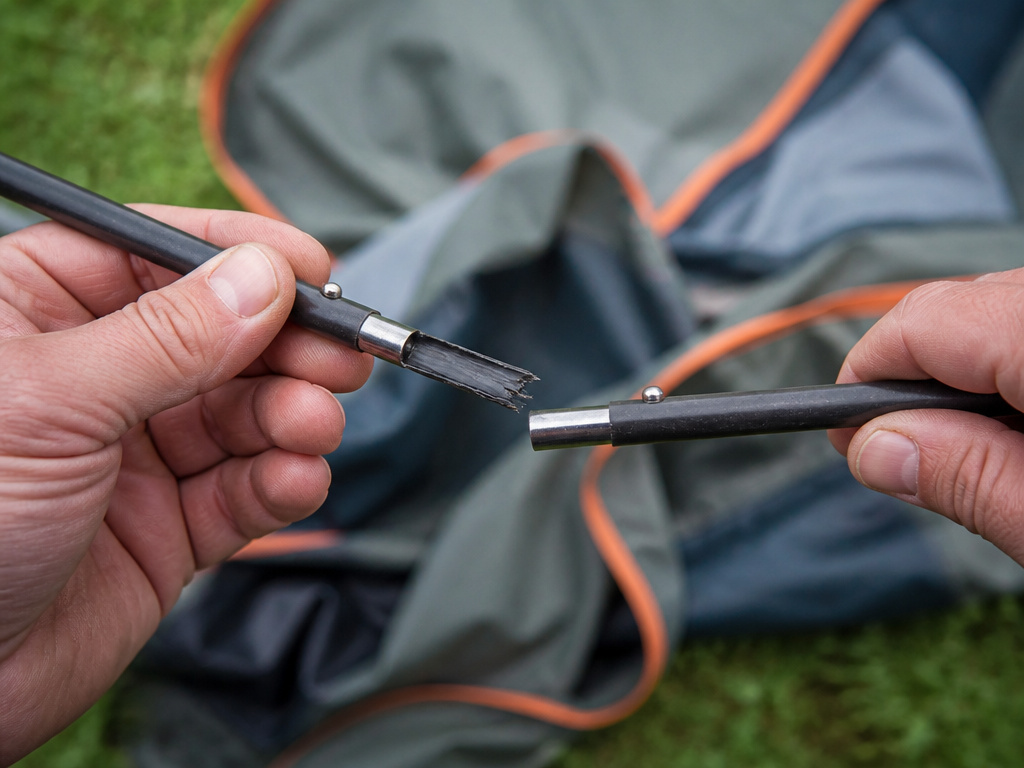
You don’t get a 2-minute setup without sacrificing something. Here are the concrete compromises.
| What You Gain | What You Give Up |
|---|---|
| Speed | Setup in under 2 minutes. |
| Simplicity | No pole segments to connect. |
| Portability | Lightweight and packs into a slim disc. |
| Low Cost | Many models are cheaper than traditional tents. |
| Ease of Use | Great for beginners or one-time events. |
The most critical trade-off is the pole system. Those spring-loaded fiberglass rods are not field-repairable. A traditional tent’s aluminum pole can be splinted with a repair sleeve. A snapped fiberglass pole in a pop-up tent often means the entire tent is trash. I’ve seen it happen in a sudden lakeside squall, one loud crack and the tent folded in on itself like a cheap umbrella.
Common mistake: Using a single-skin pop-up tent in cool or humid conditions, you’ll wake up to a fine mist of condensation on the inner walls, and your sleeping bag will be damp by morning even if it never rained.
Where Pop Up Tents Work Best (And Where They Fail)
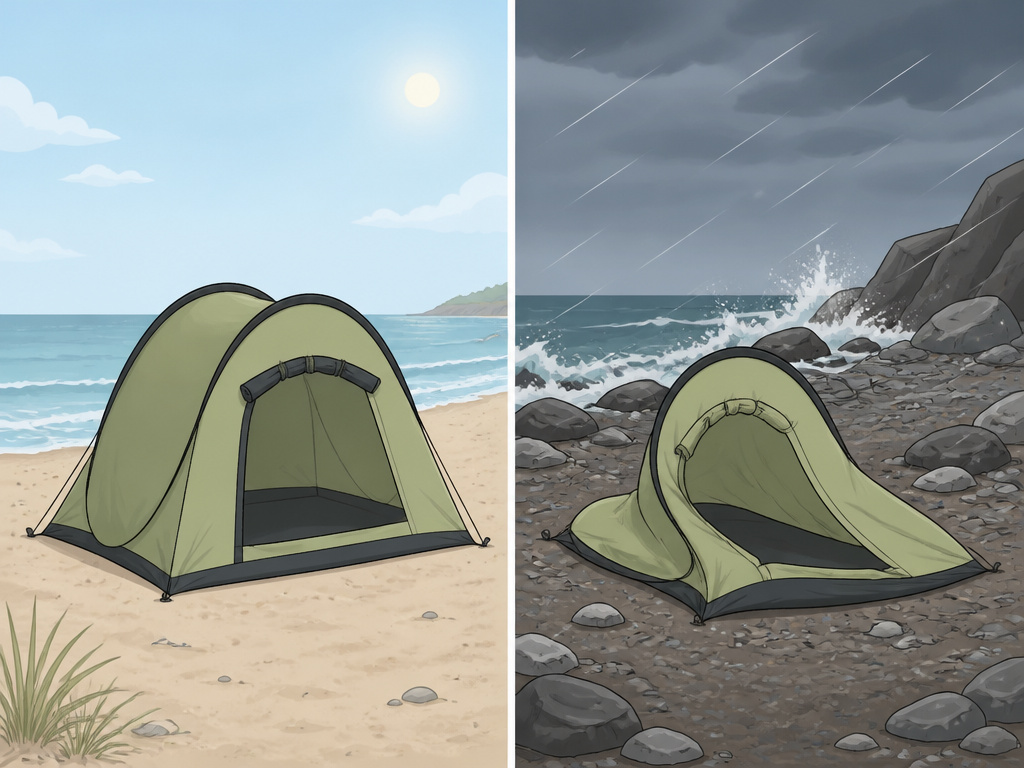
These tents are specialists, not generalists. Matching them to the right job is everything.
They Excel Here:
- Music Festivals: Speed is king. You’re carrying gear a long way, you’re tired, and you just need a private place to crash. A pop-up tent delivers that. The social, fair-weather environment of a festival is its natural habitat.
- Beach Days & Picnics: As a sun shelter or a windbreak for a day at the shore, they’re fantastic. Many pop-up tents for the beach even have UV-reflective coatings.
- Backyard Camping with Kids: The instant gratification keeps kids engaged. If the weather turns, you’re 30 seconds from the back door.
- Emergency Car Shelter: Stash one in your trunk. If you get stranded, you have instant shelter from sun or light rain while you wait for help.
They Fail Here:
- Anywhere Windy: Camping on a coast, in a valley, or on a mountain ridge? The pole structure is a liability. I watched a friend’s Quechua 2-second tent get destroyed by a wind gust at a coastal site, the poles snapped within an hour of pitching.
- Cold or Humid Climates: Without a double-wall design and a separate rainfly, condensation is inevitable. Your breath and body moisture have nowhere to go but onto the cold tent wall, then onto you.
- Multi-Day Trips in Variable Weather: You’re betting on perfect weather for days. That’s a bad bet. A stormproof stand-up tents with a robust pole frame is a safer choice.
- When You Need to Repair Anything: Forget field repairs. A torn seam or broken zipper is often a death sentence because the materials aren’t designed for patching.
If your trip involves the words “backcountry,” “forecast,” or “storm,” choose a different shelter. For a sunny weekend at a managed campground, it might be perfect.
Pop Up Tent vs. Traditional Tent: A Real Choice
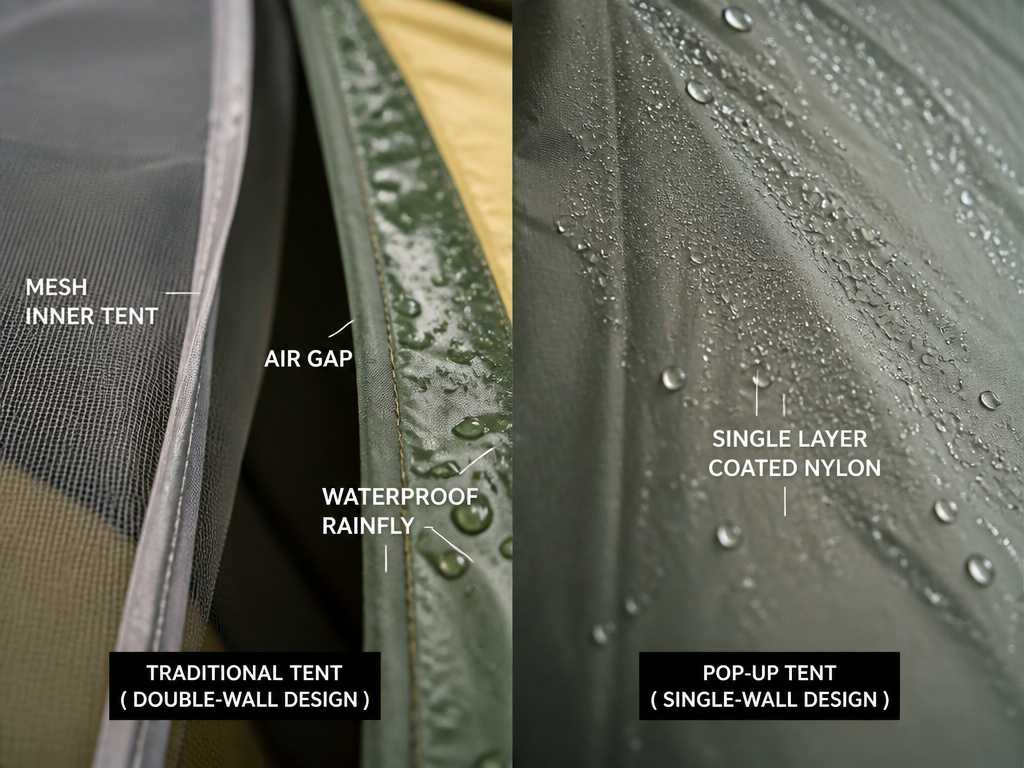
This isn’t a minor difference. It’s a fundamental design philosophy.
A traditional dome or tunnel tent is a kit of parts: separate poles, a separate inner tent, and a separate rainfly. You assemble it. That takes 10-20 minutes. The reward is a structure where each layer has a job. The inner tent breathes. The rainfly sheds water and creates a ventilated air gap to minimize condensation. The poles are stout aluminum that flexes in wind rather than snaps.
A pop-up tent is a single, integrated unit. The poles are part of the walls. The “rainfly” is usually just a waterproof coating on the same fabric. There is no air gap. When the outer fabric gets cold, the moisture in the warm air inside condenses directly on it. This is the physics behind the “pool of water” complaint you read about online.
The choice boils down to time versus resilience. How much is 15 minutes of your time worth on a rainy, windy night? For a festival, the trade is worth it. For a week in the woods, it’s not.
What to Look for If You Buy One
If the use case fits, you can still make a smarter choice. Don’t just grab the cheapest one.
- Double-Wall Design: This is the single biggest upgrade. It means a separate, detachable rainfly. This creates that crucial air gap to reduce condensation. It’s rare in pop-ups, but it exists.
- Higher Denier Fabric: Denier (D) measures fabric thickness. 75D is better than 50D. It won’t stop a pole from breaking, but it might survive a brush with a thorn bush.
- A Good Warranty: Since they break easily, a 1-year warranty is a bare minimum. Some brands offer 2-3 years, which signals slightly better confidence.
- Practice Folding It in the Store: Seriously. Ask the clerk to demonstrate the pack-up. If they can’t do it smoothly in under a minute, imagine doing it in the dark, in the rain.
Your budget matters. A $50 pop-up tent is essentially disposable. If you want something that might last a few seasons, look at the tents under $200 category, where you’ll find better-built instant shelters and also more durable traditional models. For true budget constraints, even a basic budget tents under $100 traditional tent will likely outlast a pop-up.
The Gear They Work With (And What They Replace)
A pop-up tent simplifies your shelter, but you still need the rest of your tent camping equipment. A sleeping pad is non-negotiable because the floor is thin. A good sleeping bag is too, these tents offer little insulation.
They change your packing list in one way: you can leave the pole bag and stakes behind (they’re attached). That’s it. You still need a mallet for the stakes, a ground tarp to protect the floor, and a headlamp for those late-night bathroom trips.
Consider them part of a system for specific trips. For a festival, pair one with battery-powered tent lighting options and a portable power bank. For a beach day, add a cooler and chairs. They are not a substitute for a four-season durable camping tents made of canvas.
If you’re camping in extreme heat, some campers use small portable air conditioners for tents, but that’s overkill for a pop-up’s thin walls. Focus on shade and ventilation instead.
Frequently Asked Questions
Are pop up tents waterproof?
They have a waterproof coating, usually rated between 1000mm and 2000mm. This is enough for a light shower, not a sustained downpour. Waterproofness also degrades with UV exposure and folding. Reapply a DWR treatment once a season if you use it often.
Can one person set up a pop up tent?
Easily. That’s their main advantage. The tossing method works fine solo. The challenge is always packing it up alone, which requires knee-on-tent pressure to compress the poles.
How long do pop up tents last?
With careful use, only on grass, always staked, never in strong wind, folded perfectly every time, you might get 20-30 uses. With typical use (festivals, beaches, kids), expect 1-2 seasons before a zipper fails, a pole snaps, or the fabric delaminates.
What’s the difference between a pop up tent and an instant tent?
In practical terms, nothing. “Instant tent” is often used for slightly larger models that might have a short, simple pole to extend a vestibule, but the core mechanism, pre-attached, spring-loaded poles, is the same. The Cambridge Dictionary definition of pop-up tent captures this perfectly: a tent that opens out to its full size quickly and easily.
Can you repair a broken pop up tent pole?
Rarely. The poles are specific to the model and not sold separately. Some extreme DIYers have splinted them with aluminum tubing and hose clamps, but it’s a bulky, temporary fix. When the poles go, the tent is usually done.
The Bottom Line
A pop-up tent is a brilliant solution to one problem: the need for instant shelter in predictable, fair-weather conditions. It is a tool for festivals, beaches, and backyards. It is not a backpacking tent, a family camping tent, or a storm-ready shelter.
Respect its limits. Stake it immediately. Practice the figure-eight fold at home before you leave. And if you see dark clouds on the horizon, know that you traded away security for speed. For every other kind of trip, the 15 minutes it takes to pitch a real tent is the best insurance policy you can buy.
