
Learn How To Fold Bluey Tent: A Step-By-Step Folding Guide
This post contains affiliate links. As an Amazon Associate, we earn from qualifying purchases.
To fold a Bluey tent, collapse it flat, fold it lengthwise, then twist the ends in opposite directions to form a tight figure-eight. Secure this bundle tightly with the attached fabric ties before bagging it. The opposing twist is critical, doing it wrong lets the spring-steel frame unravel every time.
I’ve pitched my fair share of pop-up tents in gale-force winds, but I’ll admit: the first time I faced the Bluey Family Cruiser Play Tent after my niece’s birthday party, it won. It was a humid, crumb-filled stalemate in a living room. The official advice felt like a suggestion, not a solution. After one too many “quiet pops” of a kinked wire, I got serious.
This isn’t just about following steps. It’s about understanding why the tent fights back, so you can win every time. Let’s break down the real-world method that works, not the showroom demo.
Key Takeaways
- The opposing twist is everything. Twist both ends the same way, and you’re just coiling a spring that will explode in your storage bag. Clockwise for one loop, counter-clockwise for the other locks the tension.
- Secure it with prejudice. The included fabric ties need at least two brutally tight wraps around the figure-eight’s center. I prefer a heavy-duty #64 rubber band from Uline as a backup, its thicker gauge won’t snap.
- Never, ever fold it damp. I learned this with a different tent. A week in a closet with just morning-dew moisture left a galaxy of black mildew spots. It smelled like a forgotten sports bag.
- If a pole kinks, stop pulling. Forcing a stuck section is how you snap the internal steel wire. Lay it flat and massage the fabric around the joint to work the kink free.
- For long-term storage, a quick wipe-down matters. I use a microfiber cloth from The Rag Company’s Eagle Edgeless line, it lifts dust without leaving lint on the Bluey print.
What’s the Secret to the Bluey Tent Fold?
The Bluey Family Cruiser Play Tent (model #BHC-1002, the 102cm tall one) uses a simple X-pole dome frame. Its magic, and frustration, comes from the flexible steel wires sewn into the fabric sleeves. They want to be a dome. Your job is to convince them to be a neat bundle.
The folding procedure for a single-cross pop-up dome involves collapsing the structure flat, performing a longitudinal fold, and applying opposing torsional forces to the ends to form a stable, compact figure-eight shape suitable for bag storage.
The entire process hinges on one non-negotiable physical principle: you must twist the ends in opposite directions. This neutralizes the frame’s circular memory. Do it right, and the tent stays put. Do it wrong, and you’ve created a coiled spring desperate to expand.
TL;DR: Collapse it, fold it longways, twist the ends against each other into a figure-eight, and cinch it down like you mean it.
Step-by-Step: The 7-Second Figure-Eight Fold
Follow this sequence on a clear floor, away from Legos and curious pets.
- Clear and Collapse: Remove all toys and shake out crumbs. Push down on the dome’s center until the entire frame lies completely flat. You should see the two main ribs form an X.
- The Lengthwise Fold: Pick up the flattened tent. Fold it in half lengthwise, bringing one long edge to meet the other, with the character print facing out. Align the seams as best you can, perfection isn’t key here.
- First Twist: Grab one end of this long strip. Twist it into a loop roughly 25-30cm (10-12 inches) in diameter. Hold it firmly.
- The Crucial Opposite Twist: Take the other end. Twist it in the opposite direction to form a second loop. You should now have a figure-eight with the loops stacked.
- Secure the Core: Bring the two loops together. Wrap the attached fabric ties around the center where they cross. Do this at least twice, pulling as tight as you can. Tie a firm knot.
- Bag It: Slide the secured bundle into the storage bag. If it’s a struggle, your loops are too big, make them smaller next time.
Common mistake: Folding the tent in half widthwise (short end to short end) instead of lengthwise. This misaligns the poles, making the figure-eight twist impossible to lock. The tent will spring open within minutes.
Troubleshooting: When Your Tent Fights Back
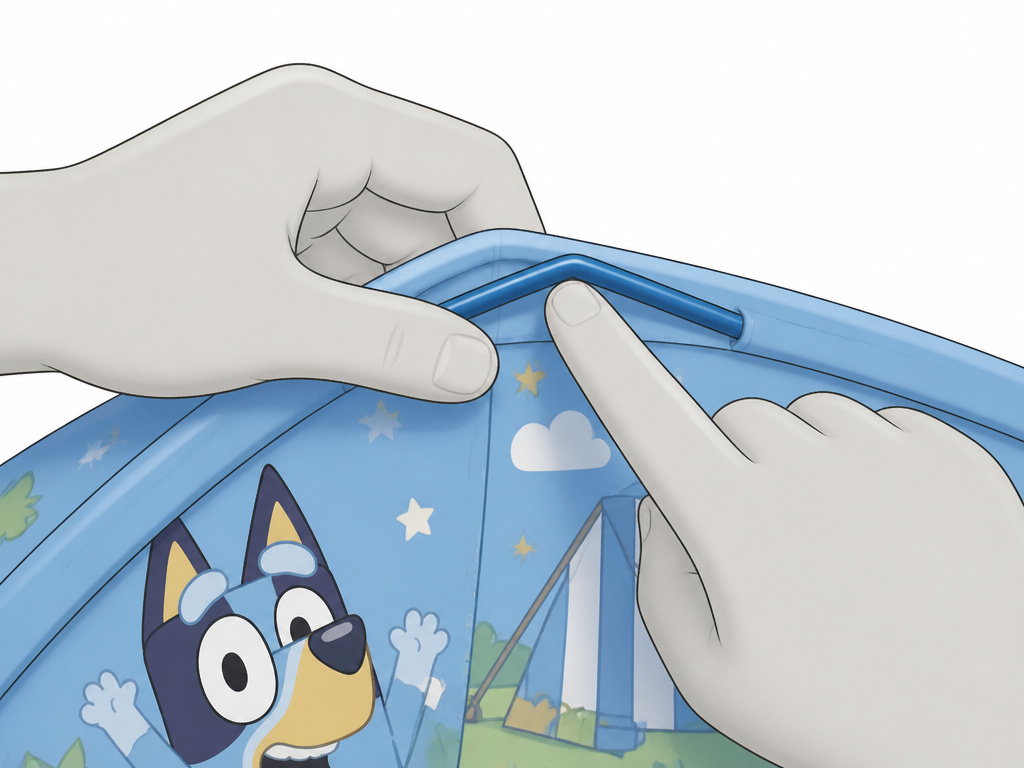
Sometimes, it feels like you’re wrestling an octopus. Here’s what’s actually happening.
The tent feels stiff and won’t collapse flat.
This usually means the poles aren’t fully extended. A correctly assembled, taut dome is actually harder to start folding. Check all four corners are fully “popped.” Give the dome a gentle shake to settle the frame into its natural, relaxed state.
A pole feels stuck or kinked.
Stop pulling immediately. You’ve likely folded across a pole joint. Lay the tent back out flat. Gently massage the fabric around the stuck section to work the kink out of the flexible wire. Forcing it is a one-way ticket to a snapped wire and a lopsided tent forever.
The fabric snags during the twist.
Pause. Find the caught edge, often it’s the roll-up door flap, and carefully smooth it out. Rushing through a snag is how you get a permanent pull or a small tear right through Bingo’s face.
| Problem | Root Cause | Immediate Fix |
|---|---|---|
| Tent slowly expands in bag | Loose or single-wrap tie | Rewrap ties tightly 2-3 times at the center cross. |
| Tent pops open immediately | Ends twisted in the same direction | Unfold completely. Restart, ensuring opposite twists. |
| Bag won’t zip shut | Figure-eight loops are too large | Make smaller, tighter loops (25cm max diameter). |
| One loop constantly unravels | Uneven loop sizes | Unwind and re-form loops to be roughly equal. |
Why Does My Folded Tent Keep Springing Open?
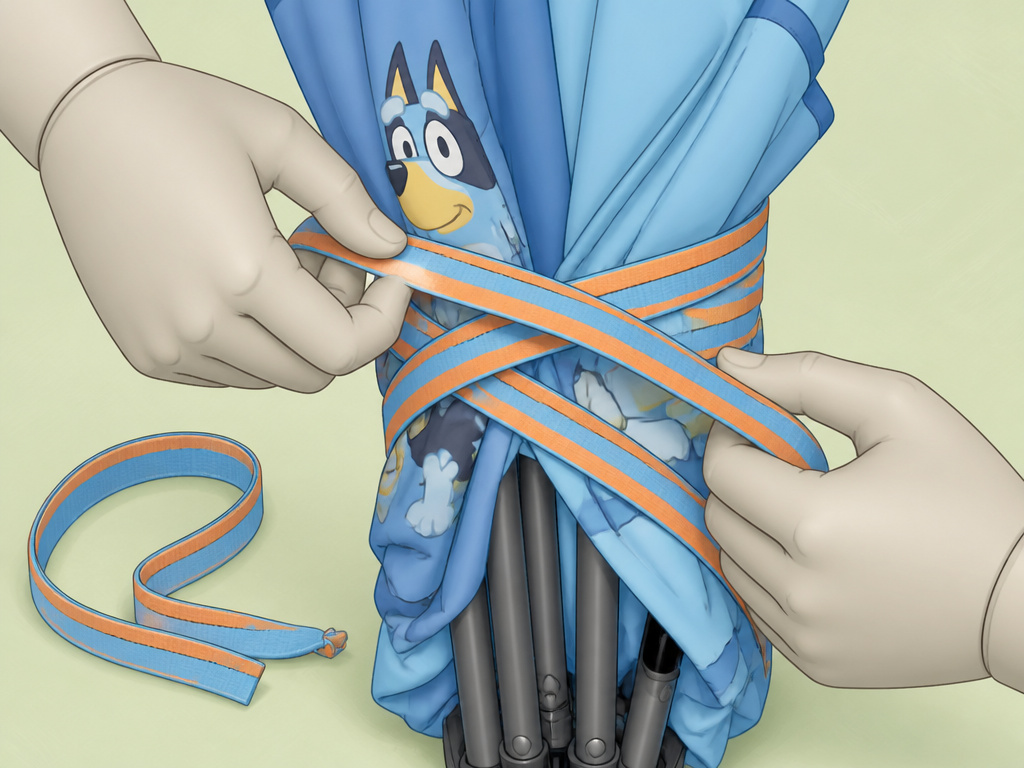
You bagged it. An hour later, the storage bag is bulging like it’s alive. This has one primary cause: insufficient securing.
The ties must make multiple tight wraps at the figure-eight’s center, the knot holding the bundle together. A single loose wrap is just a suggestion to the spring-steel frame. In windy conditions, this is even more critical; a gust can catch loose fabric and undo your work as you fumble with the ties.
If you’ve lost the ties, a heavy-duty rubber band is a good temporary fix. For a permanent solution, a short length of paracord works. Never rely on the bag itself to provide the compression.
This attention to secure fastening is a good habit for all pop-up shelters, whether you’re dealing with simple pop-up beach tents or more substantial stand-up height tents for car camping.
Storing Your Bluey Tent: Quick vs. Long-Term Prep
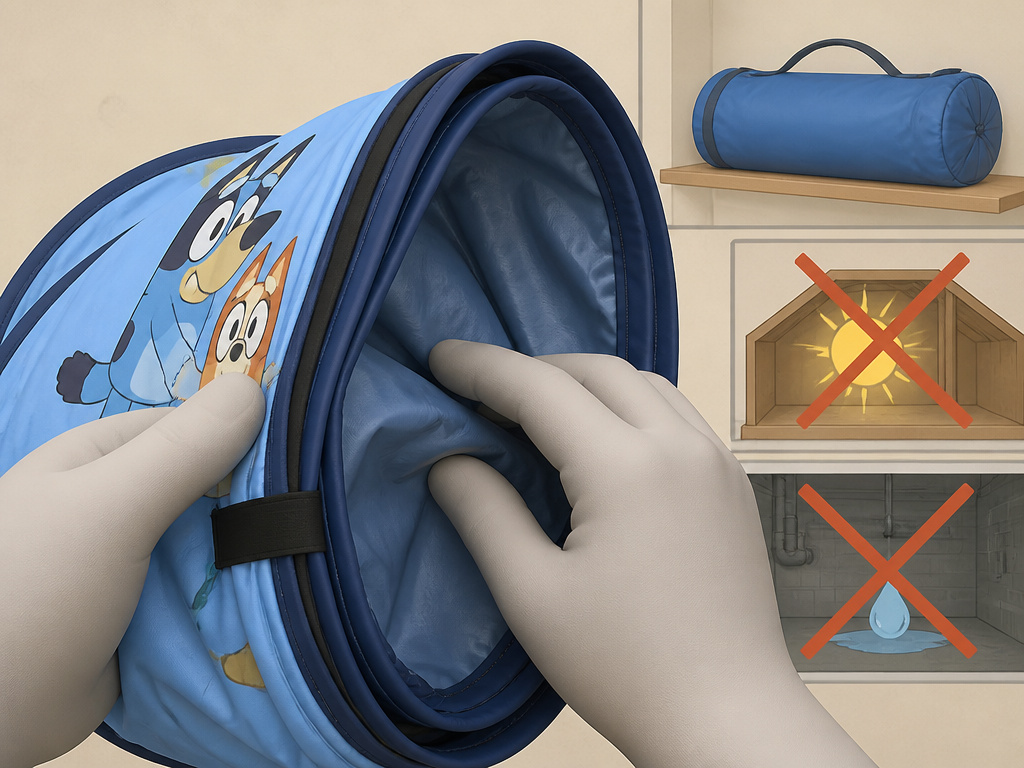
Your post-play cleanup changes based on when the tent will see daylight again.
Quick Storage (overnight or a few days):
You can skip a full clean. Do a quick visual check for large debris and give it a shake. The absolute non-negotiable is checking for dampness. Kids’ breath creates surprising condensation. Run your hand over the interior, if it feels cool or clammy, let it air out for an hour before folding. That hidden moisture is what leads to mildew.
Long-Term Storage (end of season, closet for months):
This demands a proper send-off.
1. Wipe down all surfaces with a dry microfiber cloth. For sticky spots, a slightly damp cloth followed by a dry one works.
2. Ensure it is bone-dry. Let it air out fully indoors for a few hours if you have any doubt.
3. Perform the figure-eight fold and secure it tightly.
4. Store the bag in a cool, dry place, under a bed or on a shelf is ideal. Avoid hot attics or damp basements.
Before you start: Folding a damp tent invites mold spores to grow in the dark, stored environment. A musty smell appears first, followed by grey or black speckling on the fabric within 7-10 days. Once mold sets into the print, it’s permanent.
When storing among other tent camping accessories or camping equipment checklist items, keep the Bluey tent separate from heavier gear that could crush the flexible poles.
How Does the Bluey Tent Compare to Other Pop-Ups?
The Bluey Family Cruiser uses the same basic X-pole frame as many inexpensive pop-up tents and value-priced shelters. The folding principle is universal. The main difference is often the securing system, some quality affordable tents use a plastic buckle strap instead of fabric ties, which can be more secure but slower to fasten.
Larger shelters are a different beast. Spacious group shelters or six-person family tents typically use a hub-and-pole system that doesn’t fold into a figure-eight. If you have a different model, always search for a specific video guide, generic advice will fail.
At 72cm x 72cm, the Bluey is squarely in the children’s play tents category. Its size makes it one of the more manageable pop-ups to master, a great training ground before you graduate to folding bulkier durable canvas shelters or complex large family tents.
Frequently Asked Questions
Can I machine wash my Bluey tent?
Absolutely not. The flexible steel poles inside the sleeves can rust, and the printed fabric will likely shrink or fade. I learned this the hard way with a different tent, the sound of a steel pole rattling in a dryer drum is a special kind of heartbreak. Spot clean only with a damp cloth and mild soap, then air dry completely.
My tent won’t pop up fully anymore. What happened?
You likely have a kinked or bent pole from forcing a fold. Inspect the fabric sleeves for obvious sharp bends. A permanently damaged wire will prevent the frame from achieving its full dome shape. Unfortunately, the poles are not user-serviceable.
Are official replacement storage bags sold?
Not typically, which is frustrating for a popular kids’ item. Your best bet is to measure your folded bundle and use a generic drawstring bag. The key is the secure fold, not the bag itself.
Is there an official folding video?
While not from the manufacturer, a helpful user-uploaded video titled “How To Fold Bluey Play Tent” was posted on February 26, 2022. Searching that phrase on major video platforms will show you the figure-eight fold in motion.
How many kids actually fit inside?
The Bluey Family Cruiser Play Tent, per its official specs on bluey.tv, has a 72cm x 72cm floor. It comfortably fits two small children for play. It’s a play tent, not a sleeping shelter for overnight use.
Before You Go
Folding a Bluey tent isn’t about brute force. It’s a simple puzzle of opposing forces. Master the counter-twist, cinch it down like you’re tying off a sail, and keep it desert-dry before it goes into storage. What feels like a frustrating chore becomes a five-second routine.
The real win isn’t a neatly packed tent, it’s avoiding that moment of defeat when a rainbow-colored dome erupts from its bag as you’re just trying to clean up. Get the twist right, and you’re free to focus on the next adventure, whether that’s in the living room or, for bigger dreams, under actual stars with more serious family camping tents.
