
How Big Is a 10×10 Tent? The Real Space You Get
This post contains affiliate links. As an Amazon Associate, we earn from qualifying purchases.
A 10×10 tent provides a 100-square-foot footprint, but sloping walls reduce the usable standing floor to a central zone of about 64 square feet. The critical measurement is center peak height, typically 7 to 9 feet, which determines if you can stand up and how much interior volume you truly have for people and gear.
You see “10×10” and picture a perfect square room. You start mentally arranging cots, a table, and your gear. Then you pitch it, step inside, and immediately bump your head on the fabric two feet from the wall. That perfect room vanished into thin air, stolen by geometry.
The label tells a half-truth. The footprint is 10 feet by 10 feet. But the living space, where you can actually stand, walk, and store gear you can access, is a different, smaller world defined by wall slope and peak height. I’ve learned this the hard way, in the rain, with a soaked sleeping bag as my teacher.
Let’s move past the marketing math and measure the real, livable dimensions of a 10×10 shelter.
Key Takeaways
- The advertised 100 sq ft is mostly a ghost. Sloping walls create a “dead zone” around the perimeter, leaving a central 8×8 foot square (64 sq ft) as your primary living area.
- Center peak height is the king of specs. A 9-foot peak, like on the Celina Tent Pinnacle Series, creates stand-up room for a 10-foot diameter circle. A 7-foot peak means you’ll only stand directly in the center.
- A 10×10 pop-up canopy provides zero enclosed shelter, it’s just a roof for shade. A frame tent with walls offers real protection but requires careful planning to use its full volume.
- Manufacturer capacity claims are for sleeping bags on the floor. For realistic car camping with cots and gear, a 10×10 comfortably fits two adults. Three is cozy, and four means storing bags outside.
- Always check the packed size. A frame tent like the Celina Classic Series breaks down into a 48-inch long bag; test-fit it in your vehicle with all your other essential camping gear before you buy.
What is the actual usable floor space in a 10×10 tent?
You get 100 square feet of ground cover. You get about 64 square feet of space where an adult can stand up without becoming a human tent pole.
A 10′ x 10′ frame tent’s usable interior is defined by the slope of its walls from the peak to the eaves. The central area where the wall slope is less than 45 degrees constitutes the primary living space, often forming an 8′ x 8′ square within the full footprint.
The walls aren’t vertical. From the moment you step inside, the ceiling is already angling down toward your head. That outer 12 to 18 inches around all four sides becomes a low-ceiling storage nook, not a place to walk or sleep.
TL;DR: Your functional floor is an 8×8 foot square in the very center. The perimeter is for stashing gear you don’t need to stand up to reach.
The gear zone versus the living zone
Think of the tent in two distinct layers. The outer foot is your gear shelf. This is where you line up plastic storage bins, coolers, and duffel bags. The inner 8×8 square is your living room and bedroom combined.
Common mistake: Pushing a cot against the wall to “save space”, the result is a soaked sleeping bag from condensation runoff and a nightly claustrophobic headache from the fabric inches from your face.
I learned this on a soggy trip in the Adirondacks. I’d squeezed a Teton Sports Outfitter XXL cot too close to the wall of a generic 10×10. A sudden overnight downpour caused the shallow sidewall to sag inward, touching my footbox. By morning, the down in my bag was soaked through. Now, I keep all sleeping surfaces firmly in that central zone, using the perimeter strictly for my Yeti cooler and Action Packer bins.
How does peak height change the feel of a 10×10 tent?
If floor space is the stage, peak height is the spotlight. It defines everything. A tent can be 10×10 with a 7-foot peak or a 9-foot peak, and they are fundamentally different shelters.
A 7-foot peak means the highest point is just brushing the hair of someone who is 6’2”. The ceiling plummets from there, creating a tight, narrow volume. A 9-foot peak, like on the 10’ x 10’ Pinnacle Series High Peak from Celina Tent, creates airy, vertical space that allows you to move.
This difference is best shown by the stand-up radius, how far from the center you can walk without ducking.
| Peak Height | Stand-Up Radius | Real-World Consequence | Best Match For |
|---|---|---|---|
| 7 feet | 2–3 feet from center | One person can stand in the center to change. Reaching gear on the perimeter requires crouching. | Minimalist storage, low-wind areas, or as a supplementary gear tent. |
| 8 feet | 3–4 feet from center | Two people can stand near the center simultaneously. The central 6–8 ft diameter circle is comfortable. | Most family camping shelters, offering a balance of space and stability. |
| 9 feet | 5+ feet from center | Creates a true room-like feel. You can walk under most of the peak and access wall gear with a slight bend. | A social basecamp tent or shelter where standing room is a priority. |
Wait, scratch that clinical “stand-up radius” talk. What you really want to know is: can you put your pants on without performing a precarious one-legged hop while sitting on your cot? With a 9-foot peak, yes. With a 7-footer, you’re doing the campsite hobble, one leg at a time, hoping nobody’s watching through the mesh window.
How many people can comfortably sleep in a 10×10 tent?
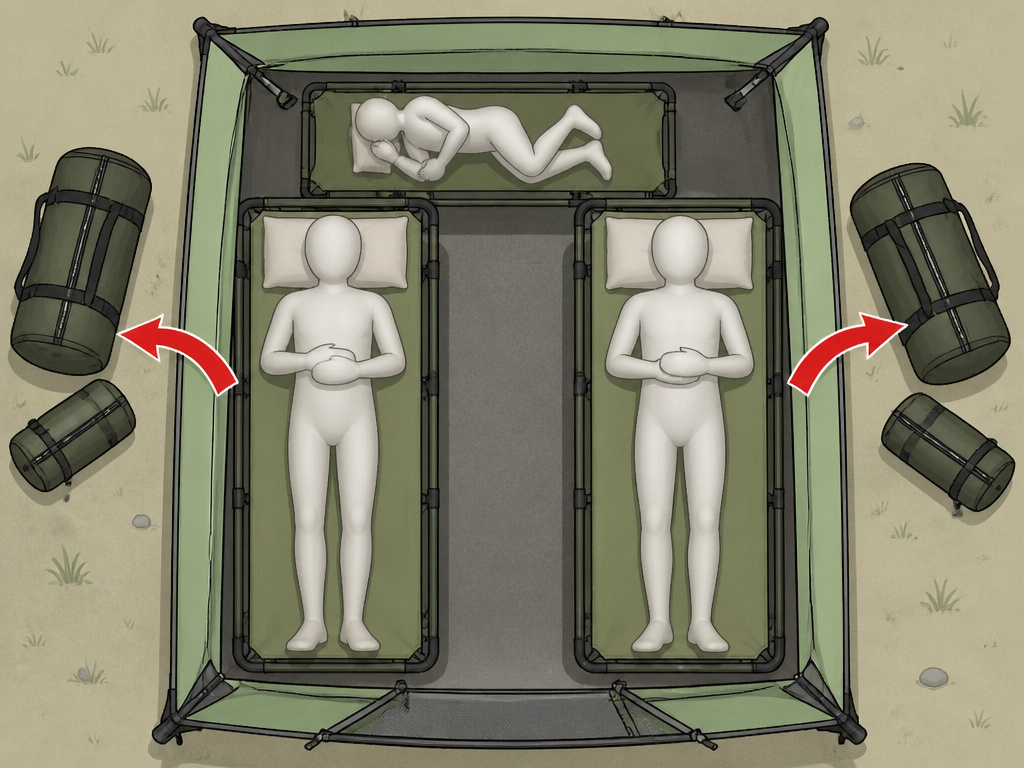
Forget the “4-person” or “6-person” label on the box. Those numbers assume a grid of sleeping pads on the floor, like sardines, with backpacks hung outside. For car camping with real beds and luggage, you need a different math.
| Camping Style | Realistic Capacity | Sample Layout | The Reality Check |
|---|---|---|---|
| Ultralight Backpacking | 4 adults | Four sleeping pads in a 2×2 grid. | Only works if all gear stays in vestibules or is ultra-minimal. Impractical for more than one night. |
| Car Camping with Cots | 2 adults, maybe 3 | Two cots (e.g., Coleman ComfortSmart) placed head-to-toe along walls, aisle between. A third cot can fit if you use narrow backpacking cots and accept minimal walkway. | This is the sweet spot. Two is comfortable. Three requires careful choreography and moving bags outside. |
| Family with Kids | 2 adults + 2–3 children | Parents on a queen air mattress on one side, kids on pads or narrow cots on the other, gear bins along the back wall. | Kids don’t mind the lower ceiling zones. This layout works well, making a 10×10 a solid mid-size family tent option. |
| Basecamp/Social Hub | 0 sleepers, 6–8 seated | Six folding chairs in a circle with a small table in the center. A cooler fits beside a chair. | Perfect for a card-playing or dining space out of the rain, but you’ll need separate spacious camping shelters for sleeping. |
I once tried to host three adults for a weekend in my 10×10 frame tent. We had three cots and three full-size duffels. The third duffel had to live in my car. Getting dressed in the morning was a silent, cooperative dance we all mastered by day two. It was doable, but it confirmed my rule: a 10×10 is a two-person palace or a three-person pact.
What is the difference between a frame tent and a pop-up canopy?
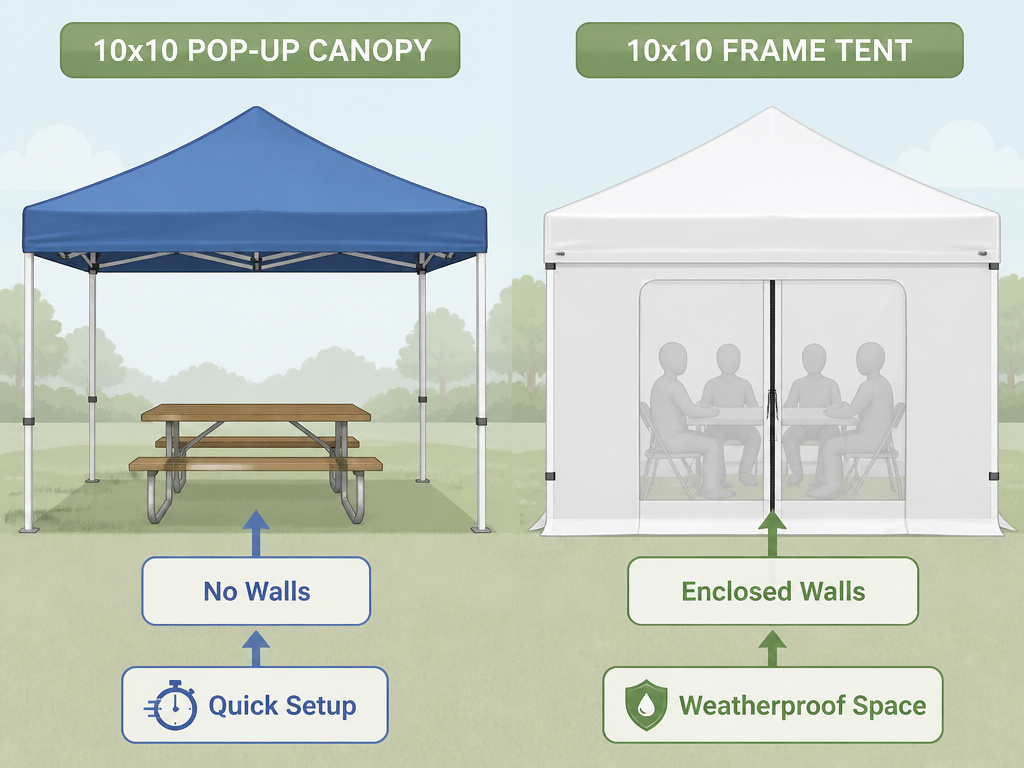
This is the most crucial distinction. “10×10” describes a footprint, not a function. A frame tent is a room. A pop-up canopy is a roof.
A model like the E-Z UP Eclipse HUT 10×10 Canopy sets up in 60 seconds and provides glorious shade over a picnic table. But let a rainstorm roll in with any crosswind, and everyone and everything underneath gets drenched. It has no walls, no bug protection, and limited wind resistance.
A frame tent, such as the Mastertent 10x10ft Square model, is built for enclosure. Its walls (often removable) provide shelter from rain, wind, and insects, creating a private, weatherproof space. The trade-off is setup time and the consumption of interior volume by those very walls.
TL;DR: Buy a canopy for a daytime beach trip or tailgate. Buy a frame tent if you need to sleep, change clothes, or wait out a storm.
The condensation caveat for enclosed tents
Here’s a specific failure mode for fully enclosed 10×10 frame tents: they can become saunas. With four people breathing in a sealed 1000-cubic-foot space, moisture has nowhere to go. It condenses on the cooler ceiling fabric and drips.
Common mistake: Zipping all the doors and vents shut on a cool night to stay warm, you’ll wake up to a steady plink… plink… of condensation on your forehead and damp gear.
The fix is mandatory ventilation. Always crack a vent or door panel opposite the wind direction, even in rain. Models with roof vents, like some durable canvas tents, handle this far better than single-layer polyester pop-ups.
What are the 3 critical measurements to check before buying?
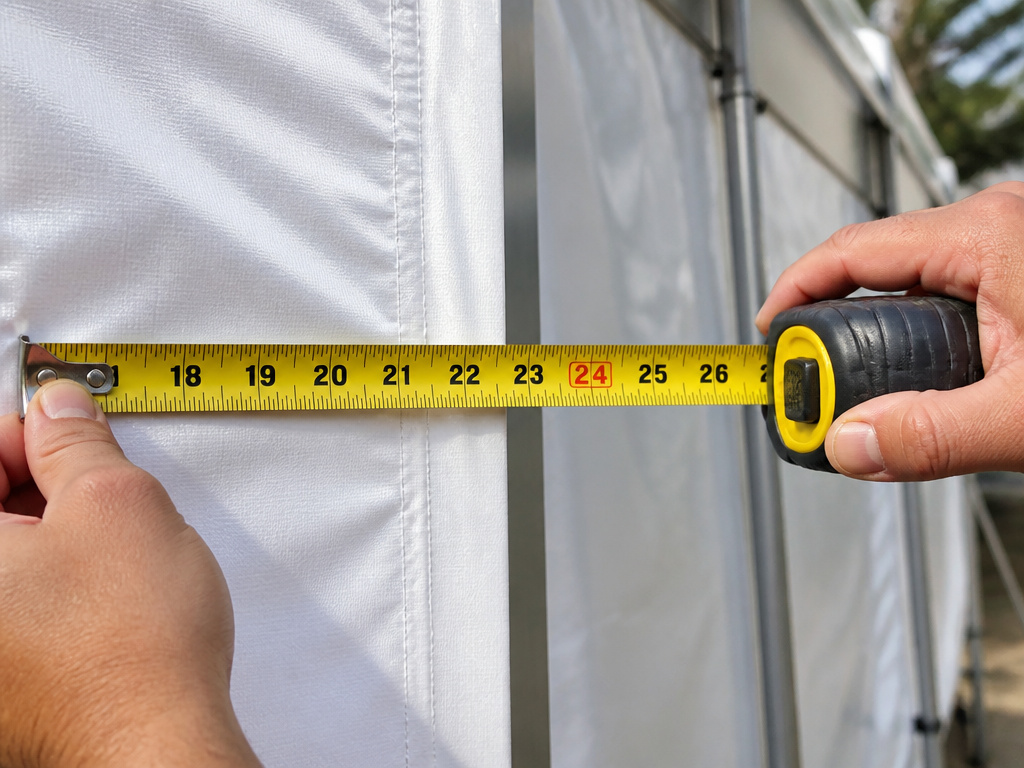
Don’t shop by footprint alone. These three specs reveal the truth about livability.
- Center Peak Height (in feet). This is non-negotiable. Find it in the manual or spec sheet. For reference, the Celina Tent Classic Series Frame Tent manual lists detailed setup but always confirm the final pitched height. Under 8 feet will feel cramped for most adults.
- Sidewall Height (in inches). This is the vertical height of the wall before it begins its slope to the peak. A higher number (e.g., 24 inches vs. 18 inches) means more usable volume near the perimeter. It’s the difference between storing a tall cooler and a short bin.
- Packed Dimensions & Weight. This is logistics. That 48-inch long bag for the Celina tent needs to fit in your vehicle with all your other kit. If you drive a small SUV, this might mean strapping it to the roof rack, a lesson I learned the hard way when a rainstorm turned my roof-strapped tent bag into a mildew incubator.
Packing a wet 10×10 frame tent is a two-person chore. The soaked polyester has a distinct, damp-dog smell, and the aluminum poles, cold and slick, always seem to find a way to whack your shin as you wrestle it into its bag. Checking the packed size isn’t just about transport; it’s about understanding the physical reality of the product off-season.
Frequently Asked Questions
Is a 10×10 tent big enough for a family of four?
Yes, if the children are young and you use sleeping pads. For a family with older kids or anyone using cots or air mattresses, it becomes very tight. Most families of four are better served by a dedicated six-person family tent for comfort and gear storage.
Can you stand up in all of a 10×10 tent?
No. You can only stand fully upright in the center, and only if the peak height exceeds your height. Due to wall slope, you will need to duck or crouch long before you reach the sides, typically within 3-4 feet of the center in an average model.
What is the best use for a 10×10 pop-up canopy?
It’s ideal for providing shade at daytime events: tailgates, farmers markets, beach days, or over a picnic table at a campground. It is not suitable for overnight shelter, storage in windy or rainy conditions, or as a privacy screen.
How do I know if a 10×10 tent will be stable in wind?
Look for models with robust, interconnected frame designs (like a truss system) and ample guylines. Heavy-duty storm-resistant tents for this size will emphasize these features. Always use all provided stakes and guylines, regardless of the weather forecast.
Are there affordable 10×10 tent options?
Yes, but prioritize frame strength over bells and whistles. Some solid budget-friendly tents in this category exist, but be wary of the lightest, cheapest models in windy conditions, they can be prone to failure.
The Bottom Line
A 10×10 tent is a study in managed expectations. The number on the box promises a room, but the physics of fabric and poles deliver a central living pod surrounded by storage nooks. Your success with it hinges entirely on understanding peak height and respecting the slope.
Use it as a cozy shelter for two, a tight bunkhouse for three, or a brilliant daytime hub for a group. Just never assume you’re getting a full 100 square feet of walk-around space. For those needing more volume, exploring our guides on large-capacity tents or tents for heavy rainfall is the logical next step. Your perfect shelter isn’t just about the footprint; it’s about the three-dimensional world inside it.
