
Learn How to Choose a Tent | Avoid Common Camping Mistakes
This post contains affiliate links. As an Amazon Associate, we earn from qualifying purchases.
Choosing a tent requires matching three things: the number of people and gear you need to shelter, the weather you expect to face, and the weight you are willing to carry. The floor length must exceed your height by at least six inches, and the packed weight should stay under three pounds per person for backpacking. Get any one of these wrong, and you buy a shelter that fails when you need it most.
Most guides tell you to pick a capacity and a season. They skip the part where you wake up with your face pressed against wet nylon because the floor is six inches too short. They don’t mention that the “two-person” label from one brand is a coffin while another feels like a palace. The difference isn’t marketing. It’s in the specs you didn’t know to check.
This guide walks through the four decisions that actually matter. We will cover how to decode capacity labels, when to ignore a 4-season rating, why floor denier matters more than you think, and how to avoid buying a tent that won’t fit your actual campsite.
Key Takeaways
- Tent capacity labels are lies. Always buy a tent rated for one more person than you plan to sleep in it. A “4-person” tent fits four sleeping bags and nothing else.
- A 90-inch floor length is the minimum for anyone over six feet tall. The standard 84 to 88 inches leaves your head and feet touching the walls, which leads to condensation soak.
- The three-pound-per-person rule is the backpacking sweet spot. Lighter than that, you sacrifice durability and weather protection. Heavier, and you’re carrying a car-camping tent on your back.
- D-shape doors keep more bugs out than arched doors when you leave them partially unzipped for ventilation on muggy nights.
- Practice pitching your new tent in your backyard before the trip. A first setup in the rain at dusk is a recipe for a miserable night.
The 4-Step Decision Framework That Works
Forget scrolling through hundreds of models. Answer these four questions in order, and your options will narrow to a manageable handful.
First, who and what are you sheltering? Second, what weather are you defending against? Third, how will you get it there? Fourth, what small details will ruin your trip if you get them wrong?
Choosing a tent is a series of trade-offs between space, weight, durability, and weather protection. No single tent excels in all four areas. A 3-season backpacking tent prioritizes weight and ventilation, while a 4-season mountaineering tent prioritizes strength and snow load capacity at the expense of weight and breathability.
TL;DR: Decide on capacity first, then seasonality, then weight, and finally livability features. This sequence prevents you from buying a feature-heavy tent that’s too heavy to carry or a light tent that can’t handle a summer thunderstorm.
Who (and What) Are You Sheltering?
Manufacturer capacity numbers are a fantasy. They represent the maximum number of average-sized sleeping pads that can be laid side-by-side on the floor, with zero space for gear.
| Stated Capacity | Realistic Sleeps | Recommended For |
|---|---|---|
| 2-person | 1 person + gear | Solo backpackers, couples who sleep very close |
| 3-person | 2 people | Two backpackers who want space for packs inside |
| 4-person | 3 people | Two adults and a child, or two adults with a large dog |
| 6-person | 4 people | A family of four, or three adults with ample gear storage |
For car camping, you can stretch these numbers a bit. For backpacking, you cannot. Your backpack, boots, and food bag take up space. If you are camping with a dog, add one full person to the capacity count. A 50-pound lab needs about as much floor area as a human.
The floor area specs tell the real story. A typical two-person tent offers 29 to 33 square feet. That is barely enough for two sleeping pads. For two people and a child, you need at least 40 square feet. For a family of four with a dog, look at large family tents in the 75 to 88 square-foot range, like those in our guide to nine-person tents.
Common mistake: Trusting the “person” count on the box — you will end up with a claustrophobic shelter where everyone’s gear stays outside and gets wet.
What Weather Are You Defending Against?
This is the seasonality question, and most people overbuy.
A 3-season tent (spring, summer, fall) is the right choice for probably 95% of campers. It uses lightweight poles, has large mesh panels for ventilation, and includes a waterproof rain fly. It handles rain and wind, but it is not designed for heavy snow load or brutal, sustained winter winds.
I won’t recommend a 4-season tent for anyone who isn’t winter camping or mountaineering. The extra pole structure and heavier, less-breathable fabrics add pounds and cost for no benefit on a summer trip. You will roast on a warm night because you cannot open enough vents.
A 4-season or mountaineering tent is a specialty tool. It has more pole intersections for strength, heavier fabrics, and minimal mesh to retain heat. It is built for fierce winds and substantial snow loads. The trade-off is weight, cost, and poor ventilation in mild weather.
An extended-season tent is a hybrid, often with closable mesh panels. It is a good choice if you camp in shoulder seasons with unpredictable weather or light snow.
For standard summer camping, a 3-season tent is perfect. If you camp in heavy rain or exposed, windy coastal areas, prioritize models with robust pole structures and full-coverage rain flies, which we cover in our review of the best tents for heavy rain.
How Will You Get It There?
This question splits the world into car camping and backpacking. The dividing line is weight.
For car camping, weight is a minor concern. You can prioritize space, standing height, and extra rooms. Look for stand-up tents with vertical walls and large windows.
For backpacking, every ounce counts. You need to understand two weight metrics:
* Minimum Trail Weight: The tent body, rain fly, and poles only.
* Packaged Weight: Everything that comes in the box (stakes, stuff sacks, repair sleeve).
Your real pack weight will be somewhere in between. A good rule of thumb for standard backpacking is to aim for a packed weight of about three pounds per person. If you are splitting a two-person tent with a partner, that means a total packaged weight of around six pounds.
Before you start: Practice setting up any new tent at home first. In the dark, with a headlamp, in the rain, a complex pole system becomes a tangled nightmare. A faulty pole or a missing stake is a problem you want to discover in your backyard, not at a remote trailhead.
Ultralight backpackers will push for one pound per person or less. This requires major trade-offs: single-wall construction (more condensation), non-freestanding designs (mandatory staking), and thinner fabrics that snag easily. My first ultralight tent was a Big Agnes Fly Creek. It saved weight but felt like sleeping in a nylon coffin. I now use a slightly heavier REI Half Dome 2 for the extra space.
What Small Details Will Ruin Your Trip?
The big three (capacity, season, weight) get you 80% of the way. The last 20% is in the details that manufacturers bury in the specs.
Floor Length: This is non-negotiable. If you are over six feet tall, you need a floor length of at least 90 inches. The industry standard is 84 to 88 inches, which forces tall campers to sleep diagonally. Many two-person tents and one-person tents designed for backpacking skimp here.
Floor Denier: Denier (D) measures fabric thickness. A higher number is more durable. For car camping, 75D is robust. For backpacking, 30D is a common balance. If you have a dog, prioritize a higher denier floor (70D or more) or use a footprint. Dog claws puncture 20D nylon instantly.
Door Shape: An arched door is cheaper to manufacture. A D-shape door has a flat bottom. When you unzip it halfway for ventilation on a buggy night, the D-shape leaves a smaller opening for insects to crawl through.
Vestibules: A vestibule is a covered porch outside your door for storing wet boots and packs. One vestibule is standard. Two vestibules, one for each door, are a game-changer for tents for couples, giving each person their own gear storage and exit.
The Three-Pound-Per-Person Rule (And When to Break It)
That three-pound-per-person target for backpacking is a sweet spot. It balances shelter strength with the reality of a loaded pack. Going lighter means making sacrifices.
| Weight per Person | Tent Type | Trade-Offs |
|---|---|---|
| < 2 lbs | Ultralight / Minimalist | Single-wall (condensation), non-freestanding (requires stakes), thinner fabrics (less durable) |
| 2 – 3.5 lbs | Standard Backpacking | Double-wall, often freestanding, good durability/weight balance. The “goldilocks” zone. |
| > 3.5 lbs | Car Camping / Expedition | Heavy materials, complex pole structures, more space. Too heavy for comfortable long-distance hiking. |
Why does this matter? A tent that’s too heavy will ruin a multi-day hike. A tent that’s too light might fail in a moderate storm. I learned this on a three-day coastal hike where a wind-resistant shelter was critical. My sub-two-pound tent shuddered and leaked mist through the single wall all night. I swapped it for a 3.2-pound model before the next trip and slept through a similar storm dry and secure.
Freestanding versus non-freestanding is the other big weight trade-off. Freestanding tents use poles that create a rigid structure, so you can pick up and move the pitched tent. Non-freestanding tents rely on stakes and guylines to hold their shape. They are lighter but useless on rocky ground where you cannot drive a stake.
Where Your Perfect Tent Will Fail (Site and Setup)
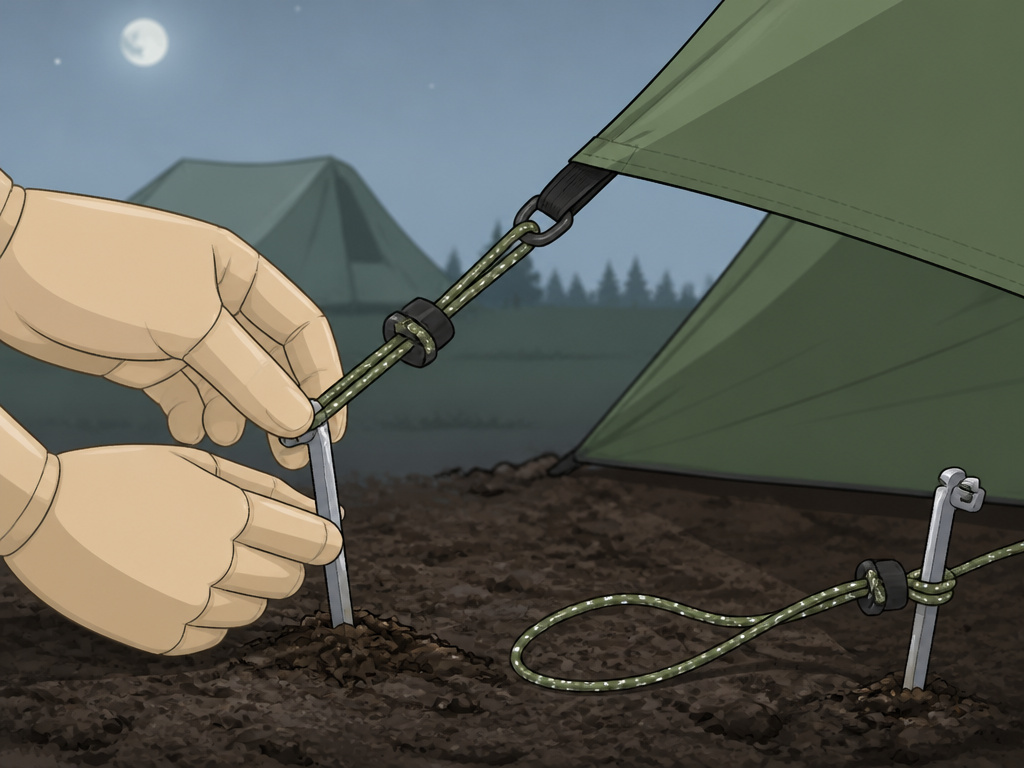
You can buy the perfect tent and still have a miserable night if you ignore the ground under it and the sky above it.
Campsite Limitations: Many established campgrounds have tent pads sized for standard four-person tents (around 56–60 square feet). Showing up with a massive 100-square-foot canvas tent means you cannot fit on the pad. Check the site dimensions before you book.
Pitch it at home first. Every tent has quirks. Color-coded clips? Poles that only fit one way? A rain fly that’s tricky to orient? Figure it out in your living room or backyard. The first time you feel rain drops while fumbling with an unfamiliar pole sleeve is the last time you’ll skip this step.
Ventilation is not optional. Even on a cool night, you exhale moisture. Without adequate airflow, that moisture condenses on the cold tent walls and rains back down on you. Always use the rain fly’s vents. In humid climates, prioritize tents with large mesh panels. If you zip everything up tight, you will wake up damp.
Common mistake: Staking out a rain fly taut on a calm evening — when the temperature drops, the fabric contracts and can rip the stake loops or overstress the seams. Leave a little slack in the guylines.
Budget vs. Reality: What Your Money Actually Buys
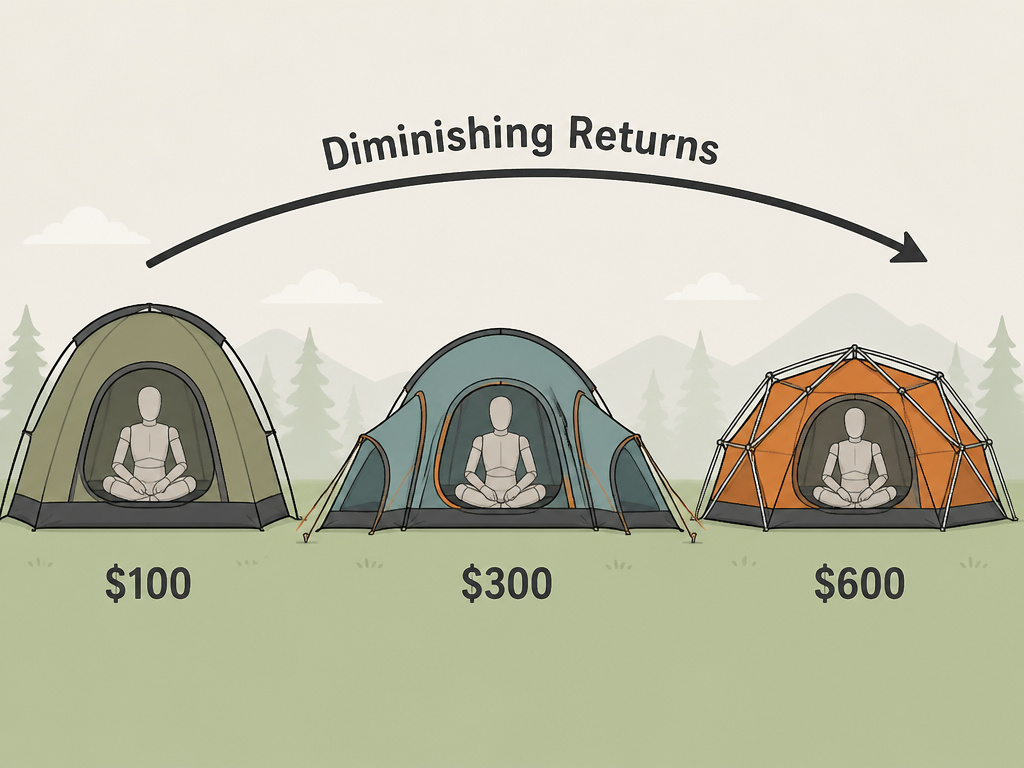
Tent pricing follows a brutal curve of diminishing returns. A $100 tent keeps you dry. A $300 tent keeps you dry with more space and less weight. A $600 tent keeps you dry in a blizzard on a mountain.
For casual car campers who go out three weekends a year in good weather, a tent under $100 is perfectly adequate. The zippers might be cheaper, the pole segments might be thinner, and it will probably weigh a ton. But it works.
The mid-range ($150–$300) is where most backpackers live. This gets you name-brand materials (like DAC aluminum poles), better waterproof coatings, and thoughtful designs like dual vestibules. Our roundup of the best tents under $200 highlights the best value in this critical zone.
The premium tier ($400+) buys specialization: extreme lightweight, expedition-grade durability, or four-season protection. You are paying for marginal gains in weight savings or strength. Don’t buy a premium tent for extreme weather for summer festival camping.
Frequently Asked Questions
What is the biggest mistake people make when choosing a tent?
They buy for the dream trip, not the real one. They buy a four-season mountaineering tent for summer car camping, or an ultralight coffin for a family festival weekend. Match the tent to the 90% of trips you will actually take.
Is a 3-season tent okay for winter?
No. A 3-season tent cannot handle snow load. The mesh panels allow wind to blow through, making it impossible to retain heat. In a winter storm, the structure may collapse. For winter camping, you need a 4-season tent.
How important is a footprint?
footprint (a separate groundsheet) protects the tent floor from abrasion and punctures. It is mandatory for lightweight backpacking tents with thin floors (20-30D) and highly recommended if you camp with a dog. For heavy-duty canvas tents or car-camping tents with thick floors, it is less critical.
Can one person set up a large family tent?
It is challenging. As noted by REI specialist Luca Stewart, the largest 8- to 10-person tents can be unwieldy for one person. They have long, heavy poles and large fabric sections that act like sails in the wind. Always recruit a second set of hands for tents designed for six or more people.
How do I stop condensation in my tent?
Maximize ventilation. Always use the rain fly vents. Pitch the tent where a breeze can pass through it. Avoid camping right next to water. Do not cook inside the tent. If condensation forms, wipe it down in the morning with a microfiber towel before packing up.
Before You Go
Ignore the flashy features and marketing hype. Your tent is a simple shelter. The right one disappears into the background of a great trip. The wrong one becomes the main character of a bad story.
Start with honest capacity. Add a person for gear or pets. Choose a 3-season model unless you are chasing snow. Use the three-pound-per-person rule to guide your backpacking search. Then, check the details: a 90-inch floor if you are tall, a high-denier floor for dogs, and D-shape doors for buggy nights.
Finally, buy from a retailer with a good return policy. Pitch the tent in your home. Lie down inside. If it feels right for the trips you actually take, you have found your shelter. Now go use it.
