
How to Insulate a Tent for Winter Camping Safely
This post contains affiliate links. As an Amazon Associate, we earn from qualifying purchases.
To insulate a tent for winter, you must combat three heat-loss paths: conduction through the ground, convection through the walls, and ventilation for air quality. Success requires a high-R-value sleep system, reflective barriers with an air gap, and a strict ventilation protocol, especially when using a stove.
Most winter campers think insulation is about sealing heat in. They tape up emergency blankets, zip the vents shut, and wonder why they wake up damp, chilled, and with a pounding headache. The real challenge isn’t just adding warmth, it’s managing the moisture and carbon monoxide that come with it.
I’ve learned this through shivering nights and gear-soaking mistakes in my trusty MSR Hubba Hubba NX. This guide ditches the generic advice for physics-backed methods from a peer-reviewed military study and my own frosty trials. We’ll cover why 4cm of loft matters, how 0.016 kg/s of airflow can save your life, and the one piece of gear that matters more than your sleeping bag.
Key Takeaways
- Your sleeping pad is your primary defense. Ground conduction steals heat relentlessly; a closed-cell foam pad like a Therm-a-Rest Z Lite Sol paired with an insulated inflatable mat is non-negotiable.
- Ventilation is a calculated trade-off. A minimum of 0.016 kg/s of airflow is required to manage carbon dioxide with a stove, but this also strips heat, you must compensate with insulation.
- Reflective materials like SOL Emergency Blankets only work with a maintained air gap. Pressed flush against the tent wall, they create a condensation highway and conduct cold.
- Tent size and construction directly impact warmth. A smaller tent is easier to heat, and a taut pitch can compress insulation layers, cutting their effectiveness by half.
- Carbon monoxide is a silent, cumulative threat. A dedicated battery-powered detector like the Kidde Nighthawk KN-COPP-B is as essential as your sleeping bag when any fuel is burned.
For a small tent with a surface area of 15 m² heated by a 2000 W stove, a minimum batting thickness of approximately 4 cm is required to achieve an average internal temperature of 55°C above ambient. This assumes a ventilation rate of 0.016 kg/s to maintain a 1% by volume carbon dioxide concentration.
Why Does Your Tent Feel Like an Icebox?
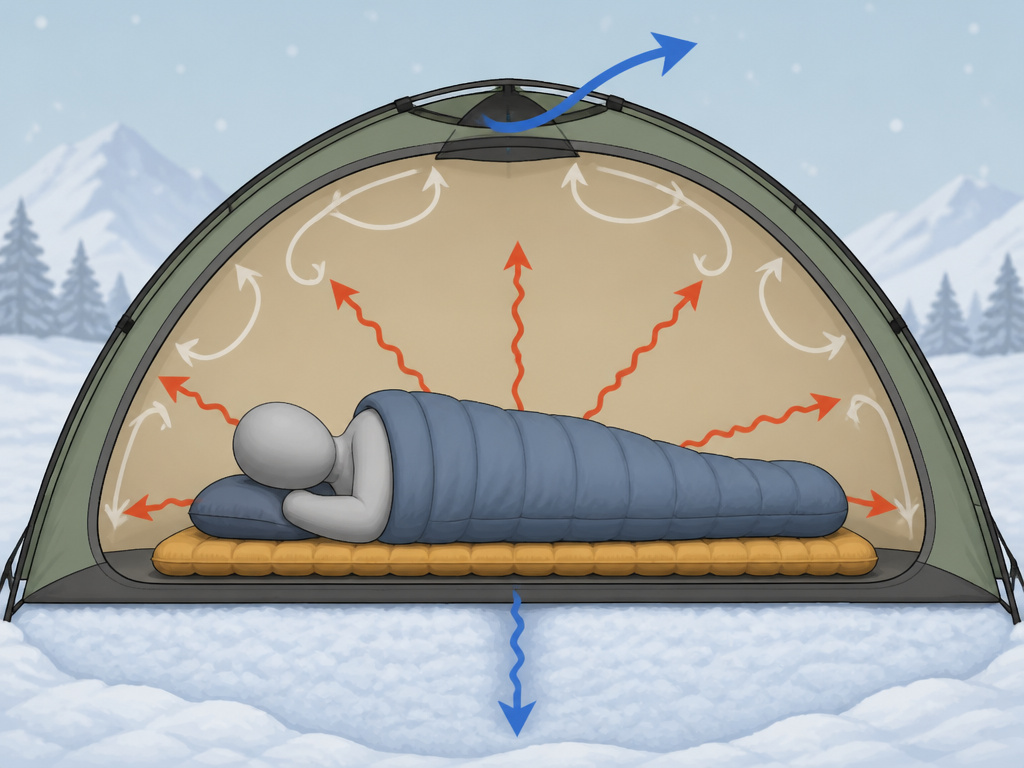
Heat escapes in three predictable ways, and most DIY insulation fails because it only addresses one. Conduction through the floor is the most direct steal, the cold earth is a giant heat sink. A U.S. Army study on insulated cold-weather operations noted that heat loss to the floor still accounts for roughly 10% of total conductive and radiative loss even in a well-insulated shelter. In a standard tent, it’s your biggest vulnerability.
Convection is the wind robbing warmth from your walls. A taut rainfly and a smart site help, but the real fix is creating a still-air barrier inside. Radiation is your body’s heat beaming into the cold night; a reflective surface bounces it back.
Then there’s ventilation, the double-edged sword. You need fresh air to breathe and to evacuate deadly gases. But that incoming air is cold, and heating it consumes energy. The study quantified this: maintaining safe CO2 levels requires a ventilation rate of 0.016 kg/s, which alone causes over 1000 watts of heat loss. You can’t stop it, so you must plan for it with more insulation or a bigger heat source.
| Heat Loss Path | Primary Defense | A Specific Product or Tactic |
|---|---|---|
| Conduction (Ground) | High-R-value sleep system | Therm-a-Rest Z Lite Sol (R-2.0) under a NeoAir XTherm (R-6.9) |
| Convection & Radiation (Walls) | Internal air gap + reflector | Reflectix bubble insulation panels hung with Velcro, leaving a 1″ gap |
| Ventilation (Air Exchange) | Strategic, mandatory venting | Top vent fully open when using a stove; CO detector at sleeping height |
How Do You Insulate a Tent Floor?
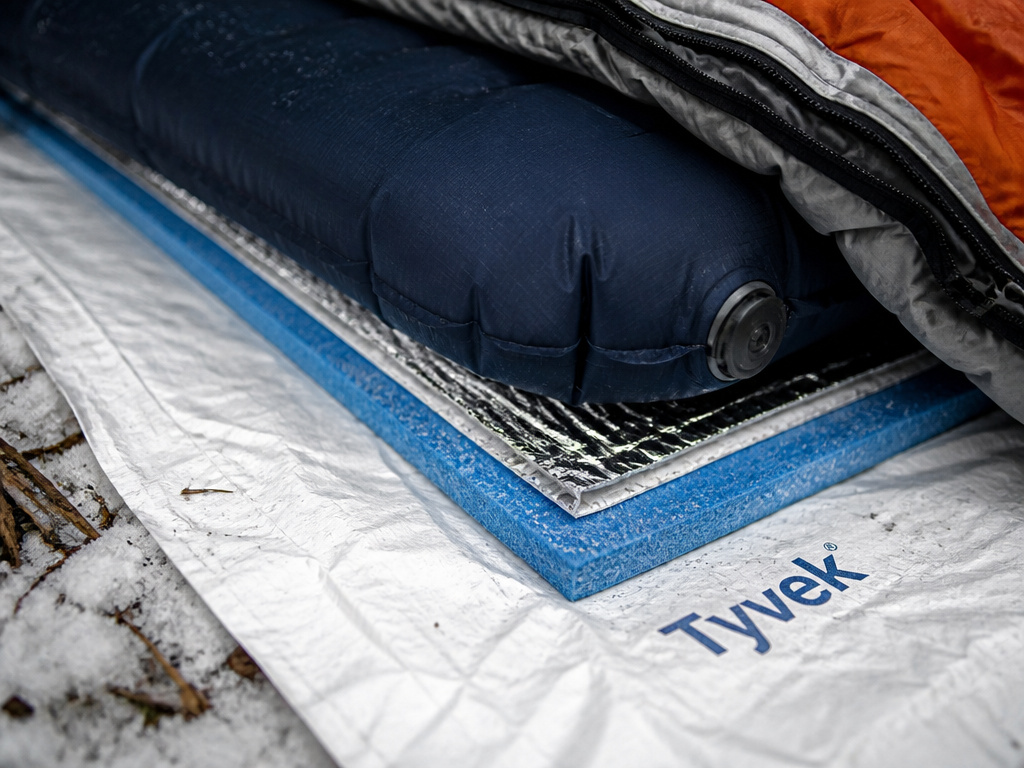
Start from the ground up. Everything else is a bonus if you’re losing heat straight into the earth.
- Choose Your Ground Like a Heat Sink. Seek out a platform of consistent, several-inch-deep snow over bare, frozen earth, it’s a better insulator. I learned this camping near Tahoe; pitching on a snow drift made a palpable 5-degree difference inside by dawn compared to a nearby frozen meadow.
- Lay a Heavy-Duty Footprint. This isn’t just for protection. A thick polycro or a second tent footprint adds a thin, moisture-blocking dead air space. In winter, I use a rugged Tyvek sheet cut larger than my tent floor.
- Deploy the Foam & Inflatable Combo. This is the core tactic. A closed-cell foam pad goes directly on the floor, its R-value doesn’t compress under you. On top, add your insulated inflatable pad. The combination is unbeatable.
- Insert a Reflective Layer. In extreme cold (below -10°C), I slide a SOL Emergency Blanket, shiny side up, between the foam and my inflatable pad. The foil reflects radiant heat back, but only because the foam pad creates the necessary air gap.
Common mistake: Using only an inflatable air pad, the air inside chills rapidly via conduction, and the insulation compresses under your hips. You’ll feel the deep cold seep in within two hours, no matter your bag’s rating.
I learned this the hard way on a -10°C trip. I used only my Exped DownMat. By 2 AM, my back was frozen, the down fill was useless once compressed. Now, my Z Lite Sol is permanent winter gear. For a complete rundown of foundational gear, our guide to essential tent camping equipment covers pads, footprints, and more.
What’s the Best Way to Insulate Tent Walls?
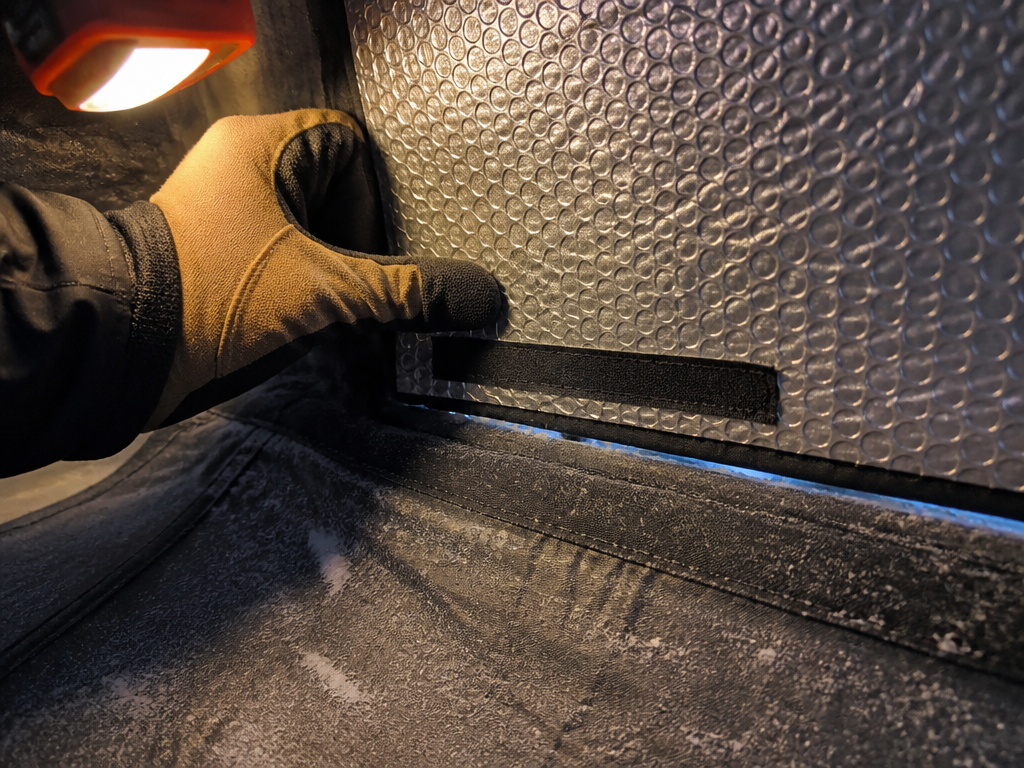
You can’t change your tent’s fabric, but you can line it. The goal is to trap still air and reflect radiant heat back, not just slap on a layer.
My method depends on the trip. For a week-long basecamp, I pre-cut panels from Reflectix double-reflective bubble insulation. I attach them to the tent’s interior with hook-and-loop tape, ensuring a slight gap at the bottom for moisture escape. This creates a genuine thermal break.
For a fast overnight, I jury-rig SOL Emergency Blankets. I use binder clips to attach them to the tent’s internal loops or gear lofts, deliberately creating sag so the blanket isn’t pressed against the cold wall. The difference? The Reflectix holds heat longer and is more durable, but the blankets pack to nothing.
The military prototype tents in the DTIC study used Polarguard batting with an aluminized vapor barrier bonded to one side. That vapor barrier is risky in consumer use.
I tried the emergency blanket trick in my three-season tent during a dry, cold snap in the Adirondacks. I taped it tight to the walls. By morning, the inside of the rainfly was soaked, and droplets ran down the inner tent seams. The blanket conducted heat to the cold outer wall, and my breath’s moisture had nowhere to go.
A well-ventilated four-season tent handles moisture better from the start. For the ultimate winter shelter, a dedicated canvas tent with a stove jack provides inherent thermal mass and breathability, moving beyond DIY fixes.
How Do You Ventilate Without Freezing?
This is where theory meets a deadly reality. You must ventilate when using a stove or any fuel-based heater. The 0.016 kg/s ventilation rate from the study is the minimum for CO2. Carbon monoxide is the greater threat. The same study found CO levels “large enough to be of concern” during and after cooking.
Always crack the top vent of your tent, even in a snowstorm. If you’re using a wood-burning tent stove, follow the manufacturer’s clearance guidelines and never block the fresh air intake. The stove pipe must be sealed where it exits the tent.
I keep a Kidde Nighthawk KN-COPP-B carbon monoxide detector clipped to my tent’s ceiling. It’s the one with the digital readout, seeing 0 PPM lets me sleep. If you wake up with a headache or nausea, get to fresh air immediately.
| Scenario | Ventilation Action | Rationale & Consequence |
|---|---|---|
| No stove, dry cold | Crack top vent 1-2 inches | Allows moisture from breath to escape; minor heat loss. |
| Stove heating | Top vent fully open + stove intake clear | Exhausts CO/CO2, feeds combustion; high heat loss requires greater stove output. |
| Stove cooking | Top vent fully open + door cracked 3-4 inches | Maximum exhaust for high CO production; expect significant heat loss. |
| High humidity or snow | Top and bottom vent cracked 2+ inches | Creates cross-flow to reduce condensation; increases convective cooling. |
TL;DR: Ventilation is non-negotiable for safety. Match your venting to your activity (sleeping vs. cooking) and compensate for the heat loss with more insulation or fuel.
Is a Hot Tent a Warmer Solution?
A hot tent with a wood stove fundamentally changes the game. The stove provides massive radiant heat, allowing you to run more ventilation safely. The insulation goal shifts from retaining body heat to retaining stove heat.
The tent itself must be stove-ready. Nylon will melt. You need a heavy-duty canvas tent or a specialized synthetic hot tent with a reinforced, metal-lined stove jack. For backpacking, lightweight hot tents for backpacking made of silicone-nylon exist, but they require meticulous spark management.
Inside a hot tent, you still need floor insulation, the ground stays cold. Wall insulation can be lighter since the stove output is high. The primary concerns become spark protection, maintaining the stove’s air supply, and having a proper hot tent stove installed correctly. Our reviews of the best hot tents detail which models balance heat retention, weight, and safety.
Before you start: Using any fuel-burning heater inside a tent introduces risk of fire and carbon monoxide poisoning. Always use a certified CO detector rated for indoor use. Never use a propane heater not explicitly rated for indoor, enclosed spaces. Ensure all vents are open according to the heater’s manual, and never leave a burning heater unattended.
Frequently Asked Questions
Can you use a space heater in a tent?
Only a low-wattage electric heater designed for indoor use, and only with a reliable power source like a campground hookup. Never use a standard propane heater like those meant for patios; they produce dangerous carbon monoxide and excessive water vapor. The only propane unit I’d cautiously consider is a Mr. Buddy Portable Buddy with a low-oxygen shutoff sensor, and even then, I’d crack a vent wider than the manual suggests.
Does putting a tarp over your tent help insulate it?
Yes, if pitched correctly. A tarp rigged several inches above your rainfly creates a dead air space that acts as insulation and blocks wind. However, if the tarp sags and touches the tent, it will conduct cold and channel rainwater onto your fly, making things worse. It’s a useful trick for snow or wind, but less effective for pure cold.
How do you stop condensation in a winter tent?
You manage it, not stop it. Ventilate more than you think you need. Avoid boiling large pots of water inside. Wipe down the walls each morning with a dedicated microfiber towel. Keep wet clothes and snow outside in a vestibule. A tent with excellent mechanical ventilation, like those designed for heavy rain, will also handle winter moisture better.
Is a 4-season tent necessary for winter camping?
For serious winter camping, yes. Three-season tents aren’t built for snow load, their ventilation is often inadequate for cold-weather moisture, and their fabrics can become brittle in extreme cold. A true storm-resistant tent has stronger poles, more robust fabrics, and strategic venting that can be controlled in high wind.
What’s the best cheap insulation for a tent?
Reflective bubble insulation (like Reflectix) from a hardware store. A roll is inexpensive. Cut it to fit your tent floor and walls, using Velcro tabs to hold it in place with an air gap. It provides both reflective and conductive insulation. For the ceiling, use an emergency blanket attached with clips, again ensuring it doesn’t lie flat against the fabric.
Before You Go
Winter tent insulation isn’t about creating a sealed, stuffy box. It’s a precise balancing act: adding enough thermal resistance to stay warm while permitting enough fresh air to stay safe. Begin with an unshakeable ground insulation system. Add wall barriers that create dead air space. Then, with unwavering discipline, ventilate according to your heat source.
The 4cm rule from military research gives you a tangible target for the loft you need. Your sleep pad system handles the floor. Reflective layers and a smaller tent volume manage the walls. Your vigilance with a vent and a carbon monoxide detector safeguards the air. Master these three elements, and you can turn a freezing shelter into a cozy refuge. For more gear to extend your season, our list of tent camping accessories covers everything from moisture management to safe lighting.
