
How To Cool Down A Tent With The 12-Inch Air Gap Method
This post contains affiliate links. As an Amazon Associate, we earn from qualifying purchases.
Cooling a tent requires managing three heat sources: radiant (sun), conductive (ground), and internal (you, your gear). Match your strategy to the environment, dry vs. humid, wooded vs. open, or you’ll fight physics instead of the heat.
Most guides tell you to find shade and open vents. That’s commodity advice. It misses the physics. A tarp laid directly on the tent fabric turns into a conductor, not a reflector. Evaporative cooling in coastal humidity just makes a muggy sauna. And evergreen trees can trap more heat than they block.
This guide explains why those common tips fail and what to do instead. We’ll cover site selection, ventilation science, DIY builds that work, and the one tool that can drop a tent’s temperature by 40 degrees when the air is dry enough.
Key Takeaways
- A reflective tarp must have a 12-inch air gap between it and the tent roof. Direct contact conducts heat straight into the fabric.
- Evaporative cooling (wet towels, swamp coolers) only works when relative humidity is below 60%. Above that, it makes the air feel muggy and oppressive.
- Dark-colored tent fabric absorbs 20–30% more radiant heat than light-colored fabric. If you own a dark tent, a correctly deployed radiant barrier is non-negotiable.
- Pitch on grass, never asphalt or concrete. Pavement stores solar heat and radiates it upward all night, raising tent floor temperature by 10–15°F.
- Evergreen trees create still-air pockets that trap heat. Deciduous trees with high, open canopies provide better shade and allow cooling breezes.
Start With Your Campsite: It’s Not Just About Shade
Where you pitch matters more than any gadget you bring. Get this wrong, and you’re fighting an uphill battle against stored ground heat and trapped air.
Face the narrow side of your tent east. The morning sun is lower and less intense, but it hits a broader surface area if the long side of your tent faces it. That heats up the interior faster. Turning the short side east reduces the morning solar footprint.
Grass beats pavement every time. Asphalt and concrete act as thermal batteries. They absorb sunlight all day and release that heat upward for hours after sunset. A tent pitched on grass at the same site will be 10–15°F cooler inside after dark. Soil and grass are natural heat sinks.
Tree choice matters, too. Dense evergreen canopies block sunlight but also stop wind. They create a still, insulated pocket of air underneath that holds heat. You want the dappled shade of deciduous trees, their higher, more open canopy allows airflow while blocking the worst of the direct sun.
Common mistake: Pitching under a thick pine tree for all-day shade, the trapped, still air underneath can be warmer than an adjacent sunny spot with a breeze by late afternoon.
If you’re car camping with a large family tent, consider a pop-up beach tent or a dedicated sun shelter to create movable shade. These are designed for maximum airflow and can be repositioned as the sun moves.
TL;DR: Pitch on grass, point the short side east, and pick deciduous trees over evergreens for shade that breathes.
The Science of Tent Ventilation (and Why More Vents Isn’t Always Better)
Opening every vent and door seems obvious. The goal isn’t just more holes, it’s creating a pressure differential that moves air through the tent, not just around inside it.
A properly ventilated tent achieves 4–7 air changes per hour, according to studies cited in the International Journal of Low-Carbon Technologies. Stagnant air is your enemy. Heat rises, so you need a high vent or open ceiling to let it escape. Many dome tents have a small mesh peak at the top; that’s your primary exhaust port. Open it first.
Cross-ventilation requires an intake and an exhaust. Open opposing vents low on the windward side and high on the leeward side. If your tent only has one door, crack a window on the opposite side to create a draft.
Ventilation is the primary mechanism for diluting heat and controlling humidity in any enclosed space, per WHO guidelines. Without it, body moisture and breathable air have nowhere to go, turning the tent into a personal greenhouse.
Removing the rainfly is the single most effective way to drop temperature without any gear. This only works if the tent has a full mesh inner body and the forecast guarantees no rain or heavy dew. It eliminates the greenhouse effect completely. I’ve done this on clear desert nights, the temperature inside matched the outside ambient air within minutes.
Some modern stand-up tents and car camping tents are designed with massive mesh panels and multiple roof vents specifically for hot-weather camping. Their high ceilings also help because heat stratifies, leaving cooler air at sleeping level.
| Ventilation Tactic | Best For | Risk If Skipped |
|---|---|---|
| Open peak vent + low windward vent | Most 3-season dome tents | Stagnant hot air pools at the ceiling |
| Remove rainfly (full mesh inner) | Clear, dry, bug-light nights | Soaked gear if rain or dew arrives |
| Cross-ventilation (opposing vents) | Tunnel tents, cabin tents | Air simply recirculates without cooling |
| Battery-powered fan aimed at vent | Still nights, high humidity | Fan batteries die mid-night |
TL;DR: Heat rises. Open high exhaust vents first, then create cross-flow with low intakes. On a clear night, ditch the rainfly entirely.
Radiant Barriers: The Right Way and the Wrong Way That Cooks You
A reflective tarp or an emergency space blanket can block up to 97% of radiant heat. The catch is in the installation. Most people lay it directly on the tent fabric. That’s a recipe for conductive heating.
The U.S. Department of Energy is clear: reflective materials are only effective at reducing radiant heat gain when the reflective surface faces an open air space. Lay the blanket directly on the tent, and you’ve created a thermal bridge. The sun heats the blanket, the blanket touches the tent, and heat conducts straight through.
You need a 12-inch air gap. String a ridge line between two trees, drape the blanket over it, and let it hang down the sides without touching the tent. The shiny side must face the sky. That gap is your insulator. The still air between the blanket and the tent roof is a poor conductor, so radiant heat reflects away before it can transfer.
I used a $10 emergency space blanket from a camping store over a dark green tent in Moab. With no gap, the tent was an oven. With the 12-inch gap, the interior was noticeably cooler before sunset. The difference wasn’t subtle.
For a more permanent solution, some high-wind tents or expedition shelters have reflective coatings built into the rainfly. These work on the same principle, the reflective layer is on the outside, separated from the inner layer by an air gap in the fabric’s construction.
TL;DR: Suspend your reflective barrier with a 12-inch air gap. Direct contact turns it into a heating pad.
Evaporative Cooling: When It Works and When It Makes Things Worse
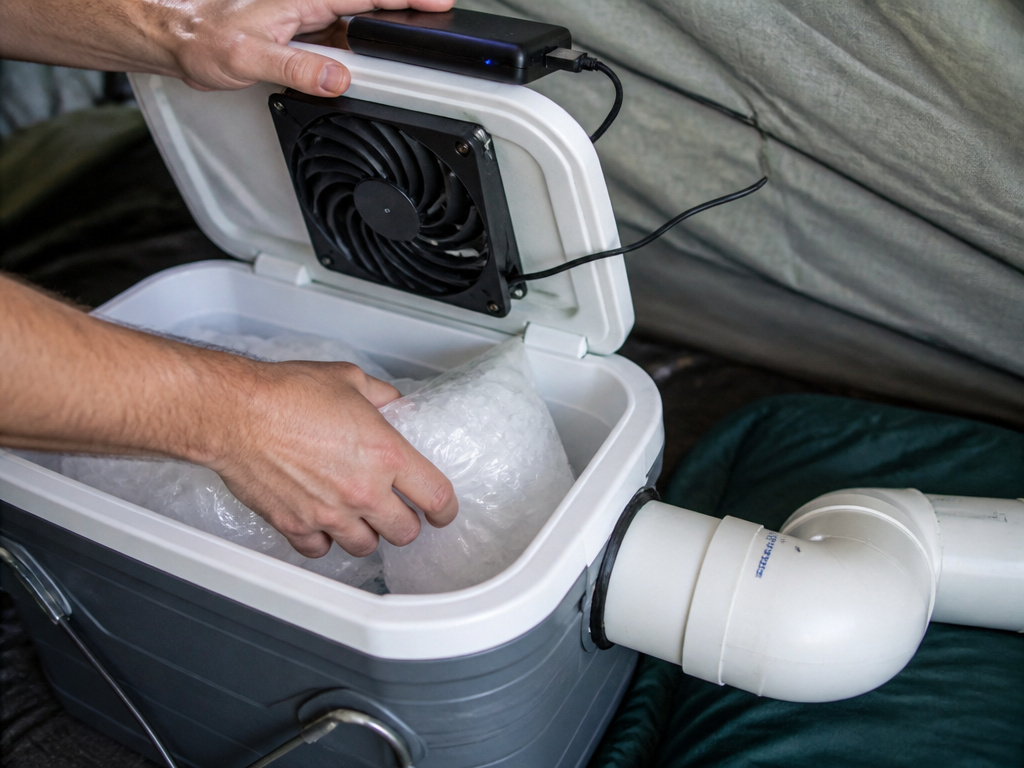
Evaporative cooling leverages a simple physical process: water absorbs heat as it changes from liquid to vapor. One gallon of evaporated water pulls about 8,700 Btu of heat from the surrounding air, according to Mississippi State University Extension.
This works brilliantly in dry climates. Hang a damp towel in front of a battery-powered fan. The moving air accelerates evaporation, cooling the air blowing past it. A DIY swamp cooler, a cooler with a fan blowing over ice and a vent ducting the cold air out, can drop localized air temperature by 10–15°F.
I built one with a $15 cooler, a $12 USB fan, and a PVC elbow. In the Utah desert at 20% humidity, it blew 40°F air. In the Georgia mountains at 80% humidity, it blew damp, coolish air that made the tent feel muggy within an hour.
Evaporative cooling can reduce surrounding air temperatures by 15° to 40°F in low-humidity environments. In high humidity, the air is near saturation, evaporation slows dramatically, and the effect diminishes to almost nothing.
That’s the critical limit: relative humidity below 60%. If you’re camping in the Southeast U.S. or any coastal area in summer, skip the wet towels and swamp cooler. You’re adding moisture to already-saturated air. The cooling effect is negligible, and you’ll just feel stickier.
Focus instead on moving dry air. Use fans alone to promote sweat evaporation from your skin, which is your body’s own cooling system. This is where a simple battery-powered fan becomes essential tent camping equipment.
| Method | Best Environment | Worst Environment | Why It Fails |
|---|---|---|---|
| Damp towel in front of fan | Arid, desert (<40% RH) | Humid, coastal (>65% RH) | Air cannot hold more moisture, evaporation stops |
| DIY swamp cooler (ice + fan) | Low humidity, night use | High humidity, daytime heat | Adds moisture, feels muggy, ice melts fast |
| Misting bottle on skin | Any dry climate | Any humid climate | Wets skin but doesn’t evaporate, feels clammy |
| Battery fan alone (no water) | All climates, especially humid | Extreme dry heat (>100°F) | Only moves existing air, no temperature drop |
TL;DR: Use evaporative cooling only if your weather app says humidity is under 60%. Otherwise, fans alone are better.
The Four Tools That Replace a $200 Service Visit
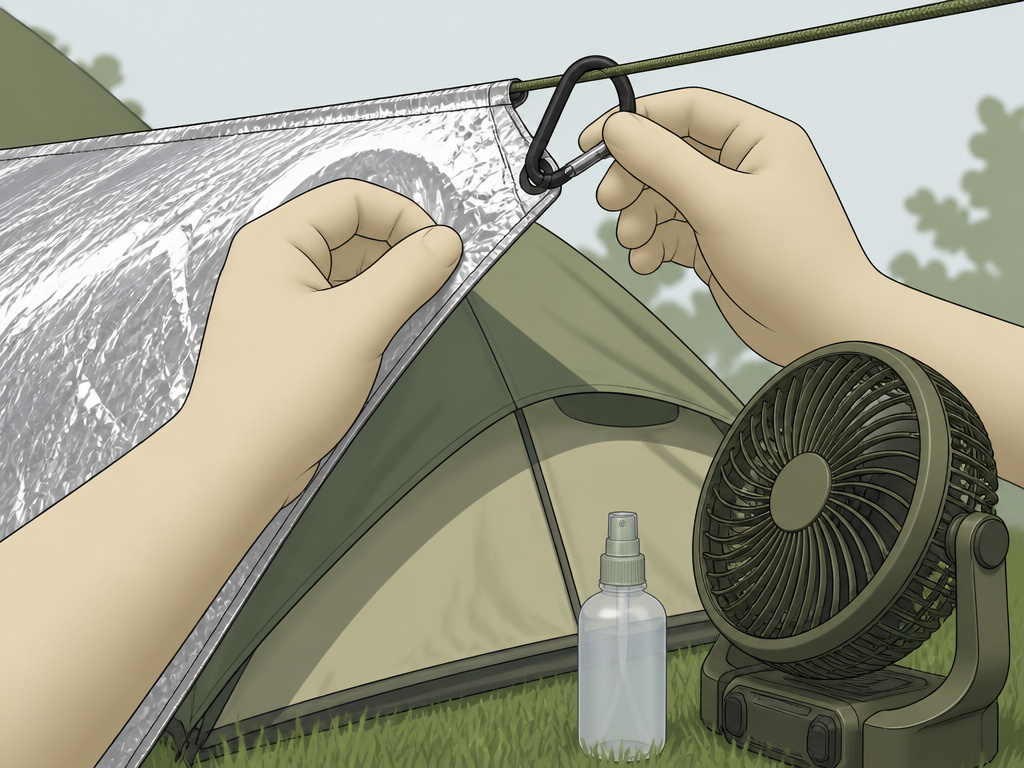
You don’t need a portable air conditioners unit for every trip. These four tools cover 90% of cooling scenarios, and they pack small.
- A Reflective Emergency Blanket: Not for wrapping yourself. Keep it in your tent camping accessories kit solely for creating a radiant barrier. It’s lighter and packs smaller than a dedicated tarp.
- A High-Volume Battery Fan: Not a little personal fan. Look for one with a 6- to 10-inch blade that can move 500+ CFM. Aim it at your body at night to accelerate sweat evaporation, or point it at an open vent to exhaust hot air.
- Paracord and Two Carabiners: For creating the mandatory 12-inch air gap for your radiant barrier. Tie a ridge line, clip the blanket, and adjust the height.
- A Small Spray Bottle: For targeted evaporative cooling on your skin and clothing in dry climates. In a pinch, lightly mist your shirt and sit in the breeze. Don’t soak your gear.
Skipping the paracord means your radiant barrier sits directly on the tent. You’ll gain 5-10 degrees of conductive heating instead of losing 15-20 degrees of radiant heat. That’s a 25-degree swing you gave away.
TL;DR: Pack an emergency blanket, a powerful fan, paracord, and a spray bottle. Deploy them based on your humidity reading.
The Dark Tent Problem (And the $10 Fix)
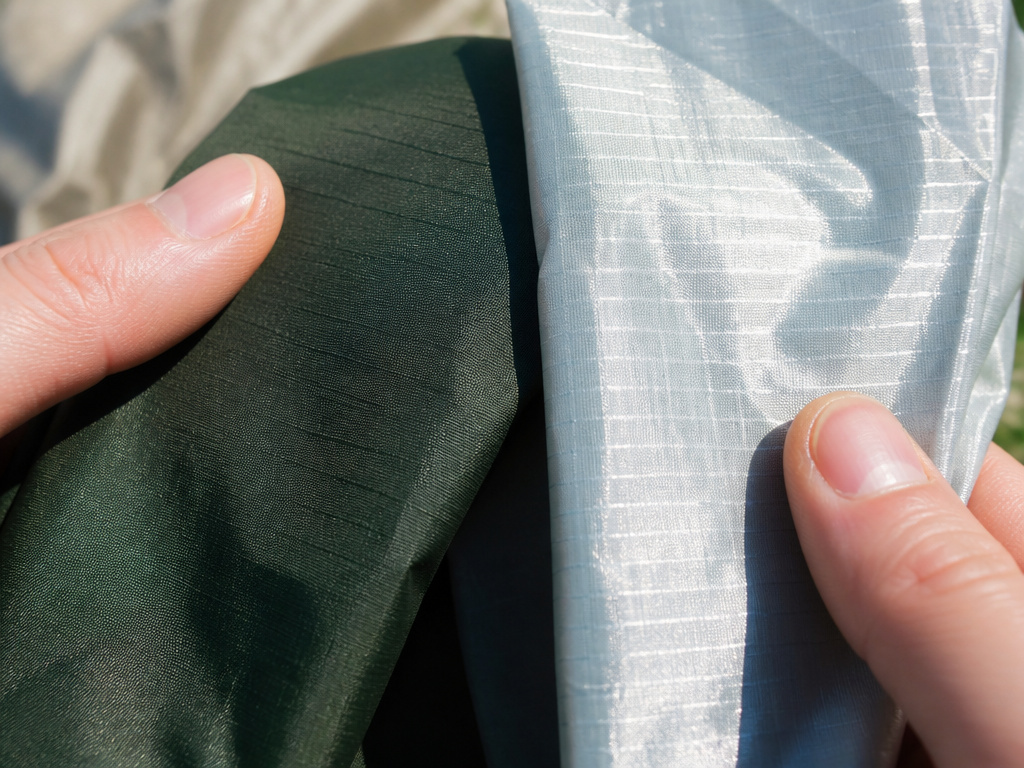
Dark green, navy, or black tent fabric absorbs 20–30% more radiant heat than light grey, tan, or silver fabric. A dark tent in direct sun is a solar oven, regardless of ventilation.
If you already own a dark tent, your first line of defense is the radiant barrier with an air gap, as described above. Your second is strategic timing. Don’t leave a dark tent sealed up in the sun. If you’re base camping, consider taking it down during the day if you’ll be out hiking. Let it lay flat in the shade. This is extreme, but it works.
Some canvas tents are naturally darker but are more breathable than synthetic fabrics, which can offset the heat absorption somewhat through better convective cooling. Still, a light-colored canvas tent will always be cooler than a dark one.
For new purchases, this is the simplest rule: buy light colors if you camp in hot climates. A silver rainfly reflects a significant amount of energy before it even becomes heat inside the tent.
When To Bring in the Big Guns: Portable AC and Real Swamp Coolers
For extreme heat or humidity-insensitive cooling, mechanical solutions exist.
A genuine evaporative cooler (swamp cooler) works like the DIY version but with a reservoir and a pump. They’re effective but bulky and require a power source. A Waykar 4500 BTU portable air conditioners unit is a true air conditioner, not an evaporator. It cools by compressing refrigerant and can work in any humidity. The trade-off is significant power draw, you’ll need a hefty power station or a generator.
These are niche tools for car camping tents where weight and power aren’t constraints, or for long-term base camps. They are overkill for a weekend backpacking trip.
I ran a small portable AC in a large family tent during a heatwave. It dropped the temperature 20 degrees, but the constant hum and the thick duct out the tent window meant we had to seal up all other ventilation, which felt counterproductive.
TL;DR: Portable AC and powered swamp coolers are for drive-up, power-rich scenarios. For most camping, physics and site selection are free and silent.
Frequently Asked Questions
Does putting a wet towel over a fan cool a tent?
Only in dry climates (relative humidity under 60%). The fan blows air through the damp towel, water evaporates, and the air cools. In humid conditions, the towel just adds moisture to the air, making it feel muggier. The towel itself also warms as it sits in the sun, reducing the effect.
Why is my tent hotter inside than outside?
Three reasons. First, the greenhouse effect: sunlight passes through the fabric, heats objects inside, and the trapped radiant heat can’t escape. Second, poor ventilation lets body heat and moisture build up. Third, conductive heating from a dark rainfly or a tarp laid directly on the tent. Always ensure a high vent is open to let hot air escape.
Should I take the rainfly off my tent to cool it down?
Yes, if, and only if, your tent has a full mesh inner body, the forecast guarantees no rain or heavy dew, and bugs aren’t a major concern. Removing the rainfly eliminates the greenhouse effect completely and is the single biggest free cooling move. On a clear night, the interior temperature will match the outside ambient air within minutes.
Do battery-powered fans really cool a tent?
They don’t lower the air temperature like an air conditioner. What they do is accelerate the evaporation of sweat from your skin, which is your body’s primary cooling mechanism. Moving air also prevents hot, humid air from stagnating around you. In still conditions, a fan can make a 90°F tent feel like 80°F through this wind-chill effect.
What’s the best way to cool a tent without electricity?
Master site selection and ventilation. Pitch on grass, not pavement. Point the narrow side east. Use deciduous tree shade, not evergreen. Open high and low vents for cross-flow. Suspend a reflective space blanket 12 inches above the tent. These passive techniques require no power and are effective in any environment.
The Bottom Line
Cooling a tent is about managing physics, not fighting it. Radiant heat needs a reflective barrier with an air gap. Conductive heat needs a grass buffer. Internal heat needs a ventilation path out. Evaporative cooling needs dry air to work.
Forget the blanket advice. Match the tool to the condition. In the desert, a damp towel and a fan are magic. On the coast, that same setup is misery. A tarp on the tent cooks you; a tarp twelve inches above it saves you.
Pack the four tools, blanket, fan, cord, bottle, and know when to use each. Your sleep depends on it.
