
How to Find Surface Area of a Tent: Formulas & Adjustments
This post contains affiliate links. As an Amazon Associate, we earn from qualifying purchases.
To find a tent’s surface area, identify its geometric shape (like a triangular prism for an A-frame), measure its key dimensions, and apply the correct formula. You must then add a buffer—typically 15%—for seams, overlaps, and cutting waste. This final number determines the actual fabric needed for construction or repair, and influences a tent’s weight, cost, and weather resistance.
I remember the first time I tried to patch a torn rainfly on my old backpacking tent. I guessed how much extra fabric I needed, bought a square yard, and ended up with a patch that was too small. I had measured the hole, but I hadn’t accounted for the seam allowance or the way nylon stretches when taut. That small failure taught me a big lesson: knowing the true surface area isn’t just math homework; it’s the difference between a quick fix and a wasted trip to the store.
Whether you’re a DIYer building a shelter, comparing the specs of two-person tents to understand their packed weight, or just curious about how much material your gear contains, this guide walks you through the real process. We’ll use specific examples, like a four-person tent design from an actual curriculum problem, and I’ll share the hard-won adjustments you need for fabric behavior and weather.
Key Takeaways
- The surface area formula depends on the tent’s core geometric shape. An A-frame is a triangular prism; a pyramid tent is a rectangular pyramid.
- Critical measurements often include base dimensions, height, and slant height. Missing dimensions like slant height can be found using the Pythagorean theorem.
- Your calculated “perfect” area is just a start. Always add at least 15% extra for seams and waste. For heavy-duty or double-walled tents, plan for 20-25% more.
- Fabric type changes the real-world area. Stretchy materials like nylon reduce effective area under tension, while non-stretch fabrics like Dyneema maintain the calculated dimensions.
- For irregular or multi-room tents, break the shape into standard geometric pieces, calculate each separately, and sum the results.
Why Accurate Surface Area Matters Beyond Math
Surface area dictates the physical reality of a tent. It determines the amount of fabric a manufacturer must buy, which directly translates to the tent’s weight, cost, and bulk in your pack. A model with 30 square meters of material will be fundamentally heavier and more expensive than one with 20, even if they share the same floor dimensions.
For DIY projects, a miscalculation means ordering too little material, forcing a mid-project scramble. More critically, surface area affects performance. A larger surface area exposes more fabric to wind pressure and snow load. Understanding this helps you choose a shelter suited to your environment, whether you’re looking at sturdy canvas tents for base camping or minimalist tarp tents for fast-and-light trips.
The total surface area of a tent is the sum of the areas of all its fabric panels. For a triangular prism design, this includes two triangular ends and three rectangular sides. Accurate measurement requires the tent to be pitched taut on level ground to obtain correct linear dimensions for calculation.
TL;DR: Surface area controls weight, cost, weather resistance, and DIY success. Ignoring it leads to under-spec’d gear or failed projects.
The Essential 4-Step Calculation Method
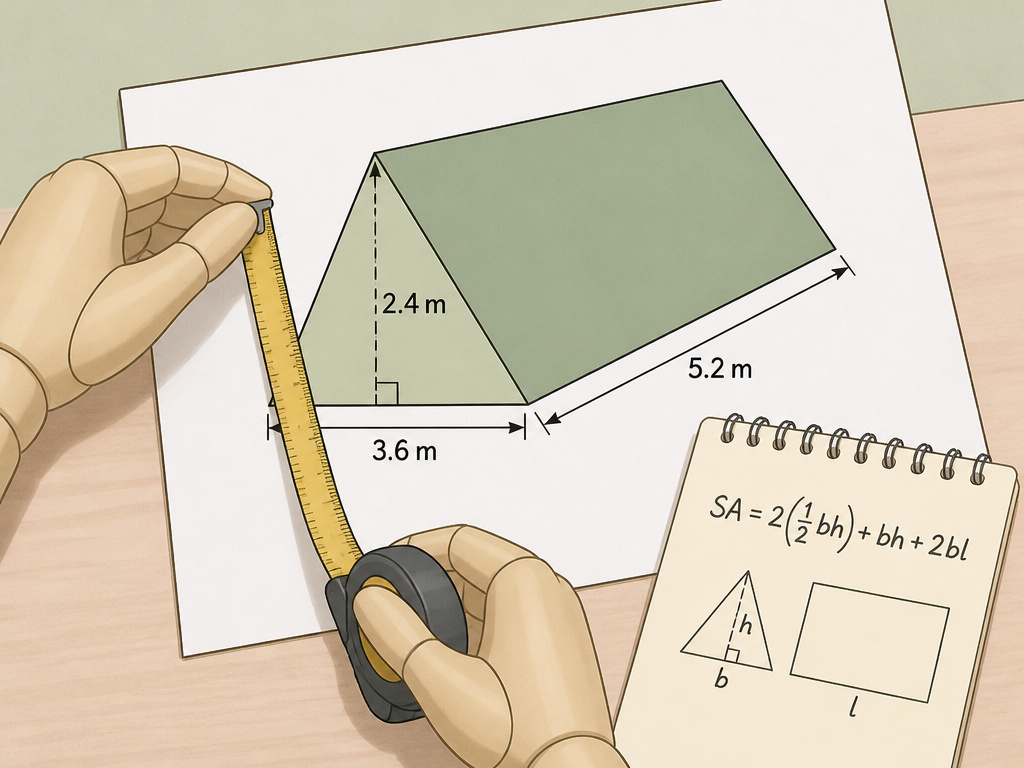
Follow this sequence precisely. Skipping a step is the most common source of error.
- Identify the Core Geometric Shape. Look at your tent’s primary form. A classic A-frame is a triangular prism. A simple pyramid is a rectangular pyramid. Dome tents are often composed of multiple triangles. Cabin tents are rectangular prisms. Naming the shape tells you which formula to use.
- Gather All Necessary Dimensions. Use a flexible tape measure. For a triangular prism, you need the base length of the triangle, its height, and the length of the tent. For a pyramid, you need base length, base width, and the slant height from a base corner to the peak. Write each down with a clear label.
- Apply the Correct Formula. Use the reference table below. Plug your numbers in carefully. If a dimension like slant height is missing, you’ll need to calculate it using geometry, often the Pythagorean theorem.
- Add the Practical Buffer. This is non-optional. Multiply your final calculated area by 1.15. This adds 15% for seam allowances, hems, and material waste during cutting. For complex designs, heavy fabrics like canvas, or tents with a separate rainfly, increase this buffer to 20-25%.
Common mistake: Using only the “clean” geometric result — this leads to fabric yardage that is 15% too small, forcing compromised seams or a second material order mid-project.
Formulas for Common Tent Shapes
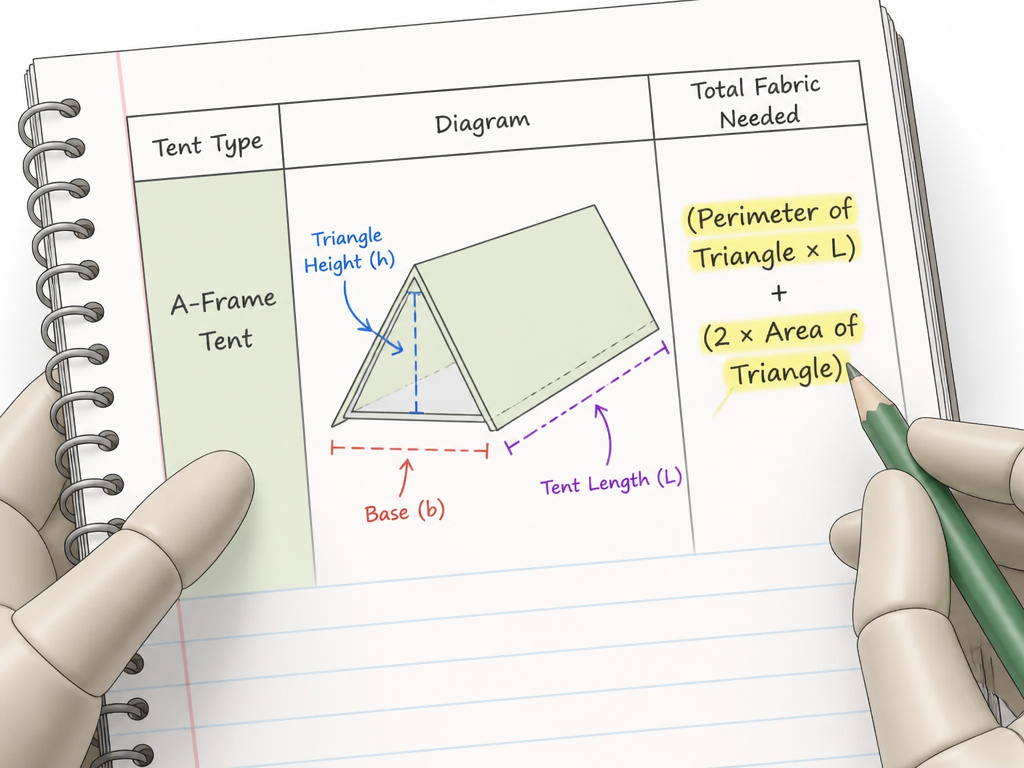
This table matches common tent designs to their geometric counterparts and formulas. The principles are similar to those found in historical guides like the Regia tent design PDF, which details calculations for traditional shelters.
| Tent Design | Geometric Shape | Required Measurements | Surface Area Formula |
|---|---|---|---|
| A-Frame | Triangular Prism | Base (b), Triangle Height (h), Tent Length (L) | (Perimeter of Triangle × L) + (2 × Area of Triangle) |
| Pyramid | Rectangular Pyramid | Base Length (l), Base Width (w), Slant Height (s) | (l × w) + (2 × l × s) + (2 × w × s) |
| Dome | Composite of Triangles | Dimensions of individual triangular panels | Sum of the areas of all triangular panels |
| Cabin | Rectangular Prism | Length (L), Width (W), Height (H) | 2(LW + LH + WH) |
Calculating a Real-World A-Frame Tent
Let’s apply the formula to a concrete example. An educational problem from Illustrative Mathematics details a four-person tent designed as a triangular prism. It has a rectangular floor (148 inches by 68 inches) and a sitting height (the triangle’s height) of 36 inches.
The full calculation is: Surface Area = 2(½ × 68 × 36) + (148 × 68) + 2(49.5 × 148) = 27,614 in². The “49.5” is the slant height of the triangle, derived using the Pythagorean theorem: √(34² + 36²) ≈ 49.5 inches. This example shows why you often need to calculate a missing dimension. Modern lightweight 2-man tents use more efficient shapes to reduce this total area, saving weight.
Handling Pyramid and Dome Tents
For pyramid tents, the slant height (s) is critical. If you only have the center height (h), calculate slant height using: s = √( (l/2)² + (w/2)² + h² ).
Dome tents require a “divide and conquer” approach. Calculate the area of one repeating triangular or rectangular panel, then multiply by the total number of panels. This same logic applies to complex, non-standard shapes: break them into calculable pieces. A tent with a vestibule attached to a dome body, for instance, would be calculated as two separate components.
Before you start: When taking measurements, ensure the tent is pitched correctly and taut on level ground. A sagging or improperly pitched tent yields shorter, inaccurate dimensions for height and slant, skewing your final area by a significant margin.
Critical Real-World Adjustments
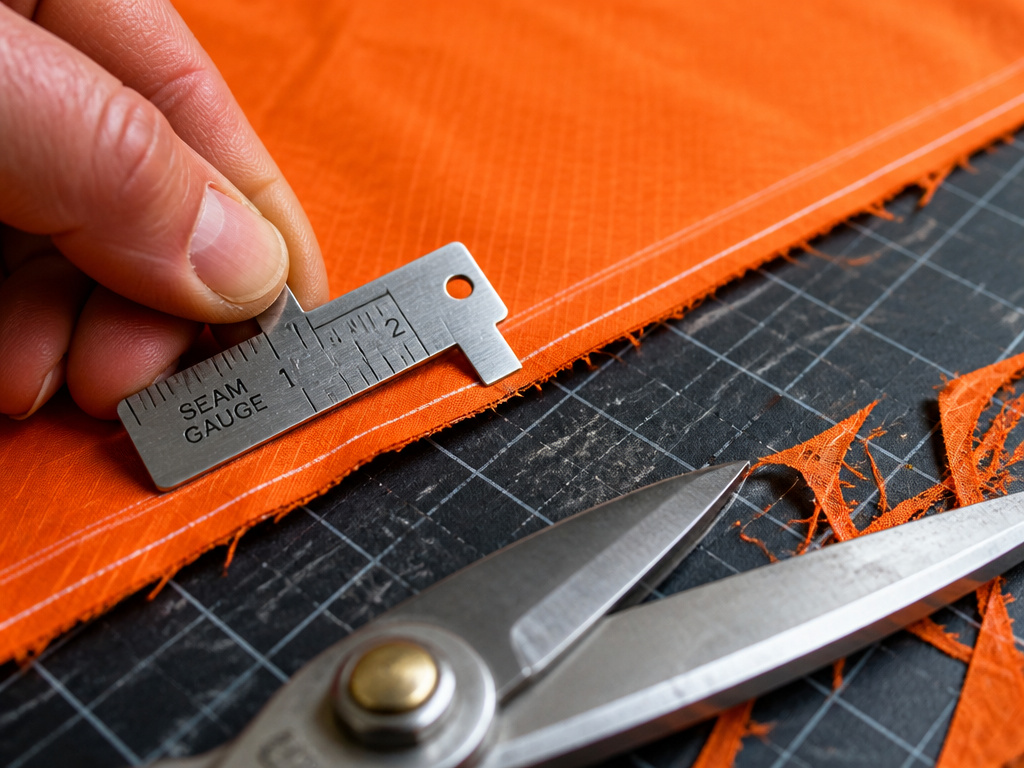
Your geometric result is a theoretical starting point. Three practical factors dictate the actual fabric needed.
1. Fabric Behavior Under Tension
Material properties drastically change the effective area. Nylon stretches when pitched taut, reducing the surface area presented to elements like wind. A non-stretch fabric like Dyneema or polyester maintains its exact cut dimensions. Therefore, a nylon tent pattern might be cut slightly larger than a Dyneema one for the same interior volume. This is a key consideration when evaluating ultralight 2-person tents that use high-tech materials.
2. Weather and Structural Loads
The nominal area changes under load. Wind pressure effectively increases the force on a tent’s surface. Snow accumulation adds vertical weight. Heavy-duty tents, designed for these conditions, often require more robust seams and therefore more fabric allowance at the seams—hence the higher 20-25% buffer.
3. Seam Allowance and Cutting Waste
No project uses fabric with 100% efficiency. The standard 15% buffer covers three areas:
| Buffer Component | Typical Use | Consequence of Omitting It |
|---|---|---|
| Seam Allowance | ~10% of total area | Seams become too narrow, critically weakening every stitch line and risking failure. |
| Pattern Matching | ~3% of total area | Fabric patterns (e.g., printed graphics) won’t align across panels, ruining aesthetics. |
| Cutting Waste & Error Margin | ~2% of total area | Minor measuring or cutting errors leave you short on one panel, halting the project. |
If your tent has a separate rainfly, you must calculate the surface area for both the inner body and the fly independently, then add them together before applying the waste percentage. This double layer is common in many backpacking tents for two designed for wet climates.
Tools and Tips for Getting Measurements Right
You don’t need advanced tools, but you do need a methodical approach.
- Use a Flexible Tape Measure. A fabric or retractable tape measure can follow curves and reach into corners. A rigid ruler will fail.
- Pitch the Tent Fully and Correctly. The tent must be fully assembled with guy lines taut on flat ground. Measure a saggy, loose tent, and you’ll get useless numbers.
- Document Each Measurement Clearly. Label them (e.g., “North Wall Height,” “East Base Length”). Mixing up height and slant height ruins everything.
- Calculate Twice, Cut Once. Run the math, then step away and do it again. A simple arithmetic error is the most frequent DIY failure point.
- Overestimate When Uncertain. Buying an extra half-yard of fabric is cheaper and less frustrating than a second shopping trip with delayed shipping.
For buyers, this math helps decode specs. A tent with standing room has a much larger surface area than a low-profile model, explaining its greater weight and packed volume. This knowledge helps you move beyond price to compare true value and material quality.
Frequently Asked Questions
Why isn’t the floor area enough for my calculation?
The floor is typically just one panel, and often the smallest. The walls and roof comprise most of the fabric. Using only floor area might account for less than one-third of the total material needed, leaving you severely short.
How do I find a missing measurement like the slant height on a pyramid tent?
Use the Pythagorean theorem (a² + b² = c²). For a pyramid, if you know the vertical height from the base center to the peak (a) and half the base length (b), the slant height (c) is √(a² + b²). This step is mandatory for accurate calculations on pyramids and triangular prisms.
Is the 15% waste factor always sufficient?
No. For simple, single-wall tents made of standard nylon, 15% is a safe minimum. For complex designs, heavy materials like canvas, or tents with a separate rainfly, increase it to 20-25%. Historical designs, like those in the Regia member tent guide, often included larger seam allowances for durability—a principle that applies to modern heavy-duty shelters as well.
Does surface area tell me how much waterproof coating I need?
Yes, directly. Coatings like silicone or PU are applied per square unit of fabric. Your total surface area calculation, plus your waste allowance, tells you the exact area requiring treatment. Underestimating leads to uncoated weak spots and premature leakage.
How does this help me choose a tent to buy?
Surface area correlates strongly with packed weight and often price. Understanding that a spacious two-person shelter options has more surface area than a minimalist one helps you interpret weight specs. A lighter tent with the same floor area often achieves it through a more efficient shape (less total fabric) or a more expensive, lighter-weight material.
What Actually Matters
Finding a tent’s surface area blends geometry with practical craft. The formula gives you a clean number, but the material’s behavior, the weather it will face, and the realities of cutting and sewing add the critical margin.
Remember the sequence: identify the shape, measure meticulously, apply the correct math, then add your buffer. That buffer transforms a theoretical figure into a usable yardage for a DIY project or a meaningful spec for comparing commercial tents. Whether you’re patching an old heavy-duty canvas shelters or selecting a new compact backpacking tents for a thru-hike, this process shifts you from guessing to knowing exactly what you’re dealing with.
