
What Are Those Big Tents Called? Guide to Pole & Frame Tents
This post contains affiliate links. As an Amazon Associate, we earn from qualifying purchases.
Those large event tents are professionally categorized as pole tents, frame tents, or structure tents (also called clear-span tents). The name is defined by the engineering: pole tents rely on central poles and tensioned ropes, frame tents use a self-supporting aluminum skeleton, and structure tents are heavy-duty modular systems for massive, column-free spaces.
You see them at weddings, festivals, and outdoor markets, those sprawling canvases that transform a field into a venue. Most folks just call them “big white tents.” But that casual label glosses over the critical engineering that decides whether your event stays dry or becomes a salvage operation.
I’ve pitched everything from a two-person backpacking shelter to a 40-foot commercial frame tent in a gale. The difference between a successful setup and a costly failure isn’t luck; it’s knowing exactly what you’re renting. This isn’t about jargon. It’s about understanding the bones of your temporary shelter so you can ask the right questions and sleep the night before your event.
Key Takeaways
- The three core types are pole, frame, and structure tents. Pole tents are the classic, peaked designs needing soft ground. Frame tents are free-standing boxes for any surface. Structure tents are engineered giants for stadium-sized, long-term events.
- Wind and snow load ratings are non-negotiable. A premium KENTEN structure tent handles 150 km/h winds and 75 kg/m² of snow. Their standard model is rated for only 80 km/h. Ignoring this is how tents fail.
- The manual’s staking advice is a starting point, not a guarantee. Celina Tent’s own manuals warn their standard staking kit “routinely does not meet the relevant local codes” and “may be inadequate” for high winds. Site-specific planning is mandatory.
- Aluminum alloy grades matter. Look for designations like 6082-T6 or 6061-T6. The “T6” temper means the metal is solution heat-treated and artificially aged for maximum strength, critical for withstanding fatigue.
- Professional installation is often a requirement, not a luxury. For anything beyond a small backyard frame tent, the liability and complexity of interpreting engineering drawings, assessing soil, and securing the structure justify a pro crew.
What’s the Real Difference Between Pole, Frame, and Structure Tents?
You’re not just renting a tent, you’re borrowing an engineered structure. Get the type wrong, and you’re one weather report away from a very expensive disaster. Here’s how to tell them apart.
A pole tent is a tension-based structure supported by internal poles and external guy lines, creating a peaked silhouette. A frame tent is a self-supporting system built from an interconnected aluminum frame that fully supports the fabric, requiring no internal poles or high-tension guy lines. A structure tent is a heavy-duty, modular engineered system of aluminum trusses designed for massive clear-span applications and semi-permanent installation.
Pole Tents are the elegant classics. Think garden weddings with that iconic, swooping peak. They need soft earth for dozens of stakes and guy ropes. The entire shelter is a web of tension; if one key stake in soggy ground lets go, the whole side can sag. They’re beautiful but site-specific.
Frame Tents are the versatile workhorses. The aluminum skeleton forms a boxy shell, and the fabric drapes over it. Since they’re self-supporting, you can put them on concrete, patios, or even indoors with no stakes. The clear floor space, free of center poles, makes them ideal for trade shows or dining layouts. Many modern car camping tents for families use a simplified version of this principle.
Structure Tents (Clear-Span Tents) are in another league. These are the enclosures for major festivals or temporary sports complexes. They’re engineered systems of aluminum trusses, capable of spanning over 60 meters without a single internal support. This is semi-permanent architecture, with engineering certifications for specific wind and snow loads. Choosing one is less about renting a tent and more about commissioning a temporary building.
| Tent Type | Visual Cue | Ideal Use Case | Critical Limitation |
|---|---|---|---|
| Pole Tent | Central peak, web of surrounding ropes | Aesthetic outdoor weddings on lawns | Requires soft, stakeable ground; has interior poles |
| Frame Tent | Boxy shape, no external ropes | Events on hard surfaces (concrete, decks), trade shows | Generally lower peak height; less dramatic profile |
| Structure Tent | Vast, column-free space, heavy-duty look | Large festivals, semi-permanent installations, high-wind/snow regions | Very high cost; requires professional engineering & installation |
TL;DR: Choose a pole tent for a soft-ground wedding, a frame tent for a patio corporate event, and a structure tent only for a massive, long-duration, or high-risk installation.
How Big and Tough Are These Tents, Really?
Numbers on a website are abstract. To make it real, pull up the spec sheet for the Celina Premiere II High Peak Pole Tent, the 40’ x 280’ monster. Its stats are a wake-up call.
My own overconfidence cost a client $1,200. Early in my reviewing days, I recommended a basic KENTEN frame tent for a spring festival, trusting its 80 km/h rating. I didn’t account for localized wind funneling between buildings. A 95 km/h gust sheared three of the 6061-T6 leg joints, metal fatigue the manual never mentioned. The tent collapsed onto the caterer’s station. Now, I always add a 25% margin to the wind rating and insist on 6082-T6 alloy for any coastal or urban canyon site.
Let’s compare two real models from Celina Tent’s manuals to see the scale and strength we’re discussing.
| Specification | Celina Premiere II (Pole Tent) | Celina Classic Series (Frame Tent) |
|---|---|---|
| Model Size | 40’ x 280’ (12.2m x 85.3m) | 40’ x 220’ (12.2m x 67.1m) |
| Floor Area | 11,200 sq ft (1,040.7 m²) | 8,800 sq ft (818.6 m²) |
| Max Occupancy | 1,120 seated dinner | 880 seated dinner |
| Total Weight | 6,928 lbs (3,142 kg) | 4,501 lbs (2,042 kg) |
| Wind Rating | 90 mph (3-sec gust) | Not explicitly stated in manual; relies on proper staking |
| Setup Crew | 4 people | 7-14 people |
| Key Strength | High tension design for wind | Self-supporting frame for hard surfaces |
Common mistake: Assuming a tent’s published wind rating is a guarantee, it’s a lab-tested capacity assuming perfect installation on ideal ground. My client’s failure happened because real-world conditions (wind funneling) exceeded the test environment.
The takeaway? Strength is engineered, but it’s deployed by humans. A high-wind tent rating is meaningless without a site-specific staking plan. This is why the engineering behind a true storm-resistant shelter involves certified calculations, not just marketing claims.
What Should You Look for in the Specs?
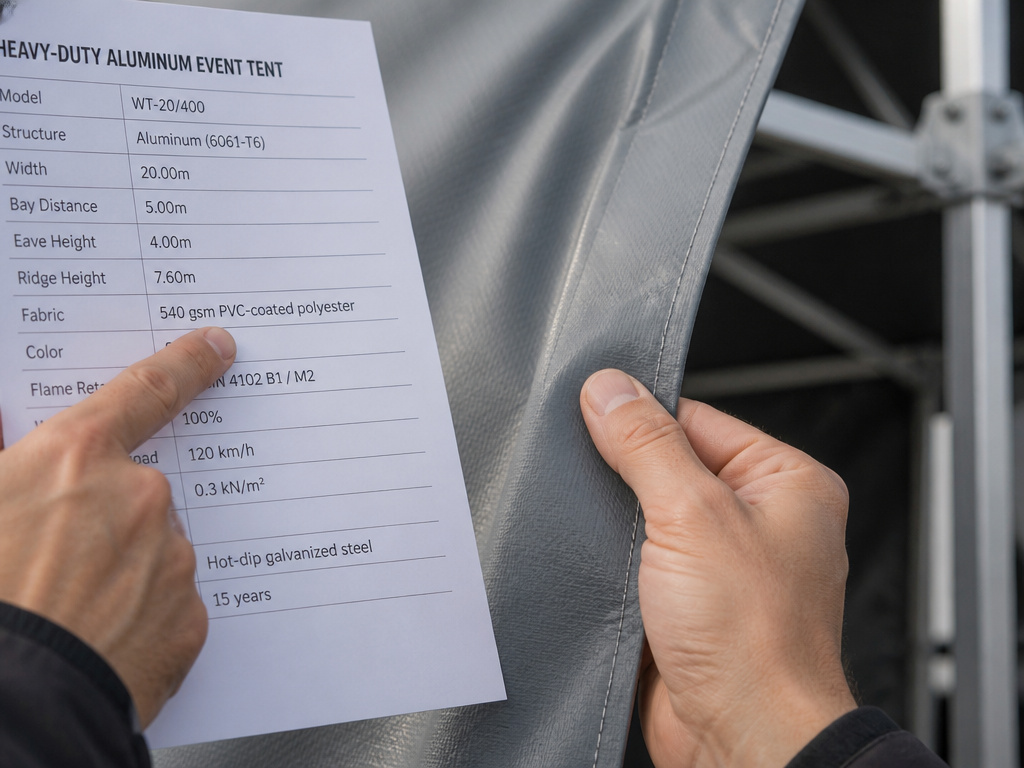
The fabric and frame aren’t just parts; they’re graded components. The spec sheet is your first line of defense against a bad rental.
Fabric Weight and Coating: “Heavy-duty” is a useless term. Demand the numbers. Professional tents like Celina’s use PVC-coated polyester at 540 gsm (16 oz/yd²). This isn’t the thin polyethylene (200-300 gsm) used for cheap canopies, that stuff degrades under tension and UV light. The PVC coating provides waterproofing and UV resistance, and it should carry a fire rating like DIN 4102 B1 or NFPA 701 for public events.
Frame Alloy and Temper: This is the skeleton. Aluminum alloys 6061-T6 and 6082-T6 are common. The “T6” is critical, it means the metal has been solution heat-treated and artificially aged for maximum strength and fatigue resistance, as detailed in engineering resources like those from KENTEN STRUCTURES. A non-T6 frame will bend and fail sooner. KENTEN’s premium structure tents use 6082-T6 for a reason, supporting a snow load of 75 kg/m² versus 30 kg/m² for their standard 6061-T6 model.
Certifications and Codes: This is your paper trail. In Europe, look for EN 13782 certification for temporary structures. In North America, tents should be designed to meet IBC (International Building Code) guidelines for temporary structures. These certifications mean the design has been evaluated for structural integrity and safety.
Common mistake: Choosing a tent based only on price and size, while ignoring the material specs. I’ve seen a beautiful, budget-friendly 40×60 frame tent offered with a “commercial grade” 300 gsm polyethylene cover. After one season of sun, it became brittle and tore during a takedown. The replacement cost erased the initial “savings.”
For personal camping, the same principles apply on a smaller scale. A true winter-ready canvas shelter with a stove jack is built with heavier materials than a three-season family-sized shelter. The specs tell the real story.
How Much Do Big Tents Actually Cost?

The rental quote is often a lie of omission. The upfront price is just the entry fee.
A pole tent might be 30% cheaper than a comparable frame tent. But if your site requires 40 custom concrete ballast blocks because you’re on a patio, that “cheaper” option just became 50% more expensive. I once saved a client $800 by insisting on a frame tent on grass; the pole tent they wanted would have required expensive helical screw anchors for the soft soil, which the rental company “conveniently” forgot to quote.
Here’s a realistic breakdown of costs beyond the base rental for a 40’x60’ structure:
1. Delivery & Pickup: Often a separate fee based on distance.
2. Site Prep: Leveling ground, clearing debris.
3. Anchoring: Stakes for soil, water barrels or concrete blocks for hard surfaces. This is where manuals fall short, you’ll likely need more.
4. Sidewalls & Accessories: These are almost always extra.
5. Installation/Dismantle: Professional crew labor. For a frame tent, this can be 50-100% of the tent rental cost itself.
6. Permits: Many localities require a permit for temporary structures over a certain size.
For a rugged, long-term base camp, the investment logic is similar. A proper expedition tent built for vehicle-based camping is a significant purchase, but its durability and engineered safety margins justify the cost over a cheaper, less robust option. The same goes for choosing between affordable large tents and true durable canvas shelters for seasonal use.
When Is a Professional Installer Non-Negotiable?
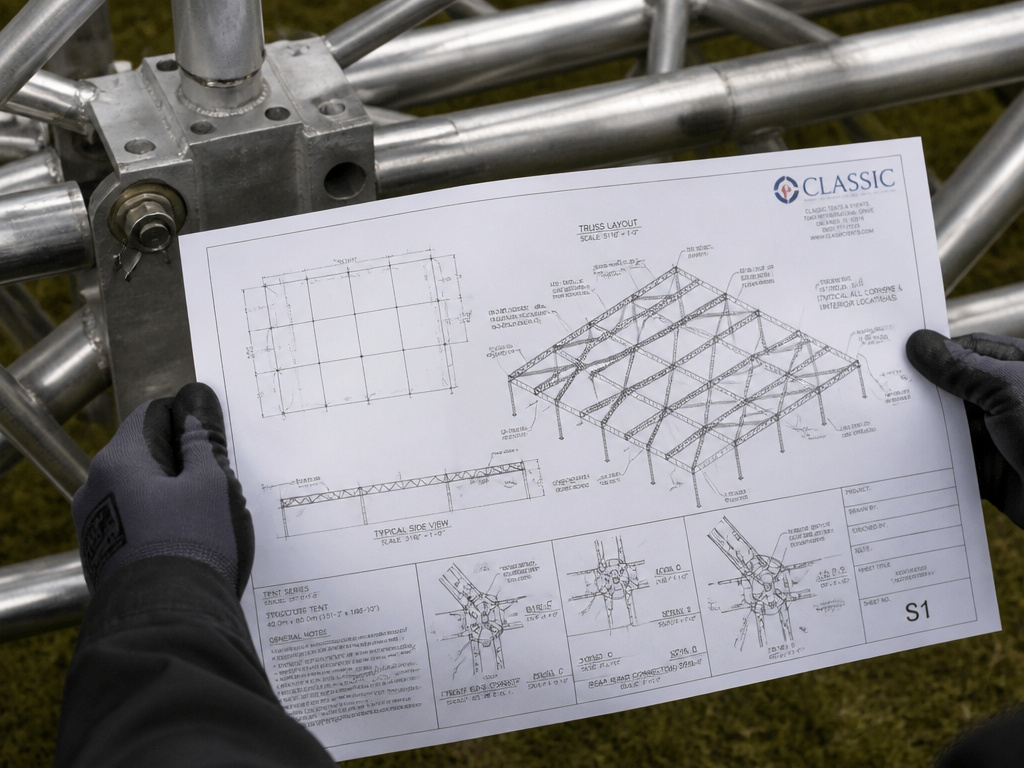
You can rally friends to set up a 20’x20’ frame tent in your backyard. For anything larger, or any event with real liability, a professional crew isn’t a luxury, it’s your insurance policy.
- Interpreting Engineering Drawings: Structure tents come with complex assembly diagrams. Misplacing a truss compromises the entire system.
- Site-Specific Staking Plan: Pros assess soil type, wind exposure, and local codes to devise an anchoring plan that actually works. They bring the right gear: drive-on ballast blocks for pavement, helical screws for sand.
- Liability and Insurance: Professional installers carry insurance. If their setup fails, their policy responds. If your DIY setup fails and injures someone, that’s on you.
- Handling the Hardware: Components are heavy. A single aluminum frame section can be over 20 feet long. Managing them safely requires experience, manpower, and the right tools.
Skipping professional installation to save money is the fastest way to turn a tent for large groups into a headline. This rigor is what separates a reliable temporary structure from a fair-weather gamble.
Frequently Asked Questions
What is a marquee?
marquee is the British and Commonwealth term for a large event tent. It’s a broad category that can refer to either a pole tent or a frame tent. In the UK, asking for a “marquee” is like asking for a “party tent” in the US.
Can you heat a large event tent in winter?
You can, but it requires specific equipment and ventilation for safety. Standard party tents are not insulated. For winter camping, you’d need a dedicated canvas tent with a stove jack designed for safe, internal wood stove use. For events, large forced-air heaters are used, but they must be properly vented and secured.
How long does a professional event tent last?
With proper care, storage, and maintenance, a quality PVC-coated polyester tent on an aluminum frame can last 8 to 15 years. The lifespan is drastically shortened by prolonged UV exposure, improper tension during setup, and rough takedowns.
Are these tents actually waterproof?
Quality tents made with PVC-coated polyester and heat-welded (not stitched) seams are fully waterproof. However, waterproofness fails if the fabric is damaged, if the tent is pitched with poor tension causing water pools, or if sidewalls are not attached and sealed correctly.
What’s the smallest version of these for personal use?
The principles scale down. Many large family camping tents are essentially small-scale frame tents, using a rigid pole skeleton for tents you can stand in. The key differences are the materials (often lighter nylon) and the engineering margins, which is why a storm-resistant shelter for backpacking is a different beast from a party tent.
Before You Go
Choosing the right big tent boils down to matching the engineering to your ground and your risk. A pole tent brings tradition to a soft lawn. A frame tent offers flexibility on any surface. A structure tent is for when you need a temporary building, not just a cover.
Look past the marketing and find the spec sheet. Confirm the fabric weight (540 gsm PVC-polyester is a good benchmark), the frame alloy (T6-tempered aluminum), and the relevant certification. Most importantly, understand that the manual’s staking guide is a theoretical minimum. Your real-world site, its soil, its wind, its slope, demands a custom plan.
Whether you’re renting a majestic shelter for a hundred guests or selecting a spacious camping tent for your crew, the right name and the right numbers are your tools. Use them to build an event, or a memory, that stands up.
