
How to Find Tent Volume for Real-World Camping Comfort
This post contains affiliate links. As an Amazon Associate, we earn from qualifying purchases.
To find the volume of a tent, match its shape to a geometric solid, like a triangular prism for an A-frame or a pyramid for a teepee, and use the correct formula with accurate interior measurements. The key is measuring the peak height from the inside floor, then mentally reducing the result by 20-30% because sloping walls create unusable space.
You know the feeling. You buy a tent rated for four people, get it pitched, and suddenly realize you’d have to stack your friends like firewood to make it work. Floor area is a lie told by spec sheets. True livability is measured in three dimensions: length, width, and that critical peak height.
This isn’t about reliving geometry class. It’s about translating a simple math exercise into a reliable predictor of comfort. I’ve squeezed into enough “cozy” two-person shelters to know the difference between theoretical volume and where you can actually stash your boots. Let’s measure it right the first time.
Key Takeaways
- Tent volume requires three measurements: interior length, interior width, and peak height measured straight up from the floor center.
- Usable space is always less than the calculated geometric volume; for dome or A-frame tents, assume 70-80% of the math result is truly livable.
- An average sleeper needs 25-35 cubic feet; below 20 feels cramped, and 50+ is roomy. This is why tent capacity ratings are often optimistic.
- The most common mistake is using the wrong formula for dome tents, if the height is less than half the width, you need a spherical cap calculation, not a hemisphere.
- For complex tents, calculate the volume of each “room” or section separately, then add them together for a total.
The volume of a tent is the amount of three-dimensional space enclosed by its canopy, measured in cubic feet or cubic meters. It is determined by the tent’s geometric shape, such as a triangular prism, dome, or pyramid, using its key interior dimensions: length, width, and peak height. This calculated figure represents the maximum potential space, though usable volume is less due to non-vertical walls.
Why Bother Calculating Tent Volume?
Floor area tells you if your sleeping pads will fit. Volume tells you if you’ll be able to sit up to pull on a rain jacket without getting intimate with the condensation on the wall. That third dimension is the difference between a place you sleep and a place you can exist during a three-day rainstorm.
A high-capacity tent with a low peak height can feel more cramped than a compact two-person backpacking tent with near-vertical walls. The math gives you an objective number to compare across different shapes and designs, cutting through marketing claims about “spacious interiors.”
Match Your Tent to the Right Formula
Forget complex derivations. Most tents approximate one of a few common shapes. Find yours below.
A-Frame / Triangular Prism: The classic pup-tent shape. Volume = (1/2 * Base Width * Peak Height) * Length. You’re finding the area of the triangular end and stretching it along the tent’s length.
Dome Tents: This covers most modern shelters. If the peak height (h) equals the radius (r, which is half the floor diameter), it’s a perfect hemisphere: Volume = (2/3) * π * r³. However, most ultralight two-person tents are lower profile. If the height is less than the radius, it’s a “spherical cap,” and the math gets fiddly, use an online calculator.
Pyramid / Teepee Tents: A square base with sides sloping to a central peak. Volume = (1/3) * (Base Length)² * Peak Height. This is the exact formula referenced in the manual for models like the Core 10 Person Lighted Instant Pyramid Tent.
| Tent Shape | What to Measure | Volume Formula | Real-World Fit |
|---|---|---|---|
| A-Frame | Base Width (W), Peak Height (H), Length (L) | V = 0.5 × W × H × L | Traditional designs, simple shelters |
| Dome (Full Height) | Floor Diameter, Height (H = Radius) | V = (2/3) × π × (D/2)³ | Many family camping tent dimensions |
| Dome (Low Profile) | Floor Diameter, Height (H < Radius) | Use Spherical Cap Calculator | Most backpacking tent dimensions |
| Pyramid | Base Length (L), Peak Height (H) | V = (1/3) × L² × H | Basecamp and minimalist shelters |
TL;DR: Identify your tent’s basic shape, grab the corresponding formula, and move on. Don’t overcomplicate it.
A Foolproof Measurement Guide (Get This Wrong & Your Math is Useless)
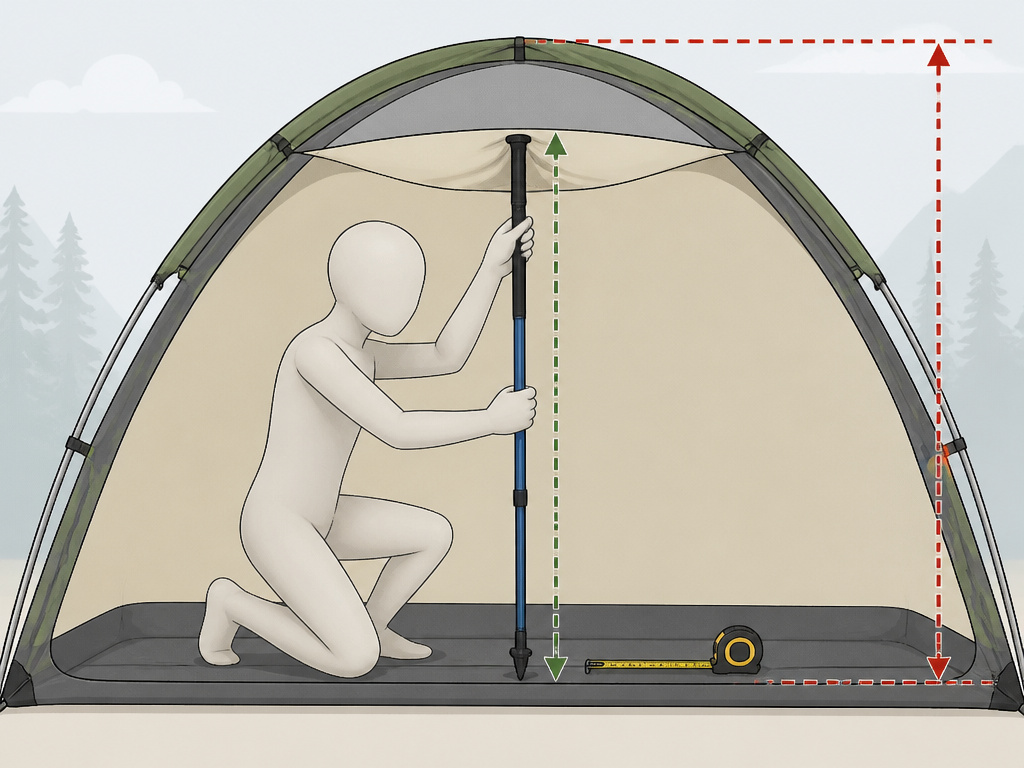
You need a flexible tape measure, a helper, and your tent pitched normally on level ground. Specs from the bag are for packed size, not interior space.
- Pitch It Properly. Stake it out and tension all guylines. A sagging canopy can rob you of 4-6 inches of height, which massively impacts volume.
- Measure Interior Length & Width. Get inside. Measure the floor from seam to seam at the widest points. For a dome’s diameter, measure across the center of the floor.
- Find the True Peak Height. This is the most error-prone step. Place the tape’s end at the exact center of the interior floor. Have your helper hold the tape straight up until it touches the highest point of the canopy fabric. Don’t measure to the top of a pole sleeve if the fabric hangs below it.
- Pro Tip: Solo? Use a trekking pole. Extend it vertically from the floor center, lock it where it touches the canopy, then measure the extended section. My Leki poles have precise markings, making this a one-person job.
- Convert to Consistent Units. If your length is 7 feet and your height is 5 feet 9 inches, convert the height to 5.75 feet before calculating. Mixing units is a guaranteed mistake.
Common mistake: Measuring height from the ground outside the tent, the groundsheet and floor fabric add inches you can’t use, and you’re measuring air outside your living space. Always measure from the interior floor surface.
What’s the consequence of a lazy pitch? If your height measurement is off by just 10%, the volume for an A-frame or pyramid is off by 10%. For a dome, where volume depends on the cube of the radius, the error balloons. That “300 cubic foot” dome might only offer 240 cubic feet of theoretical space before you even account for sloping walls.
What Your Cubic Footage Actually Means
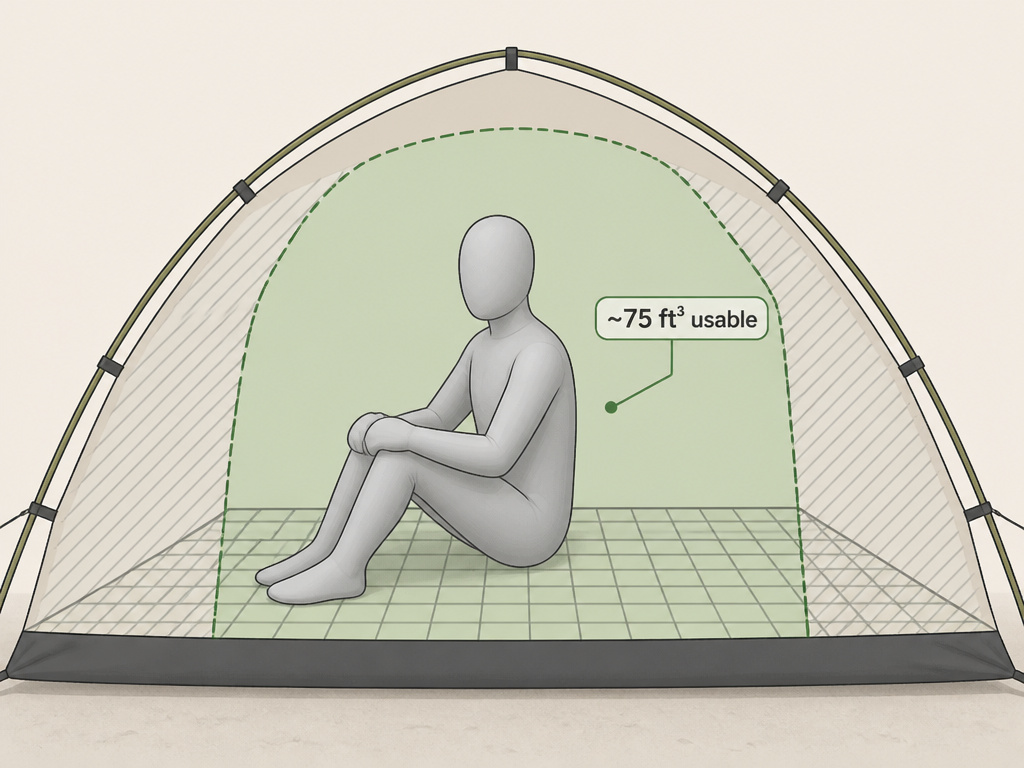
You’ve crunched the numbers. Now, what does 180 cubic feet feel like?
First, some conversions you might need:
* 1 cubic foot = 7.48052 gallons (useful for, say, estimating how much water it would take to fill your tent… theoretically).
* 1 cubic foot = 0.0283168 cubic meters (for comparing with international specs).
The crucial translation is into personal space. Research suggests an average person needs about 25-35 cubic feet for sleeping space alone. Drops below 20 cubic feet per person feel tight. Above 50 cubic feet is spacious, allowing room for gear inside. This is why a large family tent boasting “400 cubic feet!” might sleep six adults in a pinch, but for four adults with packs, it’s just comfortable.
Now, apply the sloping-wall discount. Your geometric volume is the maximum possible. Your livable volume is what matters. For domes and A-frames, take your calculated number and multiply by 0.7 to 0.8. A 100 cubic foot A-frame gives you about 75 cubic feet of space where you can actually sit up or stash a backpack.
I learned this the hard way with a popular two-person backpacking tent. On paper, its 29 cubic feet per person should have been fine. But the steeply angled walls meant my 6’2″ frame couldn’t sit up fully in the corners, my head brushed the canopy if I wasn’t in the dead center. That’s why I now prioritize tent interior volume with a high volume-to-peak-height ratio, like in designs with near-vertical walls that make every cubic foot usable.
The Mistakes That Skew Your Results (And How to Avoid Them)
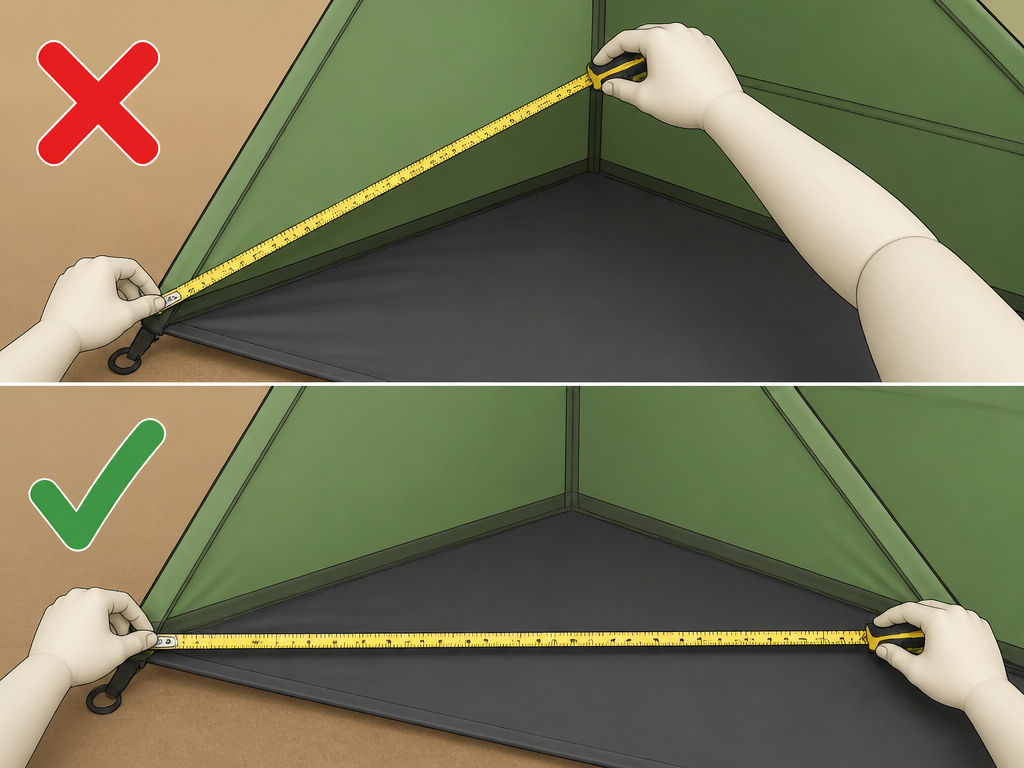
The internet is full of perfect geometric diagrams. Real tents in real fields are messier. I know because I spent an hour re-measuring my old REI Half Dome 2+ after a long day, convinced my math was wrong. (It was. The tent wasn’t.) Here’s where people usually trip.
Misidentifying the A-Frame Base: For a triangular prism, the ‘base’ is the full width of the floor. A common error, noted in geometry resources, is mistakenly using the length of the sloping side. This instantly halves your calculated volume.
The Dome Formula Trap: Using the hemisphere formula (V = 2/3πr³) for a dome where the height is less than the radius. Many backpacking tents for couples are lower-profile. Using the hemisphere formula will significantly overestimate your space. When in doubt, use the spherical cap formula or a trusted online calculator.
Ignoring Vestibules: Vestibules add valuable storage volume but not sleeping or standing volume. Calculate their space separately (treat them as low triangular prisms) and add it to your total for gear capacity, but don’t blend it into your living space calculation.
| Error | The Consequence | The Fix |
|---|---|---|
| Using side length for A-frame base | Volume is under-calculated by 50% | Measure the full, flat width of the tent floor. |
| Mixing feet and inches in one formula | Results are off by 10-20% | Convert every measurement to the same decimal unit before calculating. |
| Using hemisphere math for a low dome | Volume is grossly overestimated | Confirm if Height < Radius; use a spherical cap calculator instead. |
| Measuring a loosely pitched tent | Height & volume are underreported | Fully tension all poles and guylines before taking measurements. |
Handling Weird Shapes and Real-World Nuances
Not every tent is a perfect geometric solid. For cabin tents with vertical walls, it’s a simple rectangular prism (L x W x H). Tunnel tents are best broken into cylindrical segments.
For truly complex tents with multiple rooms or odd angles, like the Big Agnes Tensleep Station 6, don’t force one formula. Use the method outlined in technical resources like the Regia tent design PDF: divide the tent into regular shapes, calculate each volume individually, and sum them. This reveals why a well-designed tent feels bigger than a simple dome with the same total cubic footage.
The ultimate rule? Volume is a superb comparison tool, but the shape of that volume dictates comfort. A tent with 250 cubic feet of well-arranged, vertical space will feel larger than a dome with 270 cubic feet of space mostly in the upper curves where you can’t use it. This is why a tent’s peak height is a critical spec to check alongside any volume calculation.
TL;DR: For complex tents, measure and calculate by section. Volume is a key number, but always consider how that space is distributed, tall and narrow vs. short and wide.
Frequently Asked Questions
How is tent volume different from packed size?
Packed size (the dimensions of the stuff sack) tells you how small the tent compresses for transport. Volume is the amount of three-dimensional space inside the pitched shelter. They are completely different measurements.
Is there a general volume formula for any shape?
For irregular shapes, the most reliable method is to mentally break the tent into smaller, regular shapes (cubes, triangular prisms, cylinders), calculate the volume of each, and add them together. This is the principle behind many tent space calculations for custom designs.
Does more volume mean a heavier tent?
Generally, yes, more volume requires more fabric and often longer poles. However, design efficiency is a major factor. Modern materials allow for lightweight two-person tents that feel spacious without excessive weight. A bulky, old-school tent may be heavier for the same interior space.
Where can I see a step-by-step volume calculation worked out?
For a clear, educational example of applying geometry to a tent-like shape, you can review this Atlas solved geometry problem which walks through finding the volume of a conical tent.
Is a higher-volume tent always better?
Not necessarily. A high-capacity tent with great volume may be too bulky to backpack with. Volume measures living space, which you must balance against packed size, weight, and weatherworthiness. A storm-ready mountaineering tent often sacrifices volume for a lower, more stable profile.
Before You Go
Calculating your tent’s volume isn’t a geometry test. It’s a practical tool to prevent that sinking feeling of a shelter that’s tighter than advertised. The process takes five minutes with a tape measure and the right formula.
Remember the sequence: match the shape, measure meticulously from the inside, apply the formula, and then, crucially, discount the result for sloping walls. That final, realistic number is your livable volume. Divide it by 30 to estimate a comfortable person-capacity. Use this knowledge to compare tent floor plans and choose a shelter that fits not just your body, but your need for a little breathing room under the stars.
