
Tent Pegs Explained: The 4 Main Types for Secure Anchoring
This post contains affiliate links. As an Amazon Associate, we earn from qualifying purchases.
Tent pegs are anchoring spikes, typically 15 to 30 centimeters long and made from steel, aluminum, or plastic, that you drive into the ground to secure a tent’s corners and guy lines. The right peg for your campsite matches the soil type—screw pegs for sand, thick V-pegs for forest loam, steel spikes for hard ground, and ultralight U-stakes for snow. A mismatch, like using a thin wire peg in rocky soil, bends the metal on the first solid strike.
Most people think any metal spike will do. They use the flimsy pegs that come with the tent, hammer them straight down, and wake up to a collapsed shelter when the wind picks up after midnight. The peg is the single point of failure between your shelter and the ground, and treating it as an afterthought guarantees a bad night.
This guide breaks down the four peg types that actually work, the physics behind the 45-degree angle, and how to avoid the two most common mistakes that bend pegs and drop tents.
Key Takeaways
- Tent pegs are not universal. The thin wire pegs included with most tents fail in hard, rocky, or loose sand. Upgrade them before your first trip.
- The 45-degree angle is non-negotiable. A peg driven straight down relies on friction alone and will pull out. A 45-degree angle uses the soil’s shear strength.
- Peg thickness matters more than length. A short, thick 3.2mm V-peg holds better in wind than a long, thin 1.6mm wire peg because it resists bending.
- Snow and sand need specialty pegs. Standard pegs will not hold. Use ultralight U-shaped aluminum stakes for snow and wide-flanged screw pegs for sand.
- Always carry a rubber mallet. Using a rock or boot heel to drive pegs mushrooms the top, making them impossible to remove without pliers.
The 4 Main Tent Peg Types and What They’re For
Forget the generic term “tent peg.” The wrong type is just dead weight that fails when you need it. The right one is insurance.
Common mistake: Using the included thin wire pegs on hard ground — the peg bends into an L-shape on the first solid rock strike, and the guy line goes slack within an hour of moderate wind.
1. Wire / Shepherd’s Hook Pegs
These are the thin, round, bent-wire pegs that come bundled with 90% of store-bought tents. They are made from 4mm to 11.2mm diameter steel wire, usually coated. Their only real job is to hold a tent in calm weather on perfect, soft grass.
When to use them: Car camping on a maintained lawn. Nowhere else.
When to leave them at home: Any ground with rocks, roots, hard clay, or loose sand. They bend instantly.
The upgrade path: If your tent came with these, treat them as placeholders. Buy a set of V-pegs before you go anywhere with real weather.
2. V-Pegs / Y-Pegs
These have a V-shaped or Y-shaped cross-section, typically 1.6mm to 3.2mm thick. The shape gives them torsional rigidity—they resist twisting and bending far better than round wire. This is your all-rounder for forest, grass, and loamy soil.
| V-Peg Spec | Why It Matters |
|---|---|
| 150mm–250mm length | Short for summer forest floors, long for softer ground. |
| 1.6mm–3.2mm thickness | Thicker (3.2mm) resists bending in hard ground. Thinner (1.6mm) is lighter. |
| Galvanized steel | Won’t rust after a season in the rain. Coated aluminum is a lighter alternative. |
The V-profile cuts into the ground cleanly and provides more surface area for the soil to grip. It is the first peg you should buy if you are upgrading from the included set. For most multi-day trips where weight is a concern but not the absolute priority, a set of 8-10 V-pegs covers your corners and key guy lines. For a complete kit, review our list of tent camping essentials.
3. Screw / Spiral Pegs
These look like giant screws. You twist them into the ground instead of hammering. The wide, helical flange provides immense holding power in loose, granular soils where a straight peg would just pull out.
Why they work: The screw thread creates a continuous shear plane in the soil. Each turn compacts the sand or gravel around it, creating a mechanical lock. In loose beach sand, a 30cm screw peg will hold a family-sized dome tent in a coastal breeze where a V-peg would pull free with a firm tug.
The catch: They are useless in hard or rocky ground. You cannot twist them in, and hammering destroys the threads. They are a single-environment tool.
Pro tip: For sand, go longer. A 40cm screw peg holds exponentially better than a 25cm one because it reaches the damp, compacted sand layer below the dry surface. This is a critical piece of knowledge for anyone using pop-up beach tents.
4. Snow / Sand Stakes
These are the ultralight, wide, U-shaped aluminum alloy stakes you see in mountaineering kits. They weigh about 45g each. Their design is for maximum surface area in substrates with zero cohesion—snow and dry sand.
In sand or snow, ultralight U-shaped aluminum alloy pegs can be planted head outward away from the tent at a 45-degree angle, or laid flat at the bottom of a hole and buried with guy lines tied to the middle hole.
You have two methods. The first is to angle them away from the tent like a normal peg. The second, more secure method is the “deadman” anchor: dig a trench perpendicular to the guy line, lay the stake flat in it, tie the line to the center, and bury the whole thing. The weight of the overlying snow or sand provides the holding force. This technique is non-negotiable for winter camping with a hot tent wood stove, where a collapsed shelter is more than an inconvenience.
TL;DR: Wire pegs for lawns only. V-pegs for dirt and grass. Screw pegs for sand. U-stakes for snow. Using the wrong type is the fastest way to a loose tent.
Why a 45-Degree Angle Isn’t Just a Suggestion
Hammering a peg straight down feels intuitive. It is also wrong. The geometry of force changes everything.
When a guy line pulls on a vertically driven peg, it tries to pull the peg straight up. The only thing resisting is the friction between the peg and the soil. In damp ground, that might be enough. In dry or loose soil, it is not. The peg pops out with a steady tug.
A peg driven at a 45-degree angle away from the tent changes the physics. Now the pull from the guy line is mostly perpendicular to the peg. This force tries to bend the peg, not pull it out. Soil is terrible in tension (pulling) but relatively strong in compression (bending). The angled peg engages the soil’s shear strength along its entire length. The holding power multiplies.
The 45-degree rule is documented in the Wikipedia entry on tent pegs, but most manuals just show a picture without the why. Now you know. For critical lines on a high-wind resistant tent, use a second peg as a backup. Drive it about 6 inches behind the first at the same angle, and tie the guy line to both. If one fails, the other holds.
The Ground Dictates the Gear
Choosing a peg based on your tent is backwards. You choose based on the dirt under it.
Soft Ground (Grass, Forest Loam, Mulch)
This is V-peg territory. The soil is forgiving and offers good grip. A 20cm, 2.5mm thick galvanized steel V-peg is ideal. You can get away with the included wire pegs here, but why risk it? A sudden downpour softens the ground, and wind can still pull them. For comfort in these conditions, consider adding some tent camping accessories to your kit.
Hard Ground (Clay, Rocky Soil, Hardpack)
Thickness wins over length here. You need a peg that will not bend when it hits a rock. A short, thick (3.2mm) V-peg or a dedicated nail stake made of titanium or hardened steel is mandatory. As one camper noted in a gear video, “The stakes that come with these tents are not very good… I just buy giant galvanized spikes.” If the ground is too hard to start the peg, drill a pilot hole with a hand drill or a sturdy stick. This prevents bending.
Loose Ground (Sand, Gravel)
Surface area is king. This is the domain of screw pegs and wide-flange sand stakes. The goal is to maximize contact with the unstable particles. In dry, loose sand, a standard peg might hold 5 pounds of pull. A 30cm screw peg can hold 50. For beach setups, where sun protection is key, a stable anchor is crucial for your pop-up beach tents.
Snow
Weight and surface area are all that matter. Ultralight U-shaped aluminum stakes, or even stuff sacks filled with snow and buried, are the only options. The “deadman” burial method described earlier is the standard for a reason.
| Ground Type | Winning Peg | Why It Wins | What Fails |
|---|---|---|---|
| Soft Grass/Loam | V-Peg (2.5mm thick) | Good grip, resists bending in roots. | Thin wire pegs in wind. |
| Hard/Rocky | Thick V-Peg or Nail Stake (3.2mm+) | Won’t bend on impact. | All thin pegs, screw pegs. |
| Sand | Screw Peg (30cm+) | Threads compact sand for a mechanical lock. | V-pegs, wire pegs. |
| Snow | U-Shaped Aluminum Stake | Wide surface area, light weight for burial. | Every other peg type. |
TL;DR: Test the ground with your foot or a stick before you unpack a single peg. Hard and rocky? Go thick. Soft and sandy? Go wide. Getting this wrong means repitching the tent at 2 a.m.
How to Actually Set a Peg That Holds
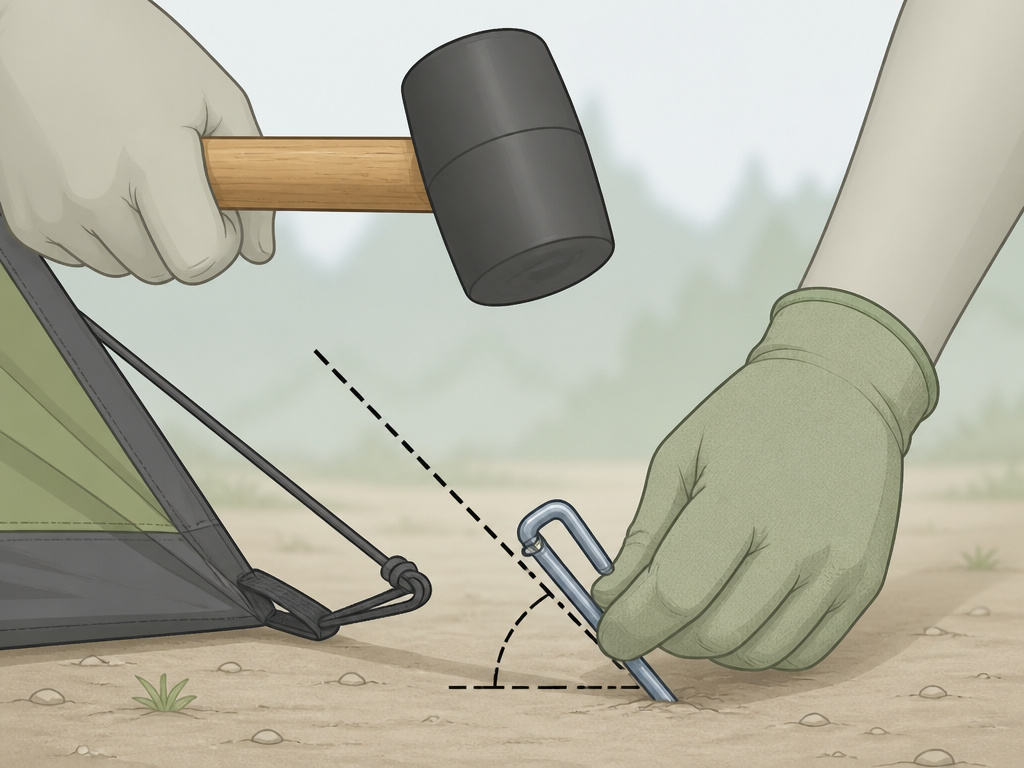
Knowing the theory is one thing. Doing it right when your hands are cold is another.
- Clear the spot. Kick away surface rocks, sticks, and pine cones. Hitting a rock off-center is the number one cause of bent pegs.
- Angle it correctly. Hold the peg at a 45-degree angle, pointing away from the tent. The top of the peg should be aimed at the tent’s attachment point.
- Start it straight. Give the peg a few light taps with a rubber mallet to set it in the ground without deflecting. A crooked start means a weak hold.
- Drive it home. Hammer it down until the eyelet is just above the soil. Leaving an inch exposed makes tying and untying easier. Do not drive it flush—you will never get it out.
- Tie a taut-line hitch. This knot grips the line under tension but is easy to adjust later when the line stretches or contracts. A simple overhand knot will slip.
- Back up critical lines. For the main windward guy lines on a tent for heavy rain or a large family tent, use two pegs in line. It is cheap insurance.
Before you start: A flying peg or a shattered rock chip can cause serious eye injury. Always wear safety glasses when hammering, especially on rocky ground. Never use a metal hammer on a metal peg without eye protection.
If a peg bends, do not try to straighten and reuse it. The metal is fatigued and will bend more easily next time. Pull it and replace it. A set of tent lighting solutions can help you see this kind of damage when packing up in the dark.
What About the Pegs That Come With the Tent?
They are cost-engineered to be just good enough for a calm weekend in a park. Manufacturers assume ideal conditions. The HandWiki engineering tent peg entry details the material science, but the practical takeaway is simple: these pegs are the weakest link in your shelter system.
I have a box of hundreds of them. They are good for practicing knots, weighting down a tarp, or as temporary markers. I do not trust them with my sleep system. The first time you camp in real wind, or on ground harder than a suburban lawn, you will understand. Upgrade before you have to learn the hard way. Your first purchase after a tent should be a proper set of pegs, not a fancy portable tent air conditioner.
When Standard Pegs Aren’t Enough
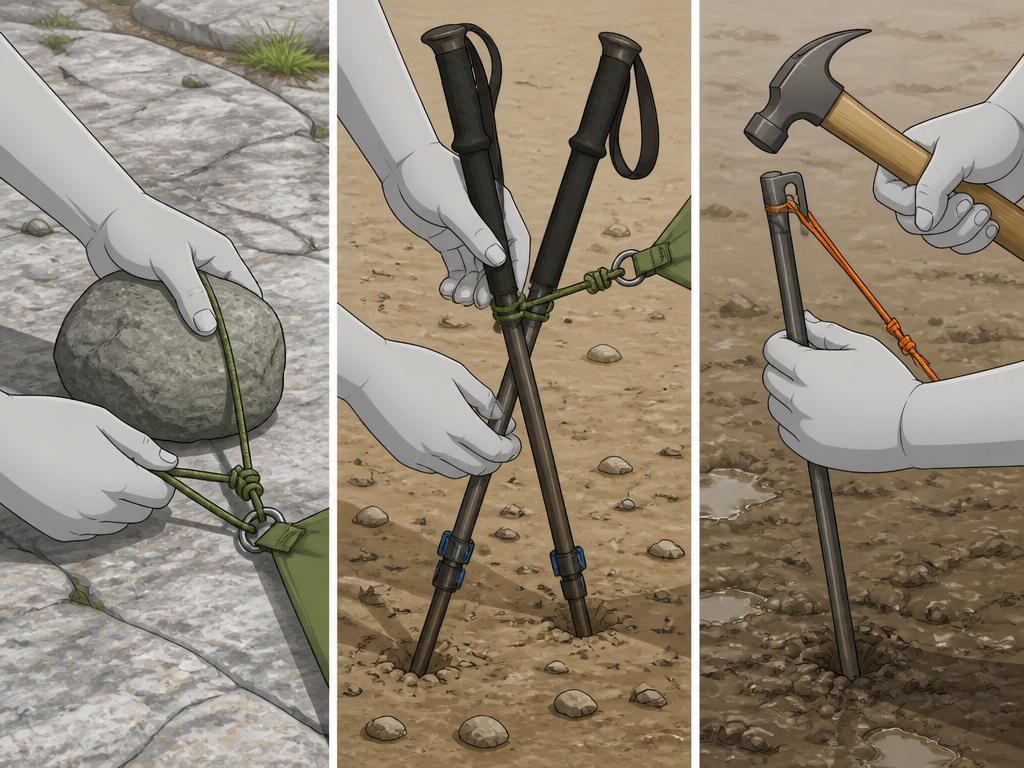
Sometimes the ground wins. You need another plan.
- Rocky slabs or solid ice: Use rocks as deadman anchors. Loop your guy line around a substantial rock and tie it off. Pile more rocks on top if needed.
- No trees for a ridgeline: Use your trekking poles or spare tent poles to create a bipod anchor. Bury them together at an angle with the guy line tied at the apex.
- Everything is mud: Use longer pegs. If your 20cm pegs are sinking, switch to 30cm or longer. The goal is to reach a more stable layer.
These techniques are part of the advanced skill set for users of four-season shelters like canvas tents with stove jacks, where a secure pitch is critical in snow.
Frequently Asked Questions
What is the most versatile tent peg?
20-25cm galvanized steel V-peg, around 2.5mm thick, is the best all-rounder. It works in most soil types except pure sand, deep snow, or solid rock. It resists bending better than wire and is easy to drive and remove.
How many tent pegs do I need?
At minimum, one per tent corner and one per guy line point. For a standard dome tent with four corners and two guy lines, that is six. Carry two extra. For larger tents, family cabins, or stand-up height tents with more guylines, carry 12-15. It is better to have spares than to rig a broken line with a stick.
Can I use regular nails or screws as tent pegs?
No. Nails are too smooth and have no eyelet for the line. They pull out easily. Screws are brittle and the heads snap off. Tent pegs are engineered for tensile and shear forces; hardware store fasteners are not. The few grams you save are not worth a collapsed tent.
Why did my tent peg bend?
You used a peg designed for soft ground on hard ground. The thin wire or narrow V-profile could not withstand the impact force against a rock or hard clay. Next time, use a thicker peg (3.2mm+) or a dedicated nail stake for that ground type.
How do I remove a stuck tent peg?
Loop a second peg through the eyelet of the stuck one and use it as a lever. Rock it back and forth to loosen the soil. Pulling straight up often does not work if the soil has settled or swelled with moisture. A pair of vise-grip pliers is a reliable tool for this job.
Before You Go
Tent pegs are not an afterthought. They are the foundation. The right peg, driven at the right angle, turns a flapping shelter into a secure home. Ignore the flimsy ones in the bag. Match a thick V-peg to forest soil, a screw peg to sand, and a U-stake to snow. Hammer them at 45 degrees, away from the tent. That is the difference between sleeping through a storm and chasing your tent across a field at midnight. Your choice of pegs matters as much as your choice of tent stove models for winter or your rainproof camping shelters for a downpour. Get it right once, and you will never think about it again.
